Industry-Verified Manufacturing Data (2026)

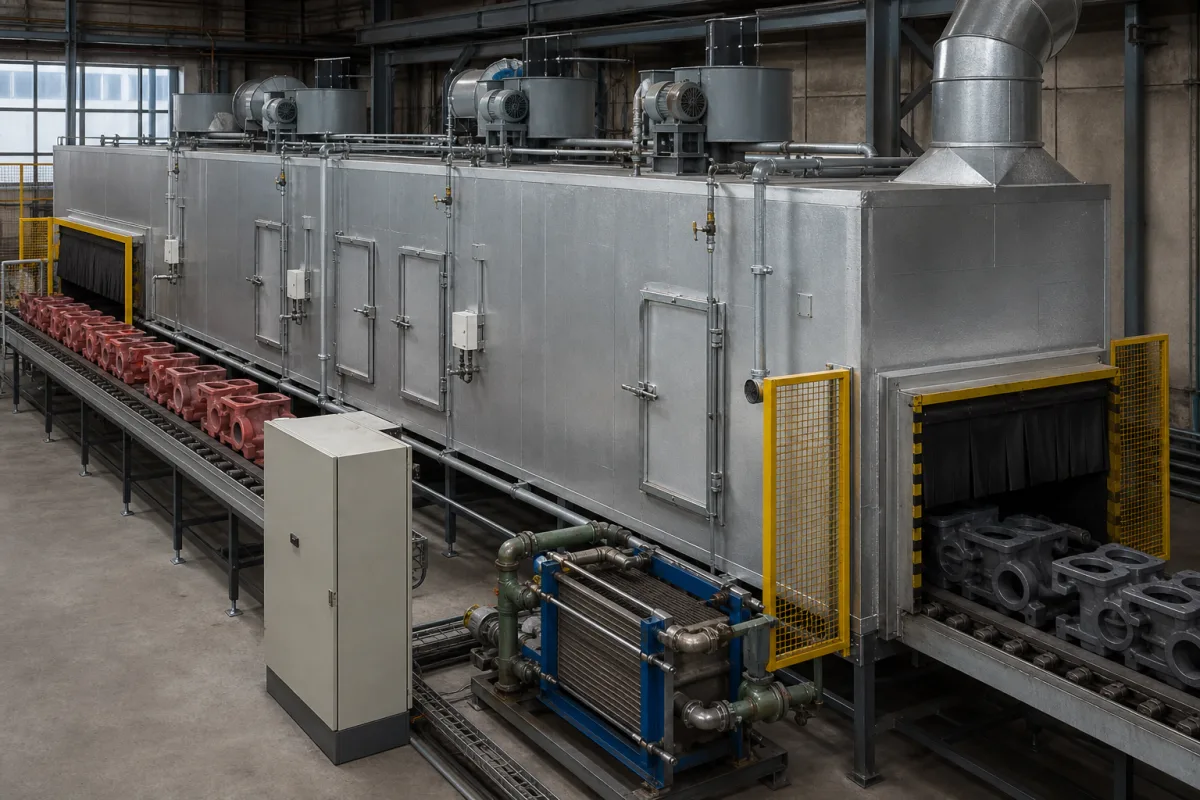
Controlled Cooling Tunnel

Based on aggregated insights from multiple verified factory profiles within the CNFX directory, the standard Controlled Cooling Tunnel used in the Machinery and Equipment Manufacturing sector typically supports operational capacities ranging from standard industrial configurations to heavy-duty production requirements.

Technical Definition & Core Assembly

A canonical Controlled Cooling Tunnel is characterized by the integration of Insulated Tunnel Housing and Forced Air Circulation System. In industrial production environments, manufacturers listed on CNFX commonly emphasize Stainless Steel (housing/ducting) construction to support stable, high-cycle operation across diverse manufacturing scenarios.

A precisely regulated cooling section within a casting production line that controls the solidification rate of cast components.
Product Specifications

Technical details and manufacturing context for Controlled Cooling Tunnel

Definition
A critical component of the Automated Precision Casting Production Line designed to provide controlled, uniform cooling of cast metal components after the molding or pouring stage. It manages the temperature gradient and cooling rate to ensure proper microstructure development, minimize internal stresses, prevent warping or cracking, and achieve the desired mechanical properties in the final cast product.
Working Principle
The tunnel uses a combination of forced air circulation, temperature-controlled zones, and sometimes mist or water spray systems to extract heat from cast components moving through it on a conveyor. Sensors monitor component temperature at various points, and a control system adjusts cooling parameters (airflow, temperature, spray intensity) in real-time to follow a predefined cooling curve, ensuring consistent and repeatable solidification conditions.
Common Materials
Stainless Steel (housing/ducting), Aluminum Alloy (internal baffles/guides), Ceramic Insulation (thermal lining)
Technical Parameters
  • Tunnel length, width, and height to accommodate the maximum cast component size and required cooling duration. (mm) Customizable
Components / BOM
  • Insulated Tunnel Housing
    Provides the main structural enclosure and thermal insulation for the cooling environment.
    Material: Stainless Steel with Ceramic Fiber Lining
  • Forced Air Circulation System
    Includes fans, ducts, and diffusers to create uniform airflow over the cast components.
    Material: Aluminum Alloy (fans/ducts), Galvanized Steel (supports)
  • Temperature Control System
    Comprises heaters, chillers, and temperature sensors to maintain precise ambient temperature zones.
    Material: Stainless Steel (sensor housings), Copper (heat exchanger coils)
  • Conveyor System Segment
    Transports cast components through the tunnel at a controlled speed.
    Material: Heat-Resistant Steel (belt/chain), Stainless Steel (rollers/frame)
  • Control Panel & PLC
    Houses the programmable logic controller and interface for setting and monitoring cooling profiles.
    Material: Mild Steel (enclosure), Electronic Components
Engineering Reasoning
Cooling rate: 0.5-5.0 °C/s, Temperature range: 20-200°C, Flow rate: 10-100 L/min
Cooling rate exceeds 7.0 °C/s causing thermal shock cracking, or drops below 0.2 °C/s causing incomplete solidification
Design Rationale: Thermal stress exceeding material yield strength (σ_y > 250 MPa for steel molds) due to rapid temperature differentials, or insufficient heat extraction violating Fourier's Law of heat conduction
Risk Mitigation (FMEA)
Trigger Coolant pump impeller cavitation at NPSH < 2.3 m
Mode: Flow rate reduction to <8 L/min causing uneven cooling
Strategy: Installation of booster pump maintaining NPSH > 3.5 m with pressure sensors at pump inlet
Trigger Thermocouple calibration drift exceeding ±1.5°C over 500 cycles
Mode: Temperature control error of ±15°C causing improper solidification
Strategy: Redundant RTD sensors with triple modular voting logic and quarterly calibration schedule

Industry Taxonomies & Aliases

Commonly used trade names and technical identifiers for Controlled Cooling Tunnel.

Industrial Ecosystem & Supply Chain DNA

Complementary Systems
Downstream Applications
Specialized Tooling

Application Fit & Sizing Matrix

Operational Limits
pressure: 0-5 bar
flow rate: 10-500 L/min
temperature: -10°C to 150°C
slurry concentration: 0-40% solids by weight
Media Compatibility
✓ water-glycol mixtures ✓ mineral oil-based coolants ✓ synthetic polymer quenchants
Unsuitable: highly corrosive acidic environments
Sizing Data Required
  • component mass and specific heat capacity
  • required cooling rate (ΔT/time)
  • production line throughput (units/hour)

Reliability & Engineering Risk Analysis

Failure Mode & Root Cause
Thermal stress cracking
Cause: Rapid temperature cycling between hot product entry and cold cooling zones, causing differential expansion and contraction in tunnel walls and support structures.
Corrosion and scaling
Cause: Moisture condensation combined with atmospheric contaminants or product residues, leading to pitting, rust, and mineral deposits that reduce heat transfer efficiency.
Maintenance Indicators
  • Uneven product cooling or hot spots detected by infrared thermography
  • Unusual vibration or rattling noises from fan assemblies or conveyor components
Engineering Tips
  • Implement gradual temperature ramping protocols during startup/shutdown to minimize thermal shock
  • Install and maintain proper humidity control and filtration systems to prevent corrosive condensation and particulate buildup

Compliance & Manufacturing Standards

Reference Standards
ISO 9001:2015 - Quality Management Systems CE Marking - EU Machinery Directive 2006/42/EC ASTM E84 - Standard Test Method for Surface Burning Characteristics of Building Materials
Manufacturing Precision
  • Temperature Uniformity: +/-2°C across tunnel length
  • Cooling Rate Consistency: +/-5% of setpoint
Quality Inspection
  • Thermal Mapping Verification Test
  • Leak Testing (Pressure Decay Method)

Factories Producing Controlled Cooling Tunnel

Verified manufacturers with capability to produce this product in China

✓ 97% Supplier Capability Match Found

T Technical Director from Canada Feb 23, 2026
★★★★★
"The Controlled Cooling Tunnel we sourced perfectly fits our Machinery and Equipment Manufacturing production line requirements."
Technical Specifications Verified
P Project Engineer from United States Feb 20, 2026
★★★★☆
"Found 36+ suppliers for Controlled Cooling Tunnel on CNFX, but this spec remains the most cost-effective. (Delivery took slightly longer than expected, but technical support was excellent.)"
Technical Specifications Verified
S Sourcing Manager from United Arab Emirates Feb 17, 2026
★★★★★
"The technical documentation for this Controlled Cooling Tunnel is very thorough, especially regarding technical reliability."
Technical Specifications Verified
Verification Protocol

“Feedback is collected from verified sourcing managers during RFQ (Request for Quote) and factory evaluation processes on CNFX. These reports represent historical performance data and technical audit summaries from our B2B manufacturing network.”

14 sourcing managers are analyzing this specification now. Last inquiry for Controlled Cooling Tunnel from Vietnam (1h ago).

Supply Chain Compatible Machinery & Devices

Hydraulic Press

Industrial machine using hydraulic pressure to compress, form, or assemble materials

Explore Specs →
Heavy-Duty CNC Plasma Cutting Machine

Industrial machine for precision metal cutting using plasma arc technology

Explore Specs →
Automated Assembly Line System

Integrated production system for sequential component assembly operations

Explore Specs →
Automated Powder Coating System

Integrated industrial system for applying dry powder coatings to metal substrates.

Explore Specs →

Frequently Asked Questions

What materials are used in the construction of this cooling tunnel?

The tunnel features stainless steel housing and ducting for durability, aluminum alloy internal baffles and guides for efficient airflow, and ceramic insulation lining for optimal thermal management.

How does this cooling tunnel improve casting production quality?

By precisely controlling the solidification rate of cast components through regulated forced air circulation and temperature management, it minimizes defects like warping, cracking, and internal stresses for consistent, high-quality results.

What components are included in the standard BOM for this system?

The standard bill of materials includes: Control Panel & PLC for automation, Conveyor System Segment for integration, Forced Air Circulation System, Insulated Tunnel Housing, and Temperature Control System for precise regulation.

Can I contact factories directly on CNFX?

CNFX is an open directory, not a transaction platform. Each factory profile provides direct contact information and production details to help you initiate direct inquiries with Chinese suppliers.

Get Quote for Controlled Cooling Tunnel

Request technical pricing, lead times, or customized specifications for Controlled Cooling Tunnel directly from verified manufacturing units.

Your business information is encrypted and only shared with verified Controlled Cooling Tunnel suppliers.

Thank you! Your message has been sent. We'll respond within 1–3 business days.

Need to Manufacture Controlled Cooling Tunnel?

Connect with verified factories specializing in this product category

Add Your Factory Contact Us
Previous Product
Control Valves & Piping
Next Product
Controlled Lighting Chamber