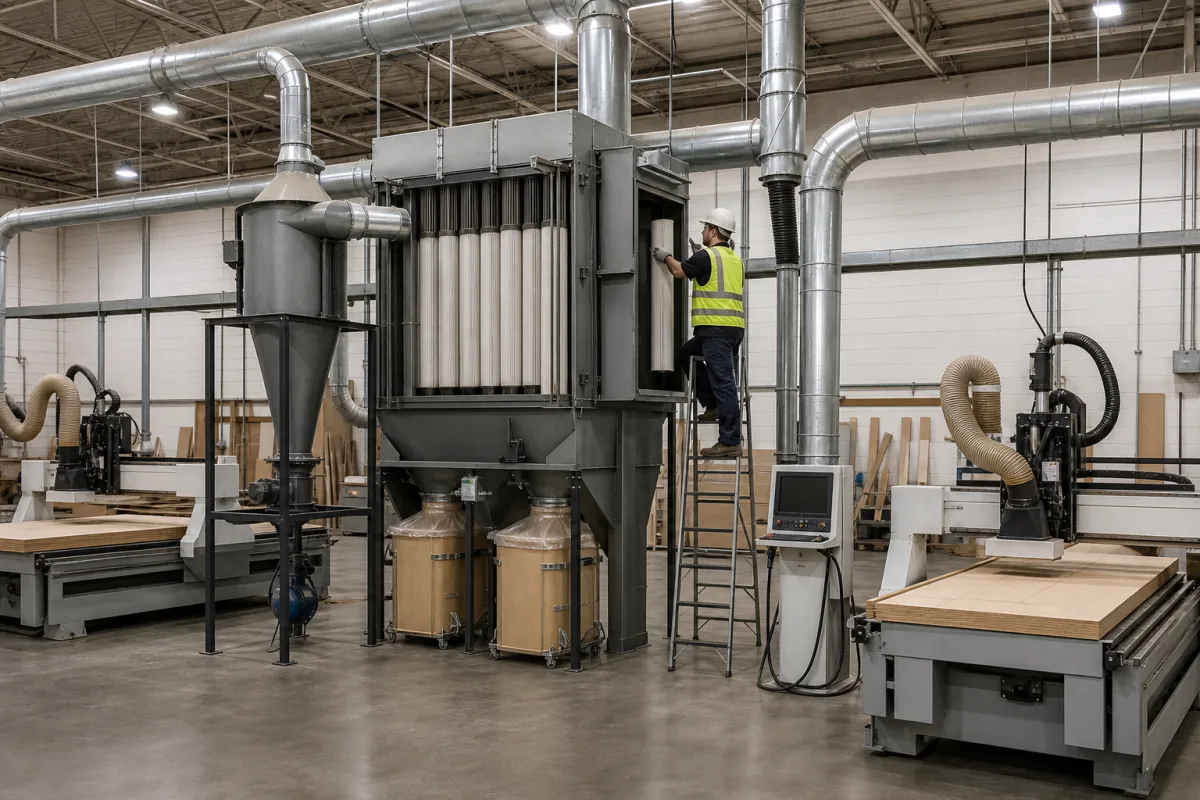
Integrated dust collection system for woodworking: central extraction from machines through ductwork to the collector
Central dust extraction systems for woodworking shops · Duct transport velocity, collector size bands and siting, explosion relief, exposure limits and annual LEV testing
This page covers the whole extraction system in a woodworking shop: capture hoods at each machine, the duct network, the fan, the cyclone or filter collector and the bins that take the waste. Ask three things first: what volume flow and duct transport velocity the design gives at each machine, how the collector is sized, sited and protected against fire and explosion, and how the system will be commissioned and tested so exposure stays under the limits.
Central dust extraction systems for woodworking and wood-panel processing: hoods, ductwork, fans, cyclones, filter collectors and waste bins designed together. Industrial dust collector units on their own, including cyclones, pulse-jet bag filters, cartridge collectors and oil-mist collectors, are covered on the Dust collector page, and general local exhaust ventilation networks for any dust, from hood capture velocity to branch balancing and the fan, on the Dust extraction system page. Wet scrubbers, electrostatic precipitators and portable shop vacuums are outside this page.
CNFX editorial research · Sources checked October 12, 2026 · 3 sources
Wood dust at the machine: blade-driven air movement, transport velocity in the duct and the 3 and 5 mg/m³ limits
HSE's information sheet WIS23 on wood dust tells employers to control dust at source with fixed local exhaust ventilation, notes that rotating blades and cutters act like fans and generate strong air movements that hoods must contain, and says ductwork should be large enough to keep the required volume flow rate but not so large that the air transport velocity falls below what keeps dust and chippings airborne; it cites BS EN 12779:2015 as specifying an air transport velocity of 20–25 m/s, lower for fine dry wood dust. [1]
HSE's WIS32 on safe collection of wood waste asks for ductwork as short as possible with a minimum number of bends, a design minimum transport velocity of 20 m/s to limit dust deposits, conductive duct materials earthed to discharge static, and regular internal inspection and cleaning of ducts. [2]
Editorial calculation: a 200 mm round duct at 20 m/s carries π × 0.1² × 20 ≈ 0.63 m³/s, about 2,260 m³/h; at 25 m/s about 2,830 m³/h. Summing the flows of all branches that run at once gives the main duct and fan duty. [1]
Give the supplier the machine list with outlet sizes and the number running at once, the wood and board types, layout drawings with duct routes, the collector location, the waste volume per shift and local rules on emissions and fire.
02
Siting the wood waste collector, explosion venting and fire precautions
HSE's WIS32 states that wood waste has a dust explosion risk where the mean particle size is below 200 microns and as little as 10% of the mixture is below 80 microns, recommends siting collection units outside away from people, gives precautions for units that have to be indoors, and sets them by size: unenclosed sock collectors below 0.5 m³/s would not produce high explosion pressures but should be kept 3 m from workers, combustibles and walkways; from 0.5 to 2.5 m³/s ignition can produce a jet of flame at head height, so indoor units need a strong metal enclosure with an outlet or vents acting as explosion relief; above 2.5 m³/s units should be sited outside or enclosed with vents to a safe place, with BS EN 14491:2006 for vent design. [2]
WIS32 adds that bins or hoppers storing explosible wood waste need explosion relief for their volume, and that larger high-efficiency cyclones need additional venting where their air outlets are too small to act as vents. [2] Editorial calculation: 0.5 m³/s is 1,800 m³/h and 2.5 m³/s is 9,000 m³/h, which places a central system serving a group of machines in the middle or upper band.
For health, WIS23 gives workplace exposure limits of 3 mg/m³ for hardwood dust and 5 mg/m³ for softwood dust as 8-hour time-weighted averages, with the hardwood limit applying to mixtures, requires exposure to be reduced as low as reasonably practicable, and notes that up to 14 months are legally allowed between thorough examinations and tests of LEV by a competent person. [1] Jiangsu Yaoxian describes bag-type explosion-proof dust collectors that collect explosive process dust through gas hoods and pipelines with an exhaust fan. [3]
03
HSE WIS32 precautions below 0.5, from 0.5 to 2.5 and above 2.5 m³/s
Airflow band, filter emission and housing values that decide the wood dust plant's precautions
Airflow matters first here: HSE WIS32 ties the fire and explosion precautions to collector capacity at 0.5 and 2.5 m³/s, so the design flow fixes whether the unit may stay indoors in a strong metal enclosure. Filter performance is judged against the 3 and 5 mg/m³ wood dust exposure limits in WIS23. [2][1]
Field
Published value or dependency
Ask the supplier for
Air Flow Capacity (m³/h)
Size bands 1,800 and 9,000 m³/h (0.5 and 2.5 m³/s) set fire and explosion precautions. [2]
Compare woodworking dust extraction system suppliers
1 company lists this product among what they make. Company figures are quoted from each
company's own website; every card states where the relationship came from.
Jiangsu Yaoxian Environmental Equipment Co., Ltd
Manufacturing site to be confirmed for the order
Lists bag-type explosion-proof dust collectors that collect process dust through hoods and pipelines.
Explore company information and manufacturing capabilities, then discuss the scope of your project with a relevant supplier.
Share this page
Compiled and source-reviewed by the CNFX editorial team.
Each manufacturer above links to the page on that company's own website where the product is listed, with the date we checked it. How we source and review
· Page last updated 13 October 2026
Buyer questions
What duct velocity does wood dust extraction need?
HSE cites BS EN 12779:2015 at 20–25 m/s air transport velocity, and WIS32 asks for a design minimum of 20 m/s. [1][2]
What are the exposure limits for wood dust?
WIS23 gives 3 mg/m³ for hardwood and 5 mg/m³ for softwood dust as 8-hour averages, with the hardwood limit applying to mixtures. [1]
Where should a wood dust collector be sited?
HSE's WIS32 recommends siting collection units outside away from people, with precautions for indoor units; units above 2.5 m³/s should be outside or enclosed with vents to a safe place. [2]
Sources and what still needs a direct check
Sources checked 2026-10-12. HSE's information sheets set out GB guidance for woodworking; Jiangsu Yaoxian describes its own collectors.