Structured Manufacturing Data (2026)

Lead Screw

Based on aggregated insights from structured factory profiles within the CNFX directory, the standard Lead Screw used in the Machinery and Equipment Manufacturing sector typically supports operational capacities ranging from standard industrial configurations to heavy-duty production requirements.

Technical Definition & Core Assembly

A canonical Lead Screw is characterized by the integration of Threads and Shaft Body. In industrial production environments, manufacturers listed on CNFX commonly emphasize Stainless Steel construction to support stable, high-cycle operation across diverse manufacturing scenarios.

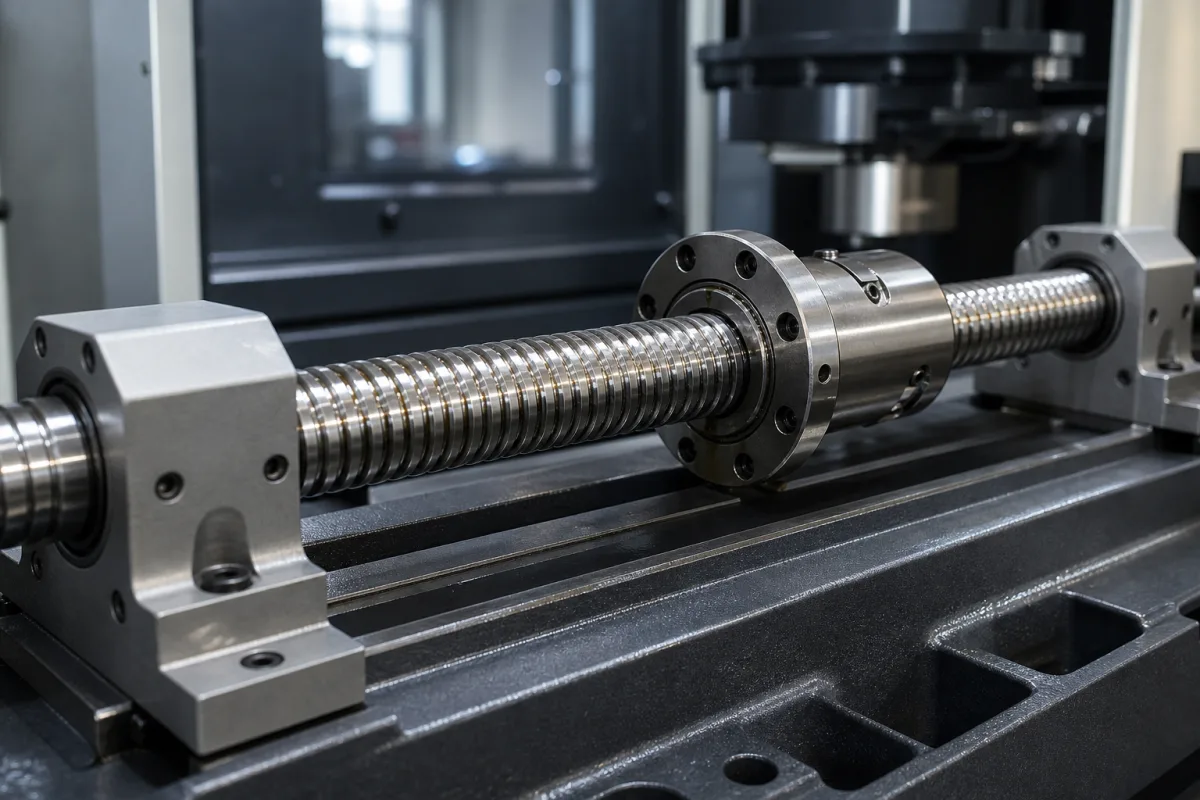
A threaded rod that converts rotational motion into linear motion within a linear actuator assembly.
Product Specifications

Technical details and manufacturing context for Lead Screw

Definition
A precision mechanical component in linear actuator assemblies that features helical threads along its length. When rotated, these threads engage with a nut or mating component to produce precise linear displacement, enabling controlled movement in automation, positioning systems, and mechanical drives.
Working Principle
Rotational force applied to the lead screw causes the engaged nut to travel along the screw's helical threads, converting rotary motion into linear motion. The pitch of the threads determines the linear travel distance per revolution.
Common Materials
Stainless Steel, Carbon Steel, Alloy Steel
Technical Parameters
  • Diameter and pitch specifications that determine load capacity and linear travel speed (mm) Standard Spec
Components / BOM
  • Threads Part
    Helical grooves that engage with the nut to produce linear motion
    Material: steel
  • Shaft Body Part
    Main structural support that transmits torque and handles axial loads
    Material: steel
  • End Machining Part
    Precision machined ends for bearing mounting or coupling connections
    Material: steel

Industry Taxonomies & Aliases

Commonly used trade names and technical identifiers for Lead Screw.

Applied To / Applications

This component is essential for the following industrial systems and equipment:

Industrial Ecosystem & Supply Chain Structure

Complementary Systems
Downstream Applications
Specialized Tooling

Application Fit & Sizing Matrix

Operational Limits
pressure: Axial load capacity: 100N to 50kN (dependent on screw diameter and material)
other spec: Maximum linear speed: 0.1-1.0 m/s (dependent on pitch and RPM limits)
temperature: -40°C to 120°C (dependent on material and lubrication)
Media Compatibility
✓ Industrial machinery lubrication oils ✓ Clean dry air environments ✓ General industrial atmospheres
Unsuitable: High-concentration abrasive slurry environments
Sizing Data Required
  • Required axial load capacity (N)
  • Required linear travel distance (mm)
  • Required positioning accuracy/repeatability (mm)

Reliability & Engineering Risk Analysis

Failure Mode & Root Cause
Thread wear and backlash
Cause: Insufficient lubrication leading to metal-on-metal contact, abrasive contamination in the lubricant, or misalignment causing uneven loading and accelerated wear.
Lead screw bending or buckling
Cause: Excessive axial load beyond design limits, improper installation causing misalignment, or impact loading during operation.
Maintenance Indicators
  • Audible grinding or squeaking noises during operation indicating lubrication failure or contamination
  • Visible wobble or runout in the screw during rotation, suggesting bending, bearing failure, or mounting issues
Engineering Tips
  • Implement a strict lubrication schedule using manufacturer-recommended grease or oil, and install protective bellows or covers to prevent contamination ingress
  • Regularly check and adjust alignment using precision instruments, and install overload protection devices to prevent excessive axial forces

Compliance & Manufacturing Standards

Reference Standards
ISO 2904:2010 (Lead screws for machine tools) ANSI/ASME B5.48-1977 (Lead screws and nuts) DIN 103:1999 (Trapezoidal screw threads)
Manufacturing Precision
  • Lead accuracy: ±0.005 mm per 300 mm
  • Thread flank angle tolerance: ±15 minutes of arc
Quality Inspection
  • Lead error measurement (using laser interferometer or ball-bar system)
  • Hardness testing (Rockwell C scale for screw material)

Factories Producing Lead Screw

Manufacturer profiles with relevant production capability in China

Manufacturer listings support early research and capability understanding. They are not certification, ranking, or transaction guarantees.

Technical documentation
4/5
Manufacturing capability
4/5
Inspection readiness
5/5
Supplier transparency
3/5

These scores are example evaluation dimensions, not real customer ratings, country-specific buyer feedback, or live inquiry activity.

Supply Chain Compatible Machinery & Devices

Heavy-Duty CNC Plasma Cutting Machine

Industrial machine for precision metal cutting using plasma arc technology

Explore Specs →
Automated Assembly Line System

Integrated production system for sequential component assembly operations

Explore Specs →
Automated Powder Coating System

Integrated industrial system for applying dry powder coatings to metal substrates.

Explore Specs →
Centrifugal Pump Impeller

Rotating component that transfers energy to fluid in centrifugal pumps.

Explore Specs →

Frequently Asked Questions

What materials are best for lead screws in heavy machinery applications?

For heavy machinery, alloy steel offers optimal strength and wear resistance, while stainless steel provides corrosion resistance for harsh environments. Carbon steel is cost-effective for standard applications.

How do I select the right lead screw for my linear actuator assembly?

Consider load capacity, speed requirements, precision needs, and environmental conditions. The BOM components (threads, shaft body, end machining) must match your actuator's specifications for proper conversion of rotational to linear motion.

What maintenance do lead screws require in industrial equipment?

Regular lubrication, cleaning to remove debris, and inspection for thread wear or damage. Proper alignment in the actuator assembly is crucial to prevent premature failure and maintain motion accuracy.

Can I contact factories directly on CNFX?

CNFX is an open directory, not a transaction platform. Each factory profile provides direct contact information and production details to help you initiate direct inquiries with Chinese suppliers.

Data Basis

CNFX manufacturer profiles, technical classification, publicly available product information, and ongoing plausibility checks.

Preliminary Technical Classification
This page supports structured research, RFQ preparation, and supplier evaluation. It does not replace buyer-led supplier qualification, standards review, or technical approval.

Request Manufacturing Insight for Lead Screw

Ask for use case, specification boundaries, supplier type, and RFQ preparation information for Lead Screw.

Your business information is used only to process this request.

Thank you! Your message has been sent. We'll respond within 1–3 business days.

Need to Manufacture Lead Screw?

Compare manufacturer profiles with relevant product and process capability.

Create Manufacturer Profile Contact Us
Previous Product
Layout Algorithm Module
Next Product
Lead Screw / Ball Screw