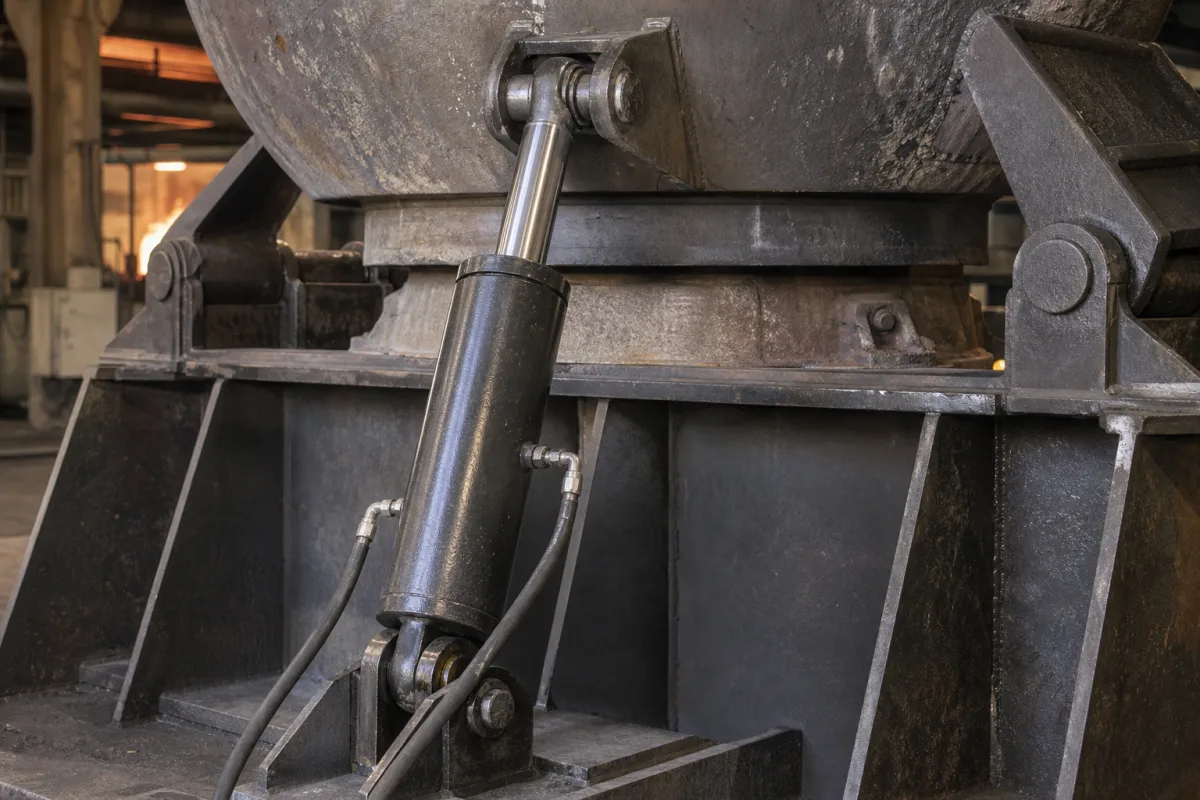
The illustrated cylinder is pinned by eye bearings at both ends, one on a heavy base frame and one on a lug beside a vessel. On a steel plant ladle lift the same arrangement has to raise a full ladle level, take the impact when a crane sets the ladle down, and keep working between casts with little time for maintenance. Two steel-plant equipment patents, from SMS Demag and Siemens VAI, and an SKF bearing datasheet set out the choices.
Covers hydraulic lift cylinders and the lift mechanisms they drive for raising steel ladles: ladle turret and ladle car lifts at continuous casters, ladle hoists for RH vacuum degassers, and the bearings at the cylinder ends. The original catalogue entry also named pneumatic actuators for a ladle lift-and-seal mechanism; pneumatic cylinders are outside this page. Hydraulic ladle tilting is on 992; general-purpose hydraulic cylinders are on 3023 (tie-rod), 1411 (single-acting rams), 2897 (piston assemblies) and 187 (piston rods); excavator boom cylinders are on 3363, and mould oscillator cylinders on 502. Forklift mast cylinders, gas springs and tractor hitch lift cylinders carry the same name and are outside this page.
CNFX editorial research · Sources checked October 13, 2026 · 3 sources
Four lift points, one level ladle: three ways to drive them
US 6,640,691 (SMS Demag, filed 2001) reviews how ladles are lifted on ladle cars and turrets at continuous casters. A ladle sits on two horizontal seats; the lift has to keep them level, carry the vertical load, and take lateral loads from the crane setting the ladle down and from accelerations as the ladle moves.
In the third arrangement the cylinder stays close to vertical, but as the upper link frame rotates the cylinder pivots slightly about its lower bearing, and the upper bearing turns through about the same angle as the frame. That rotation, under the full ladle load, is what the cylinder's end bearings have to carry.
The patent also notes that the cylinder assembly's height drives the size and shape of the surrounding support and lift frames, so a lower bearing envelope at each end of the cylinder is worth having.
Drive (US 6,640,691)
How the four lift points stay level
What the patent says against it
Electromechanical screw jacks
Two lifting bridges on four screw jacks, synchronised by universal spindle shafts and gearboxes from one electric motor
Reliable for a short, slow lift; a longer, faster lift needs heavy-duty ball screw jacks that are not commercially available and are costly to buy and maintain
Four hydraulic cylinders in place of the jacks
Synchronisation within the hydraulic system
Susceptible to wear of system components and leakage of hydraulic fluid; electronic position feedback helps but is costly and needs a strict maintenance schedule
One hydraulic cylinder with mechanical synchronisation
Two parallelogram linkages tied by a rigid frame; the lower links keep the ladle supports horizontal through the lift
Hydraulic speed without the maintenance of electromechanical drives; unaffected by wear in the hydraulic system, so hydraulic maintenance can be less stringent
02
The bearings at each end of the cylinder
The same patent describes the spherical bearings used at the rod and cylinder ends of ladle-lift cylinders, each an inner and outer ring with mating spherical surfaces, and explains why they cause trouble on this duty.
The patent's conclusion is that, whichever material is chosen, a larger bearing is needed to meet all the requirements. Its own answer replaces the spherical bearing with pivot blocks whose load-bearing surfaces roll rather than slide, with the stated aims of longer maintenance intervals and replacing individual bearing elements without an extended interruption to casting.
SKF's datasheet and the patent agree on the point that matters here: PTFE suits the heavy one-direction load of a lift cylinder, but only if dirt and moisture are kept out, which is hard next to a caster (editorial comparison).
Contact pair
Patent (US 6,640,691)
Bearing maker (SKF GE 20 C datasheet)
Steel on steel
Withstands extreme impact loads, but is hard to lubricate under a one-way load, giving low dynamic capacity; galls in the presence of the minutest metallic particles, which must be purged by frequent relubrication
—
Steel on PTFE
Self-lubricating and preferred, but performs poorly under impact and must be protected from contaminants including moisture; the grease barrier used for that is itself harmful to PTFE
Steel/PTFE sintered bronze, maintenance-free, suitable for heavy, constant-direction loads; sliding surfaces have to be externally protected from contaminants
Fitting
Inner ring installed with an interference fit on the shaft, needing precise alignment and a heavy pressing force
—
The SKF data are for one small bearing size, used here for the stated material properties, not as a sizing reference.
03
Lifting a ladle into an RH degasser
US 7,662,337 (Siemens VAI, 2010) deals with raising a ladle of liquid steel from a transfer car to the immersion pipes (snorkels) of a fixed RH vacuum vessel.
The patent allows each arm its own hydraulic cylinder, or a single cylinder on one arm when the cross support is stiff enough in torsion to carry the second arm with it. The single-cylinder idea is the same one SMS Demag used on the caster turret: let a stiff structure, not the hydraulics, keep the ladle level (editorial comparison of the two patents).
Large snorkels shorten treatment time, which is why the patent treats horizontal ladle movement as a cost: any sideways travel has to be allowed for by making the snorkels smaller.
Option (US 7,662,337)
Patent's assessment
Lower the vacuum vessel into the ladle
The vessel carries the connections for vacuum generation and treatment gases, and every movement of the vessel stresses those connections and their lines
Raise the ladle by crane cable suspension or hydraulic lifting mechanisms
Gives the exact vertical movement needed with large snorkels, but requires a lot of space and a large capital investment
Raise the ladle on a pivot arm moved by a hydraulic cylinder
More economical, but the arc of the arm also moves the ladle horizontally, which would force a smaller snorkel diameter
The patent's design
Two lifting arms on a cross support whose circular-arc runway rolls on a stationary saddle, shifting the pivot point so the horizontal movement is compensated
04
What to give a ladle-lift cylinder supplier
Paste it into your enquiry below or into an email to a maker, then replace every bracket.
Give the full ladle mass and the lift mechanism (four-point, single cylinder with linkage, or pivot arm), stroke and lift time, the impact load when the crane sets the ladle down, mounting geometry and the rotation each end bearing sees through the stroke, ambient temperature and radiant heat near the ladle, hydraulic fluid type, and how much time is available to change a bearing. Ask for the bore, rod and pressure, end-bearing type and contact material, sealing of the bearings against scale and moisture, buckling check at full extension, and how bearings are replaced in place.
1 company lists this product among what they make. Company figures are quoted from each
company's own website; every card states where the relationship came from.
Yancheng Haite Machinery Technology Co., Ltd
card
Lists metallurgical hydraulic cylinders among its product categories. Location TBC.
Explore company information and manufacturing capabilities, then discuss the scope of your project with a relevant supplier.
Share this page
Compiled and source-reviewed by the CNFX editorial team.
Each manufacturer above links to the page on that company's own website where the product is listed, with the date we checked it. How we source and review
· Page last updated 13 October 2026
Buyer questions
Why not lift a ladle with four synchronised hydraulic cylinders?
US 6,640,691 notes that synchronising four cylinders within the hydraulic system is susceptible to wear and leakage, and that electronic feedback control is costly and needs strict maintenance. [1]
Which bearing material suits a ladle-lift cylinder?
The SMS Demag patent finds steel-on-steel hard to lubricate under a one-way load and PTFE poor under impact and sensitive to moisture; SKF rates steel/PTFE bearings for heavy constant-direction loads if protected from contaminants. [1][3]
How is a ladle lifted to an RH degasser?
US 7,662,337 describes lifting arms driven by hydraulic cylinders, with a circular-arc runway on a saddle support that compensates the ladle's horizontal movement under the snorkels. [2]
Sources and what still needs a direct check
Sources checked 2026-10-13. Two steel-plant equipment patents, SMS Demag's on ladle-lift cylinder bearings and Siemens VAI's on RH degasser ladle hoists, and an SKF spherical plain bearing datasheet.