Editorial Technical Reference

Linear Guide / Bearing Housing

This page explains how Linear Guide / Bearing Housing is classified within Machinery and Equipment Manufacturing. Technical values and manufacturer relationships are research references; confirm the current specification and supplier evidence for each order.

Technical Definition & Core Assembly

A structural component that houses and supports linear bearings or guide rails, providing precise linear motion guidance within mechanical systems.
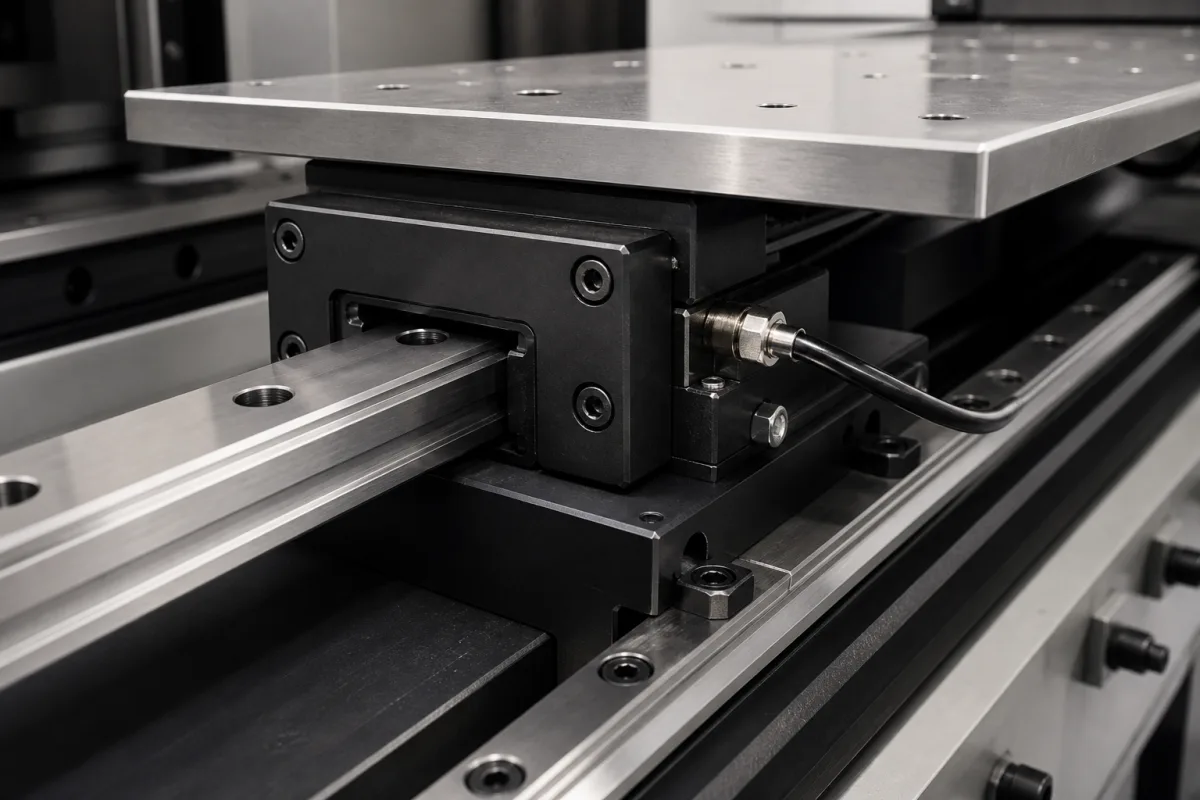
Representative product image. Confirm appearance and specifications with the manufacturer.

Product Specifications

Technical details and manufacturing context for Linear Guide / Bearing Housing

Definition
In a Vertical Positioning Actuator, the Linear Guide / Bearing Housing is a critical mechanical part that encloses and secures the linear bearing assembly or guide rail system. It ensures the actuator's moving platform or carriage moves along a strictly vertical axis with minimal friction, high rigidity, and precise alignment, directly contributing to the system's positioning accuracy and load-bearing capacity. The housing provides a rigid, precisely machined mounting surface and internal raceways for linear bearings (such as ball bushings) or a secure base for mounting guide rails. It transfers loads from the moving carriage to the actuator's main structure while maintaining the alignment of the rolling elements (balls or rollers) to facilitate smooth, low-friction linear motion along the guideway. This component is typically manufactured from cast iron, aluminum alloy, or carbon steel, with material selection based on required strength, weight, and cost. Key parameters include rail width (15–65 mm), housing bore diameter (12–100 mm), dynamic load rating (5–120 kN), static load rating (10–250 kN), accuracy grade (C1–C5), running parallelism (±0.005–±0.02 mm), operating temperature (-20–80 °C), maximum speed (60–300 m/min), housing material (GC15–GC45), surface treatment (black oxide to phosphating), and weight (0.5–15 kg). These values are reference ranges and must be verified for the specific model and application. Standards such as ISO 12090-1 and ISO 14728-1 are referenced for dimensional and load ratings, but compliance must be confirmed with the manufacturer. The housing's design directly influences the actuator's precision, rigidity, and service life. Proper selection requires consideration of load, speed, accuracy, and environmental conditions. Maintenance signals include increased friction, noise, or play, which may indicate wear or misalignment. Failure boundaries include exceeding load ratings, which can cause permanent deformation, or operating outside temperature limits, which may affect lubrication and materials. Always consult the legal manufacturer for model-specific values and standards.
Working Principle
The housing provides a rigid, precisely machined mounting surface and internal raceways for linear bearings (such as ball bushings) or a secure base for mounting guide rails. It transfers loads from the moving carriage to the actuator's main structure while maintaining the alignment of the rolling elements (balls or rollers) to facilitate smooth, low-friction linear motion along the guideway.
Common Materials
Cast Iron, Aluminum Alloy, Carbon Steel
Technical Parameters
ParameterTypical rangeNotes & selection driver
Rail Width15–65 mmDetermines load capacity and stiffness.ISO 12090-1
Housing Bore Diameter12–100 mmMust match bearing outer diameter.
Dynamic Load Rating5–120 kNHigher values allow longer service life.ISO 14728-1
Static Load Rating10–250 kNExceeding may cause permanent deformation.ISO 14728-1
Accuracy GradeC1–C5C1 is highest precision, C5 is standard.ISO 12090-1
Running Parallelism±0.005–±0.02 mmTighter tolerance for high-precision applications.ISO 12090-1
Operating Temperature-20–80 °COutside range may affect lubrication and materials.
Maximum Speed60–300 m/minLimited by lubrication and seal design.
Housing MaterialGC15–GC45Cast iron grades; steel for higher strength.GB/T 9439
Surface TreatmentBlack oxide–PhosphatingImproves corrosion resistance and appearance.
Weight0.5–15 kgAffects handling and dynamic behavior.

Ranges are indicative industry figures for RFQ preparation, not a supplier commitment. Confirm every value and standard with the legal manufacturer before ordering.

Components / BOM
  • Housing Body Part
    Main structural frame that provides rigidity and mounting points.
    Material: Cast Iron or Aluminum Alloy
  • Bore / Raceway Part
    Precision-machined internal surface that guides the linear bearing or contacts the guide rail.
    Material: Hardened Steel or bearing-grade material
  • Mounting Holes / Tapped Threads Part
    Allow secure attachment of the housing to the actuator structure and the bearing/rail to the housing.
    Material: Same as housing body
  • Seals / Wipers (if present) Optional Part
    Protect the internal bearing or guideway from dust, chips, and contaminants.
    Material: Rubber or Polyurethane

Applied To / Applications

This component is essential for the following industrial systems and equipment:

Industrial Ecosystem & Supply Chain Structure

Complementary Systems
Downstream Applications
Specialized Tooling

Application Fit & Sizing Matrix

Operational Limits
pressure: Max 10 MPa (100 bar) static load capacity, dependent on housing material and mounting
other spec: Max linear speed: 2 m/s (continuous), 5 m/s (peak); Vibration tolerance: Up to 15 g; IP rating: IP54 standard, IP67 optional
temperature: -20°C to +80°C (standard), up to +120°C with special seals/lubrication
Media Compatibility
✓ Machine tool cutting fluids ✓ Industrial lubricants (grease/oil) ✓ Clean dry air environments
Unsuitable: High-concentration abrasive slurries or corrosive chemical baths
Sizing Data Required
  • Maximum dynamic load (N) and moment loads (Nm)
  • Required stroke length and mounting space constraints
  • Precision class (e.g., μm repeatability) and stiffness requirements

Reliability & Engineering Risk Analysis

Failure Mode & Root Cause
Wear and scoring
Cause: Contamination ingress (dust, debris, metal particles) due to inadequate sealing or improper lubrication, leading to abrasive damage on guide rails and bearing blocks.
Misalignment and binding
Cause: Improper installation (uneven mounting surfaces, excessive preload), thermal expansion mismatches, or foundation shifts causing uneven load distribution and increased friction.
Maintenance Indicators
  • Audible grinding, scraping, or squealing noises during operation
  • Visible metal shavings or discoloration around the housing or lubrication points
Engineering Tips
  • Implement strict contamination control: Use proper seals/wipers, maintain clean lubrication systems, and ensure clean installation environments.
  • Follow precise alignment procedures during installation: Use dial indicators for parallelism, verify mounting surface flatness, and apply manufacturer-specified preload/torque values.

Indicative industry ranges for design and RFQ preparation. Confirm the exact figures and applicable standard with the manufacturer before specifying.

Compliance & Manufacturing Standards

Applicable Standards
ISO 3408-1:2006 (Ball screws - Part 1: Vocabulary and designation) ANSI/ABMA 9:1990 (Load Ratings and Fatigue Life for Ball Bearings) DIN 645:2002 (Linear ball bearings - Housing units - Dimensions and tolerances)

Quoted from the published standard.

Manufacturing Precision
  • Bore diameter: ±0.01 mm
  • Flatness of mounting surface: 0.05 mm
Quality Inspection
  • Dimensional verification with CMM (Coordinate Measuring Machine)
  • Hardness testing (Rockwell C scale)

Manufacturers of Linear Guide / Bearing Housing

Manufacturer profiles associated with Linear Guide / Bearing Housing.

Sourcing Linear Guide / Bearing Housing from China?
Tell us your specification and target quantity — we will match it against manufacturer records and come back with the factories that fit.
Request manufacturers We manufacture this

Manufacturer listings support early research and capability understanding. They are not certification, ranking, or transaction guarantees.

Technical documentation
Request current drawings, revision history, and a signed specification sheet.
Manufacturing capability
Verify equipment lists, process limits, capacity, and representative production evidence.
Inspection readiness
Confirm test methods, calibrated equipment, sampling plans, and traceable reports.
Supplier transparency
Check the legal entity, factory address, ownership, certifications, and direct contacts.

CNFX does not score or rank suppliers. Buyers must verify all claims and documents with the legal manufacturer before ordering.

Supply Chain Compatible Machinery & Devices

Automated Powder Coating System

Integrated industrial system for applying dry powder coatings to metal substrates.

Explore Specs →
Centrifugal Pump Impeller

The centrifugal pump impeller is a critical rotating component that converts mechanical energy from the motor into kinetic energy in fluid systems.

Explore Specs →
High-Precision CNC Laser Cutting Machine

Computer-controlled industrial machine using focused laser beams to cut sheet metal with micron-level accuracy.

Explore Specs →
Industrial-Grade Hydraulic Cylinder Piston Rod

This industrial-grade piston rod is a precision-ground cylindrical component designed for use in hydraulic cylinders.

Explore Specs →

Frequently Asked Questions

What is the primary function of a Linear Guide / Bearing Housing?

It houses and supports linear bearings or guide rails, ensuring precise, low-friction linear motion along a defined axis. It transfers loads from the moving carriage to the actuator structure while maintaining alignment.

What materials are commonly used for this housing?

Typical materials include cast iron, aluminum alloy, and carbon steel. The choice depends on required strength, weight, and cost. Specific grades like GC15–GC45 are listed as reference ranges.

How do I select the correct housing size?

Selection is based on rail width, housing bore diameter, load ratings, accuracy grade, and operating conditions. Always verify these parameters with the manufacturer for your specific application.

What maintenance signals indicate a problem?

Increased friction, unusual noise, or visible play in the carriage may indicate wear, misalignment, or contamination. Regular inspection and lubrication are recommended.

Data Basis

Editorial classification, named public sources where available, and source-reviewed manufacturer records.

Preliminary Technical Classification
This page supports structured research, RFQ preparation, and supplier evaluation. It does not replace buyer-led supplier qualification, standards review, or technical approval.
Buyer enquiry

Request manufacturing insight for Linear Guide / Bearing Housing

Ask for use case, specification boundaries, supplier type, and RFQ preparation information for this product.

Where it goes
Straight to the CNFX editorial desk, and to the manufacturer if this product is linked to a claimed profile. Nothing is broadcast to a supplier list.
Your details stay here
We do not sell or rent enquiry data, and we do not add you to a mailing list. Used only to answer this request.
No commission, no middleman
CNFX is a directory. We take no cut of any order and never negotiate on a supplier's behalf.
What we don't claim
A listing is not an endorsement. Qualify every supplier and verify every figure yourself before ordering.

Your business information is used only to process this request.

Thank you! Your message has been sent. We'll respond within 1–3 business days.
Sorry, we couldn't send your message. Please try again, or email us at contact@cnfx.com.

Need to Manufacture Linear Guide / Bearing Housing?

Compare manufacturer profiles with relevant product and process capability.

Previous Product
Z-axis Ram/Spindle
Last Product
Get QuotesChat