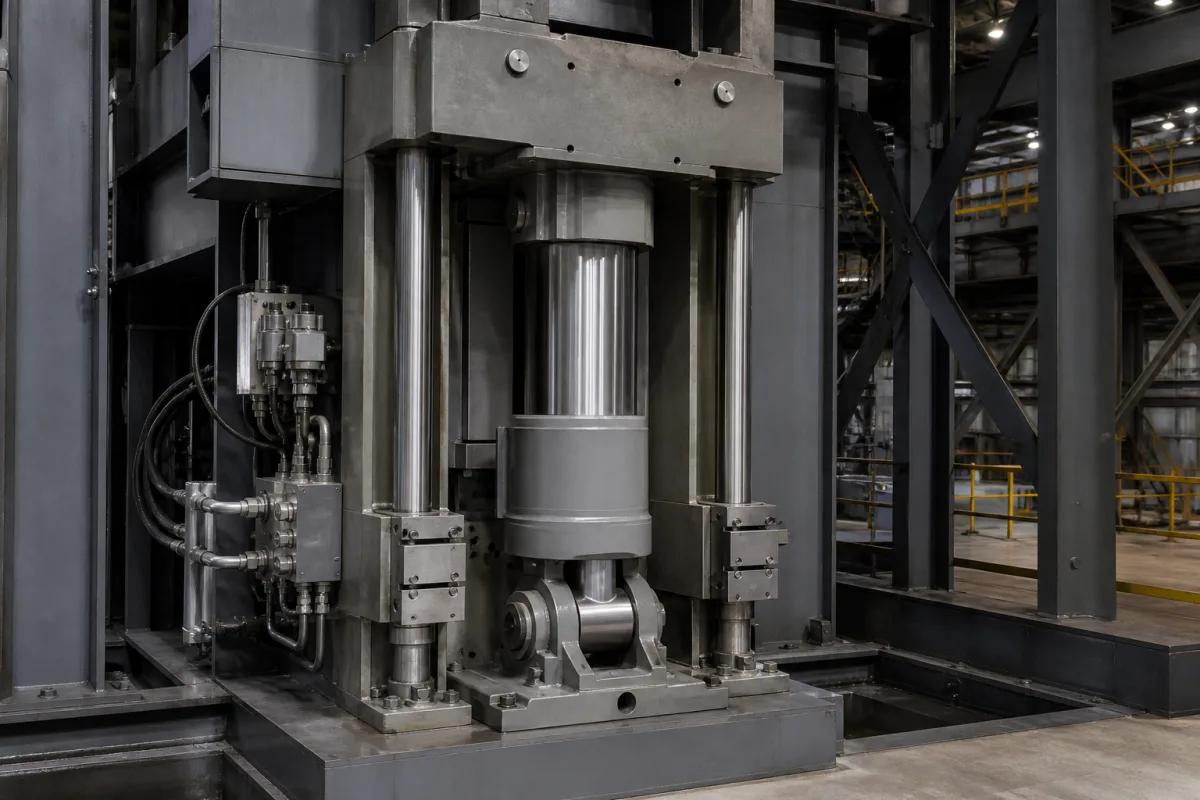
Vertical positioning actuator for arc furnace electrodes: the servo-valve hydraulic drive, its response time, its up-down asymmetry and its fire-resistant fluid
The servo-valve-and-cylinder drive that moves each arc furnace electrode up and down under regulation · response of the order of 50–80 ms with a pressure set point within about 1 %, an electrode that rises about three times faster than it falls in a measured ladle furnace, and water-glycol fluid kept below 60 °C
Electrode regulation decides how far each electrode should move; the vertical positioning actuator is what moves it. In the furnaces cited here that is a hydraulic cylinder under the mast, fed through a fast servo or proportional valve and watched by a pressure transducer. Its job is measured in milliseconds and kilograms: how fast it answers a correction, how differently it rises and falls, and how it tells the controller that the electrode has touched scrap.
Vertical positioning actuators for electric arc furnace and ladle furnace electrodes, treated as the drive element of electrode regulation: the hydraulic cylinder, servo or proportional valve, pressure transducer and position sensing, their response and asymmetry, and the fire-resistant hydraulic fluid. Electrode masts, current-carrying arms, clamps and electrode adding are covered on the Electrode mast, current-carrying arm and clamp of an arc furnace page; regulation software and process models on the Process control system for electric arc furnace steelmaking page; the furnace itself on the Electric arc furnace page. Servo cylinders for mould oscillation, valve-on-cylinder servo assemblies and rolling-mill hydraulic gap control are covered on their own pages (Servo actuator unit for continuous casting mould oscillation; Valve-on-cylinder actuator assembly; Heavy-duty rolling mill hydraulic gap control system).
CNFX editorial research · Sources checked October 13, 2026 · 3 sources
A pressure-controlled servovalve drive: 50–80 ms response, a set point within about 1 % and electrode weight read at every descent
Danieli's patent puts a pressure transducer on the cylinder that lifts and lowers the electrode-bearing arm, and closes the loop through a processor and a quick-response servovalve. At each swift descent at the start of melting the processor stores the dynamic pressure, which gives the weight of arm and electrode, so electrode wear can be followed through the heat; it then sets an intervention point differing by less than a preset percentage, about 1 %, from that value. [1]
When the electrode lands on scrap the pressure change is seen at that point and the servovalve either lifts the electrode and holds it at a preset pressure or lets a graduated share of its weight press through non-conductive material so the arc can strike. The patent states response times “of the order of 50-80 milliseconds” and a maximum of 100 ms, and attributes to that speed and the 1 % threshold the avoidance of electrode breakage and short circuits. It contrasts this with an earlier pressure-switch and relay design that regulated in steps. [1]
Ask for the step response of the actuator from valve command to electrode movement, how the pressure set point is chosen, and whether electrode weight is logged at each descent.
02
Rising three times faster than falling: single-acting cylinders lowered by gravity on a 60 t ladle furnace
A 2024 IFAC conference paper on the 60 t ladle furnace at ACINOX Las Tunas, with 300 mm electrodes and three-phase AC supply at about 82 kWh/t, describes single-acting cylinders: oil enters and leaves one chamber and the electrode comes down under gravity. Identified models gave a gain of 1.74 rising and 0.57 falling with almost the same time constant (0.018 s) and delay (0.014–0.015 s), so the electrode responds about three times faster upward than downward to the same valve signal. [2]
With electrode weight varied between its extremes, the time constant ranged from 0.04 to 0.1 s and the delay from 4.6 to 18 ms; the authors treated the actuator as a linear parameter-varying system and compensated the asymmetry with a non-linear PI controller. [2] Editorial calculation: 1.74 ÷ 0.57 ≈ 3.05; adding time constant and delay, 0.018 + 0.015 ≈ 0.033 s for the rising model, below the 50–80 ms Danieli gives for its whole pressure loop, which includes more than the cylinder. [2][1]
Ladle furnace actuator model (IFAC paper)
Gain K
Time constant T
Delay
Electrode rising
1.74
0.018 s
0.015 s
Electrode falling
0.57
0.018 s
0.014 s
Maximum electrode weight
0.363
0.1 s
0.018 s
Minimum electrode weight
0.40
0.04 s
0.0046 s
Ask whether the cylinders are single- or double-acting, the rising and falling speeds at full and worn electrode weight, and how the controller compensates the difference.
03
Water-glycol fluid under the furnace: about 37 % water, ISO VG 46, and no more than 60 °C
Because the actuator sits close to the arc, slag and molten metal, its circuit is a candidate for fire-resistant fluid. Repsol describes Telex HFC as a water-glycol fluid for systems with high fire risk, designed for the metallurgy industry, with about 37 % water, ISO VG 46, density 1.080 g/cm³ and a pour point of −48 °C (typ.), meeting ISO 6743/4 HFC, ISO 12922 HFC and the 7th Luxembourg Protocol. [3]
Repsol specifies it for systems where the fluid does not exceed 60 °C, and notes that losing water raises viscosity, to be corrected by adding deionised water. [3]
Ask which fluid class the servovalves, seals and pump are rated for, the maximum fluid temperature at the actuator, and how water content is checked.
04
What to send for an electrode vertical positioning actuator
Paste it into your enquiry below or into an email to a maker, then replace every bracket.
Furnace: [EAF or ladle furnace; heat size; electrode diameter]
Load: [arm and electrode weight new and worn; stroke]
Drive: [single- or double-acting cylinder; servo or proportional valve]
Response: [step response; rising and falling speed]
Sensing: [pressure transducer; position transducer or limit switches]
Fluid: [mineral oil, HFC or HFD; maximum temperature]
Explore company information and manufacturing capabilities, then discuss the scope of your project with a relevant supplier.
Share this page
Compiled and source-reviewed by the CNFX editorial team.
Each manufacturer above links to the page on that company's own website where the product is listed, with the date we checked it. How we source and review
· Page last updated 13 October 2026
Buyer questions
How fast must an electrode actuator respond?
Danieli's patented pressure-controlled servovalve drive states response times of the order of 50–80 ms, with 100 ms as the maximum. [1]
Why does an electrode rise faster than it falls?
With single-acting cylinders the electrode descends under gravity; on a 60 t ladle furnace the identified gain was 1.74 rising and 0.57 falling. [2]
How can the actuator detect electrode wear?
Danieli's system stores cylinder pressure at each descent, which gives the weight of arm and electrode during the heat. [1]
What temperature can a water-glycol hydraulic fluid take?
Repsol specifies its Telex HFC metallurgy fluid for systems where the fluid stays at or below 60 °C. [3]
Sources and what still needs a direct check
Sources checked 2026-10-13. The pressure-controlled servovalve drive comes from a Danieli patent on the EPO server; measured actuator dynamics from an IFAC PID 2024 paper on a ladle furnace; hydraulic fluid data from Repsol's Telex HFC data sheet.