Industry-Verified Manufacturing Data (2026)

Locking/Latching System

Based on aggregated insights from multiple verified factory profiles within the CNFX directory, the standard Locking/Latching System used in the Machinery and Equipment Manufacturing sector typically supports operational capacities ranging from standard industrial configurations to heavy-duty production requirements.

Technical Definition & Core Assembly

A canonical Locking/Latching System is characterized by the integration of Latch Mechanism and Strike Plate. In industrial production environments, manufacturers listed on CNFX commonly emphasize Stainless Steel construction to support stable, high-cycle operation across diverse manufacturing scenarios.

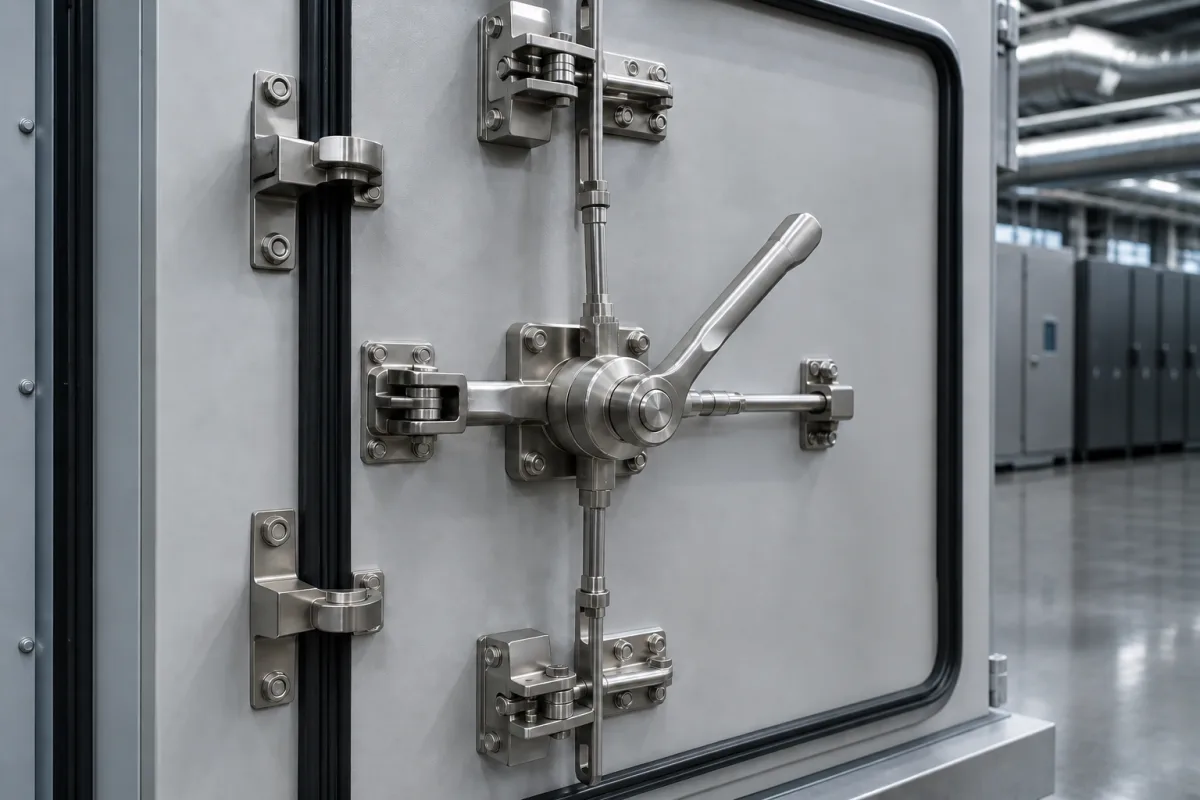
Mechanical system that secures an insulated chamber door in a closed position to maintain environmental seals.
Product Specifications

Technical details and manufacturing context for Locking/Latching System

Definition
A specialized locking/latching system designed for insulated chamber doors that provides secure closure while maintaining thermal and environmental seals. This system ensures the door remains tightly shut during operation to prevent energy loss, maintain temperature/humidity control, and ensure safety in industrial applications.
Working Principle
The system typically employs mechanical latches, bolts, or clamps that engage with corresponding strike plates or receivers on the door frame. When activated (manually or automatically), the locking mechanism applies pressure to compress door seals against the frame, creating an airtight and insulated barrier. Some systems incorporate thermal breaks to prevent cold bridging.
Common Materials
Stainless Steel, Galvanized Steel, Aluminum Alloy
Technical Parameters
  • Locking point spacing and engagement depth (mm) Standard Spec
Components / BOM
  • Latch Mechanism
    Primary engagement component that secures door to frame
    Material: Stainless Steel
  • Strike Plate
    Receiving component mounted on door frame for latch engagement
    Material: Galvanized Steel
  • Operating Handle
    Manual interface for activating/deactivating the locking system
    Material: Aluminum Alloy
  • Seal Compression Plate
    Distributes locking force evenly across door seals
    Material: Stainless Steel
Engineering Reasoning
0.5-2.5 kN latch force, 0.1-0.3 mm door-seal compression, -40°C to 85°C ambient temperature
Latch force < 0.4 kN causes seal leakage > 0.5 L/min at 50 Pa pressure differential, actuator torque > 3.5 N·m causes gear tooth shear stress > 250 MPa
Design Rationale: Hooke's law elastic limit exceeded in spring components at >0.4% strain, Hertzian contact stress > 1.1 GPa causes surface pitting in cam mechanisms, thermal expansion mismatch (Δα=12×10⁻⁶ K⁻¹) between stainless steel and aluminum creates binding at >70°C ΔT
Risk Mitigation (FMEA)
Trigger Corrosion-induced material loss in latch mechanism (≥0.2 mm thickness reduction)
Mode: Insufficient engagement force causes 0.8 mm door displacement under 100 Pa pressure
Strategy: 316L stainless steel construction with 25 µm electroless nickel plating, cathodic protection at -0.85 V vs SCE
Trigger Lubricant degradation at >120°C reduces viscosity below 68 cSt
Mode: Increased friction coefficient from 0.15 to 0.45 causes actuator stall at 85% rated torque
Strategy: Perfluoropolyether grease with 2% MoS₂ additive, thermal management maintaining <100°C at sliding surfaces

Industry Taxonomies & Aliases

Commonly used trade names and technical identifiers for Locking/Latching System.

Applied To / Applications

This component is essential for the following industrial systems and equipment:

Industrial Ecosystem & Supply Chain DNA

Complementary Systems
Downstream Applications
Specialized Tooling

Application Fit & Sizing Matrix

Operational Limits
pressure: 0 to 15 psi differential
other spec: Door deflection ≤ 5mm under max pressure
temperature: -40°C to +150°C
Media Compatibility
✓ Clean air environments ✓ Dry inert gases ✓ Low-particulate industrial atmospheres
Unsuitable: High-corrosion chemical exposure (e.g., chlorine, strong acids)
Sizing Data Required
  • Door dimensions and weight
  • Required sealing force (N)
  • Chamber pressure differential (psi)

Reliability & Engineering Risk Analysis

Failure Mode & Root Cause
Wear-induced misalignment
Cause: Friction and repeated cycling leading to component deformation or loss of material, causing improper engagement or disengagement.
Corrosion or contamination binding
Cause: Exposure to moisture, chemicals, or debris accumulation that restricts movement or prevents full latching/unlatching.
Maintenance Indicators
  • Audible grinding, clicking, or excessive noise during operation
  • Visual signs of rust, deformation, or difficulty in smooth manual operation
Engineering Tips
  • Implement regular lubrication with appropriate, compatible lubricants to reduce friction and wear
  • Establish routine inspection and cleaning schedules to remove contaminants and check for early signs of corrosion or misalignment

Compliance & Manufacturing Standards

Reference Standards
ISO 9001:2015 - Quality management systems ANSI/BHMA A156.13 - Mortise locks and latches DIN 18251 - Door locks and latches
Manufacturing Precision
  • Bore diameter: +/-0.05mm
  • Surface flatness: 0.1mm
Quality Inspection
  • Dye Penetrant Test for surface defects
  • Torque/Force Testing for latching mechanism

Factories Producing Locking/Latching System

Verified manufacturers with capability to produce this product in China

✓ 96% Supplier Capability Match Found

T Technical Director from Australia Jan 02, 2026
★★★★★
"The technical documentation for this Locking/Latching System is very thorough, especially regarding technical reliability."
Technical Specifications Verified
P Project Engineer from Singapore Dec 30, 2025
★★★★☆
"Reliable performance in harsh Machinery and Equipment Manufacturing environments. No issues with the Locking/Latching System so far. (Delivery took slightly longer than expected, but technical support was excellent.)"
Technical Specifications Verified
S Sourcing Manager from Germany Dec 27, 2025
★★★★★
"Testing the Locking/Latching System now; the technical reliability results are within 1% of the laboratory datasheet."
Technical Specifications Verified
Verification Protocol

“Feedback is collected from verified sourcing managers during RFQ (Request for Quote) and factory evaluation processes on CNFX. These reports represent historical performance data and technical audit summaries from our B2B manufacturing network.”

6 sourcing managers are analyzing this specification now. Last inquiry for Locking/Latching System from Mexico (1h ago).

Supply Chain Compatible Machinery & Devices

Heavy-Duty CNC Plasma Cutting Machine

Industrial machine for precision metal cutting using plasma arc technology

Explore Specs →
Automated Assembly Line System

Integrated production system for sequential component assembly operations

Explore Specs →
Automated Powder Coating System

Integrated industrial system for applying dry powder coatings to metal substrates.

Explore Specs →
Centrifugal Pump Impeller

Rotating component that transfers energy to fluid in centrifugal pumps.

Explore Specs →

Frequently Asked Questions

What materials are available for this locking/latching system?

This system is available in stainless steel for corrosion resistance, galvanized steel for durability, and aluminum alloy for lightweight applications in machinery and equipment manufacturing.

How does this system maintain environmental seals in insulated chambers?

The system includes a seal compression plate that applies consistent pressure when the door is latched, ensuring the insulated chamber maintains its environmental seals against temperature, moisture, or pressure variations.

What components are included in the BOM for this locking system?

The bill of materials includes a latch mechanism, strike plate, operating handle, and seal compression plate - all designed to work together for secure closure of machinery chamber doors.

Can I contact factories directly on CNFX?

CNFX is an open directory, not a transaction platform. Each factory profile provides direct contact information and production details to help you initiate direct inquiries with Chinese suppliers.

Get Quote for Locking/Latching System

Request technical pricing, lead times, or customized specifications for Locking/Latching System directly from verified manufacturing units.

Your business information is encrypted and only shared with verified Locking/Latching System suppliers.

Thank you! Your message has been sent. We'll respond within 1–3 business days.

Need to Manufacture Locking/Latching System?

Connect with verified factories specializing in this product category

Add Your Factory Contact Us
Previous Product
Locking System (e.g., Ball-Lock, Taper)
Next Product
Logic Controller