Bulk handling · Field depth, burden and tramp metal
A magnet only catches what its field reaches. Deep material on a fast belt hides small pieces of iron; a magnet sized for the average load misses them. Describe the burden depth, belt speed and the smallest, worst-shaped piece you must catch, then choose suspended, pulley or drum design and how the collected iron will be cleaned off.
Suspended (overband or cross-belt) magnets, magnetic head pulleys, drum and grate separators for removing or recovering ferrous metal from conveyed bulk materials, abrasives and recycling streams, plus eddy-current separators for non-ferrous metals. Magnetic filters for liquids are outside this page.
CNFX editorial research · Sources checked October 11, 2026 · 6 sources
Describe burden depth, belt speed and the iron to catch
Eriez, a magnetic separation manufacturer, lists the factors that decide collection: as belt speed rises it becomes harder to remove ferrous pieces, and larger, stronger electromagnets may be needed; as burden depth rises, more field strength is needed; small pieces of 1–2.5 cm may be very hard to remove under a deep overburden compared with shovel teeth, rail spikes or rebar. [1]
Shape matters too: Eriez notes that flat plates and rod-shaped pieces are easier to remove than spheres or cubes because of their higher surface-area-to-weight ratio. [1]
Ask the supplier to size the magnet for the deepest burden and fastest belt you run, and for the smallest compact piece you must remove, not for the average case.
Give the supplier belt width and speed, burden depth, material type, bulk density, lump size and moisture, throughput, and the size, shape and frequency of the iron to be removed.
02
Choose suspended magnet, head pulley or drum
Eriez describes suspended (overband or cross-belt) magnets hung above the belt: permanent ceramic-magnet versions need no power, while suspended electromagnets have a deeply penetrating field for heavy burdens on fast belts and can be switched off for cleaning or service. [1]
A magnetic head pulley replaces the conveyor's end pulley: magnets inside hold ferrous metal to the belt until it passes under the end, while non-magnetic material continues downstream. Eriez offers ferrite and rare-earth pulleys from 200 to 1,200 mm diameter and 500 to 2,000 mm wide. [2]
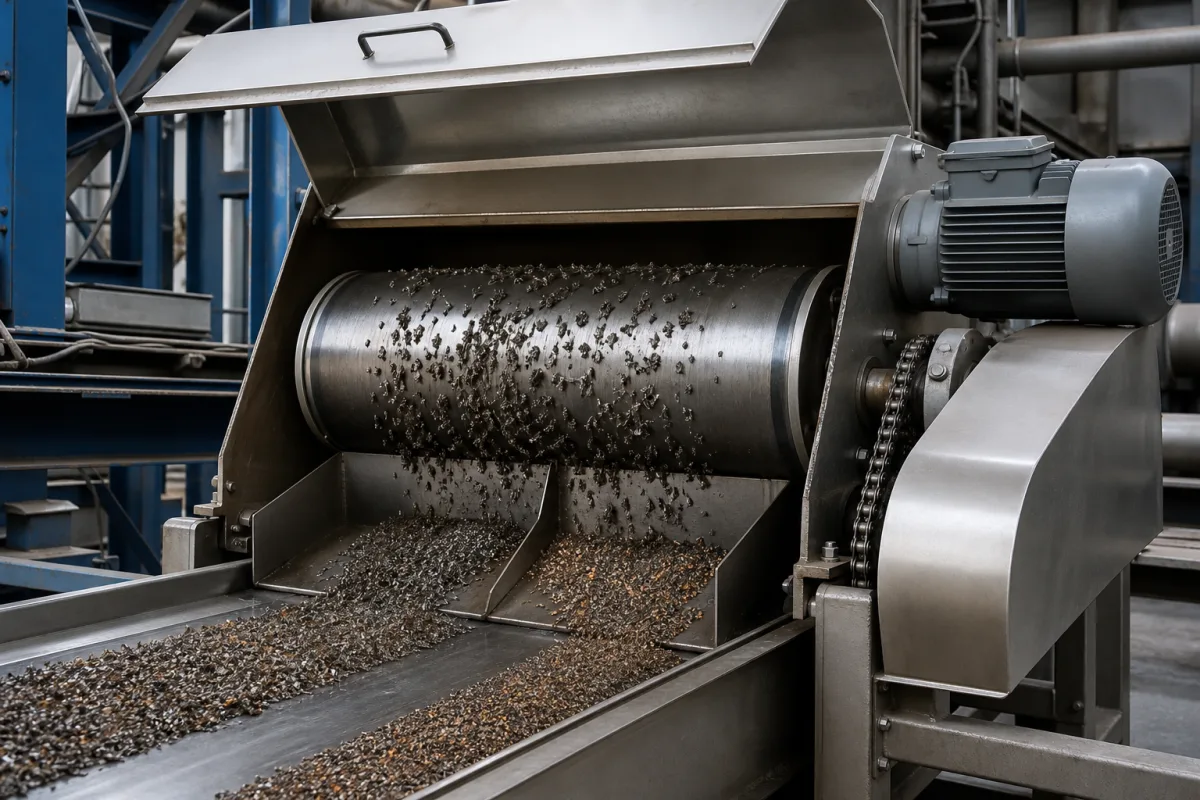
Drum separators feed material over a rotating shell with internal magnets, splitting magnetic and non-magnetic streams; suppliers linked to this page list dry and wet drum separators for minerals and recycling. Eddy-current separators, also listed, separate non-ferrous metals. [4][6][5]
03
Decide how collected iron is cleaned off
Eriez's self-cleaning suspended magnets run a short rubber belt around the magnet face to carry iron away continuously; manual-cleaning models are moved to a dump point and, for electromagnets, switched off, and are recommended where iron concentration is low or for work-hardened stainless steel. [1]
Ask the supplier how often a manual unit must be cleaned at your iron load, how the discharge is guarded, and what happens to separation if cleaning is missed.
04
Compare what suppliers offer
Suppliers linked to this page list suspended and overband magnets, drum and grate separators, dry electromagnetic separators and eddy-current separators. [3][5][6]
Great Magtech lists magnetic separator conveyors, dry electromagnetic separators and grate hopper magnets, and on a second site suspended magnets and drum separators for mining; GTEK lists overband magnets, eddy-current separators and magnetic filters; Ruijie lists magnetic and eddy-current separation for resource recovery. [3][4][5][6]
05
Trace the magnetic separator components
This is a functional reference built from the sources cited; it is not one maker's parts list.
Part
Role
Fix in the order
Magnet (permanent or electro)
Creates the field; electromagnets reach deeper and can be switched off. [1]
Magnet type, material and field at working distance.
Rotate drum or cleaning belt; suspend the magnet. [1]
Motor, reducer and mounting.
Splitter and chutes (drum types)
Separate magnetic and non-magnetic streams.
Splitter position and wear lining.
06
Fill the specification fields with values for your stream
A magnetic separator quotation needs stream-specific values. The table explains each field, gives published values where a reviewed source states them, and says what to obtain from the supplier.
Explore company information and manufacturing capabilities, then discuss the scope of your project with a relevant supplier.
Share this page
Compiled and source-reviewed by the CNFX editorial team.
Published product pages show what a company offers, not tested performance. Confirm the legal seller, factory and scope for your order. How we source and review
· Page last updated 13 October 2026
Buyer questions
Why does a magnet miss small pieces of iron?
Eriez notes small pieces of 1–2.5 cm can be very hard to remove under a deep burden, and that faster belts and deeper burdens need stronger magnets. [1]
Permanent or electromagnet?
Eriez describes permanent suspended magnets as needing no power, while suspended electromagnets have a deeper field for heavy burdens on fast belts and can be switched off for cleaning. [1]
What does a magnetic head pulley do?
It replaces the conveyor end pulley; magnets inside hold ferrous metal to the belt until it drops under the end while other material continues. [2]
Sources and what still needs a direct check
Sources checked 2026-10-11. Eriez is a magnetic separation manufacturer; its brochures describe its own products and general collection factors. Supplier pages describe their own offers. No separation standard was read for this page.