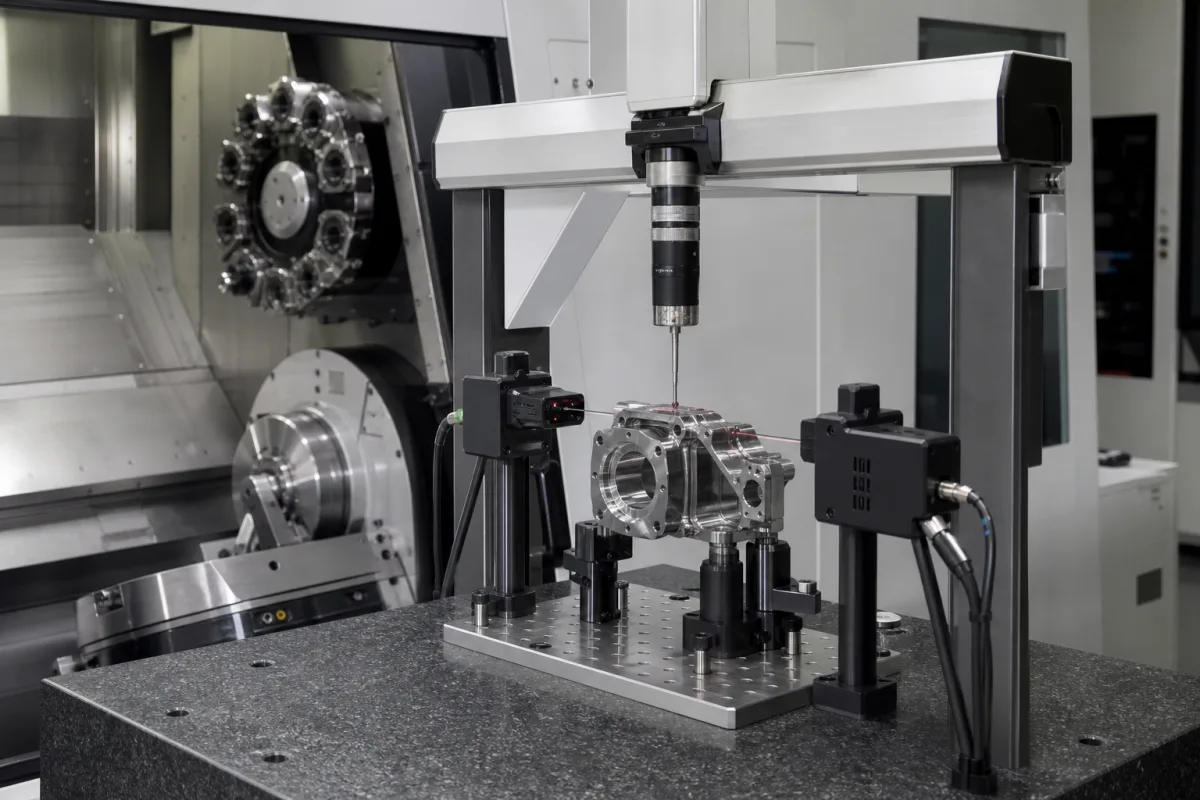
Measuring system for the shop floor: a coordinate measuring machine that keeps its accuracy beside machine tools, over 10 or 15 to 40 °C
Shop-floor coordinate measuring machines · Accuracy guaranteed from 10 or 15 °C up to 40 °C, MPE that widens with temperature, gradient limits per day, hour and metre, IP54 covers and workpiece temperature sensing beside the machine tools
This page covers shop-floor coordinate measuring machines: CMMs built to stand on the production floor beside machine tools, with structures, covers and temperature compensation that hold a stated accuracy across a wide temperature range and against dust, coolant and vibration. Ask three things first: the temperature range over which accuracy is guaranteed and the gradients allowed, the maximum permissible error at the warm end of that range as well as at 20–22 °C, and the protection class and workpiece temperature handling.
Shop-floor coordinate measuring machines for use beside production machines, with accuracy guaranteed over wide temperature ranges, thermal compensation and dust and splash protection. Bridge, gantry and Cartesian CMMs as a family are covered on the Coordinate measuring machines (CMM) page, sub-micron reference CMMs on the High-accuracy reference bridge CMM page, and touch-trigger probes on their own page. Vision measuring machines, portable measuring arms, rotary encoders and length-measuring systems on saws are outside this page.
CNFX editorial research · Sources checked October 12, 2026 · 3 sources
Accuracy guaranteed over 10–40 °C or 15–40 °C instead of a 20 °C measuring room
Mitutoyo describes its MiSTAR 555 as a shop-floor CNC CMM that can be operated next to a machine tool, with an accuracy-guaranteed temperature range of 10 to 40 °C achieved by a symmetric structure, uniform materials and temperature compensation, and a horizontal-arm design that leaves three sides open for loading parts. [2] Zeiss states that CMMs in production must withstand dust, oil, floor vibration and temperature changes with only minor effect on results, and lists its DuraMax HTG and PRISMO fortis for 15–40 °C with temperature gradients of 5 K per day, 2 K per hour and 1 K per metre. [1] Accretech, which sells the DuraMax HTG in Japan, states that the standard DuraMax is guaranteed from 18 to 30 °C and that the HTG reaches 15–40 °C by covering the body and table periphery with thermally insulating metal sheets. [3]
Give the supplier the parts, sizes and features to measure, the tolerances, the shop's temperature range and its daily and hourly swings, dust, coolant mist and floor vibration near the planned spot, the takt time, and how parts reach the machine from production.
02
MPE widens with temperature: read it at 22 °C and at 40 °C
Zeiss quotes accuracy at both ends of the range: the DuraMax HTG from 2.2 + L/300 µm at 22 °C to 3.9 + L/100 µm at 40 °C, and the PRISMO fortis from 0.7 + L/400 µm at 22 °C up to 2.7 + L/80 µm at 40 °C, with L in millimetres. [1]
Editorial calculation: over a 300 mm length, the DuraMax HTG allows 2.2 + 1.0 = 3.2 µm at 22 °C and 3.9 + 3.0 = 6.9 µm at 40 °C, more than twice as much; the PRISMO fortis allows 0.7 + 0.75 ≈ 1.5 µm at 22 °C and 2.7 + 3.75 ≈ 6.5 µm at 40 °C. A part tolerance that fits the 22 °C figure may not fit the 40 °C one. [1]
Editorial note: ask the supplier for the MPE at the hottest temperature your shop reaches, the probe used for the stated figure, and the acceptance test it will run on installation.
03
Dust and splash protection, compact layout and the workpiece's own temperature
Accretech gives the DuraMax HTG protection class IP54, dust-protected and splash-proof from all directions, improved X- and Y-axis covers and a heat-insulating body cover, a compact body with linear guides and drives, a monitor carried on an integrated arm instead of a separate PC rack, and a temperature sensor that reads the workpiece temperature automatically as a standard feature. [3] Mitutoyo adds a touch panel and a work-positioning pallet for operators at the line, and on-line monitoring of machine status and measurement data. [2]
Editorial note: a part taken warm from a machine tool expands with its own temperature; ask how the CMM's workpiece temperature reading is used in compensation and how long parts should wait before measurement.
04
Send the parts, tolerances and shop conditions together
Paste it into your enquiry below or into an email to a maker, then replace every bracket.
Parts: [size; weight; features; tolerances]
Rate: [parts per shift; takt]
Shop: [temperature range; daily and hourly swing; gradients]
Environment: [dust; coolant mist; vibration]
Accuracy: [MPE at 20–22 °C and at the warm end]
Integration: [loading; pallet; data to production]
Explore company information and manufacturing capabilities, then discuss the scope of your project with a relevant supplier.
Share this page
Compiled and source-reviewed by the CNFX editorial team.
Each manufacturer above links to the page on that company's own website where the product is listed, with the date we checked it. How we source and review
· Page last updated 13 October 2026
Buyer questions
What temperature range can a shop-floor CMM work in?
Mitutoyo guarantees the MiSTAR 555 from 10 to 40 °C; Zeiss lists its DuraMax HTG and PRISMO fortis for 15–40 °C with gradient limits of 5 K/day, 2 K/h and 1 K/m. [2][1]
How much does a shop-floor CMM's accuracy change with temperature?
Zeiss gives the DuraMax HTG 2.2 + L/300 µm at 22 °C and 3.9 + L/100 µm at 40 °C; over 300 mm that is about 3.2 µm against 6.9 µm (editorial calculation). [1]
How is a shop-floor CMM protected against dust and coolant?
Accretech gives the Zeiss DuraMax HTG protection class IP54, with insulated covers on the body and axes. [3]
Sources and what still needs a direct check
Sources checked 2026-10-12. Zeiss and Mitutoyo describe their own shop-floor CMMs; Accretech describes the Zeiss DuraMax HTG it sells.