Industry-Verified Manufacturing Data (2026)

Encoder

Based on aggregated insights from multiple verified factory profiles within the CNFX directory, the standard Encoder used in the Machinery and Equipment Manufacturing sector typically supports operational capacities ranging from standard industrial configurations to heavy-duty production requirements.

Technical Definition & Core Assembly

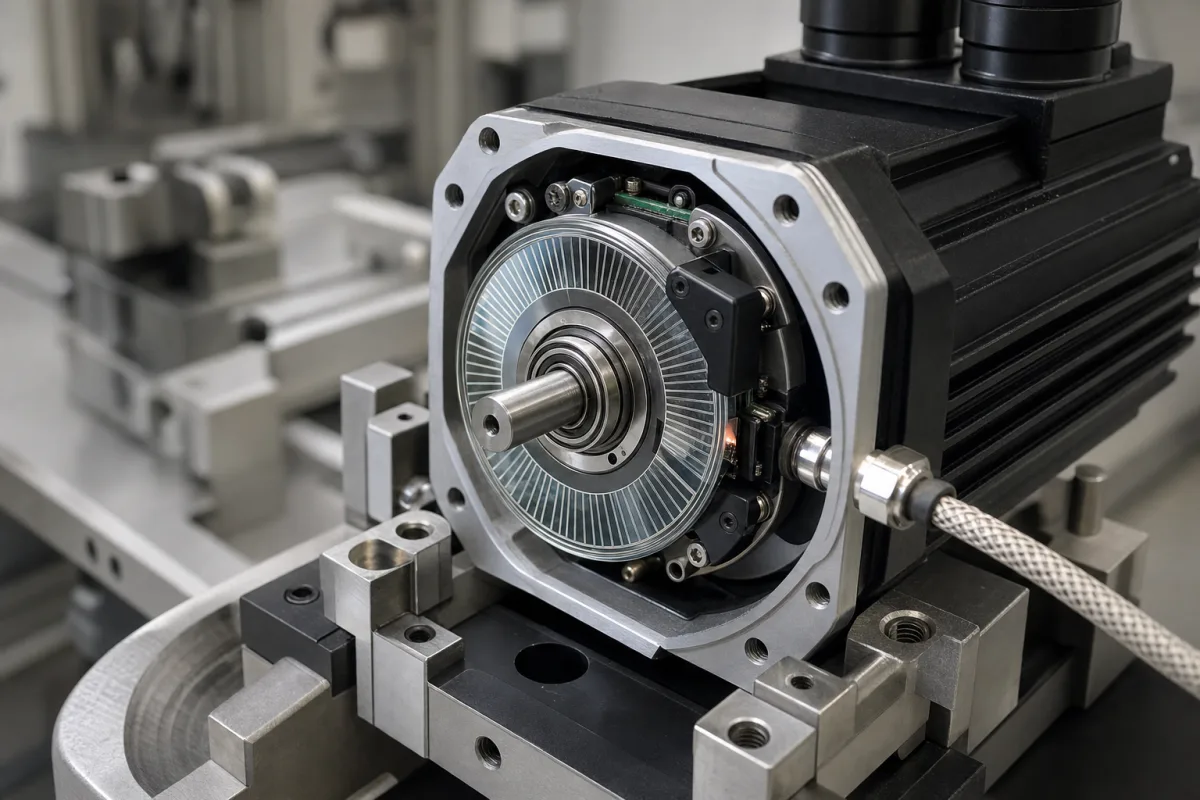
A canonical Encoder is characterized by the integration of Code disk and Light source/LED. In industrial production environments, manufacturers listed on CNFX commonly emphasize Aluminum alloy construction to support stable, high-cycle operation across diverse manufacturing scenarios.

A device that converts mechanical motion into electrical signals to measure position, speed, or direction in servo/stepper motor systems.
Product Specifications

Technical details and manufacturing context for Encoder

Definition
An encoder is a critical feedback component in servo and stepper motor systems that provides precise position, velocity, and direction information by converting the mechanical rotation or linear motion of the motor shaft into corresponding digital or analog electrical signals. This feedback enables closed-loop control systems to achieve accurate positioning, speed regulation, and motion synchronization in industrial automation applications.
Working Principle
Encoders work by using optical, magnetic, or capacitive sensing methods to detect position changes. In rotary encoders, a patterned disk attached to the motor shaft rotates between a light source and photodetectors (optical) or between magnets and Hall-effect sensors (magnetic). As the disk rotates, the pattern interruptions create pulse signals that are counted and processed to determine position, speed, and direction of rotation.
Common Materials
Aluminum alloy, Stainless steel, Optical glass, Printed circuit board, Magnetic materials
Technical Parameters
  • Resolution measured in pulses per revolution (PPR), indicating the number of discrete positions the encoder can detect in one complete rotation (pulses/revolution) Per Request
Components / BOM
  • Code disk
    Patterned disk that creates optical or magnetic interruptions for position detection
    Material: Optical glass or magnetic alloy
  • Light source/LED
    Emits light for optical encoders to detect code disk patterns
    Material: Semiconductor materials
  • Photodetector array
    Detects light interruptions from code disk and converts to electrical signals
    Material: Silicon photodiodes
  • Shaft and bearings
    Mechanical interface for connecting to motor shaft with minimal friction
    Material: Stainless steel
  • Signal processing circuit
    Processes raw sensor signals into usable position data
    Material: Printed circuit board with integrated circuits
Engineering Reasoning
0-10000 RPM rotational speed, -40°C to 85°C ambient temperature, 4.75-5.25 VDC supply voltage
Exceeding 12000 RPM causes centrifugal force > 1500 g, operating above 100°C causes thermal expansion > 15 μm in bearing clearance, voltage spikes > 7 VDC damage CMOS circuitry
Design Rationale: Centrifugal force exceeding yield strength of encoder disk mounting (σ_yield = 250 MPa), differential thermal expansion between glass scale (α=8.5×10⁻⁶/K) and aluminum housing (α=23×10⁻⁶/K) causing optical misalignment, electrostatic discharge > 2000 V damaging photodiode junctions
Risk Mitigation (FMEA)
Trigger Contaminant ingress (particles > 5 μm) into optical path
Mode: Signal amplitude reduction below 0.5 Vpp threshold
Strategy: IP67-rated sealing with double-lip labyrinth seals and positive pressure purge system
Trigger Bearing lubrication degradation at temperatures > 80°C
Mode: Radial runout exceeding 15 μm causing quadrature signal distortion
Strategy: Ceramic hybrid bearings with perfluoropolyether grease rated for 150°C continuous operation

Industry Taxonomies & Aliases

Commonly used trade names and technical identifiers for Encoder.

Applied To / Applications

This component is essential for the following industrial systems and equipment:

Industrial Ecosystem & Supply Chain DNA

Complementary Systems
Downstream Applications
Specialized Tooling

Application Fit & Sizing Matrix

Operational Limits
pressure: Atmospheric to 1.5 bar (typical sealed units)
other spec: Vibration: 10g (5-2000 Hz), Shock: 100g (11ms), IP rating: IP64/IP67 (depending on model)
temperature: -40°C to +85°C (operating), -55°C to +125°C (storage)
Media Compatibility
✓ Clean industrial air environments ✓ Non-corrosive oil mist (with proper sealing) ✓ Dry particulate environments (with IP67 rating)
Unsuitable: High-pressure washdown or submerged conditions without proper IP68/IP69K rating
Sizing Data Required
  • Required resolution (bits or pulses per revolution)
  • Maximum rotational speed (RPM)
  • Shaft size and mounting configuration

Reliability & Engineering Risk Analysis

Failure Mode & Root Cause
Signal degradation or loss
Cause: Contamination ingress (dust, oil, moisture) compromising optical/electrical components, or wear/damage to code disc/scale from particulate abrasion
Mechanical binding or misalignment
Cause: Bearing failure due to improper lubrication, excessive axial/radial load, or thermal expansion causing shaft/bushing seizure; mounting misalignment inducing eccentric wear
Maintenance Indicators
  • Intermittent or erratic output signals (e.g., skipped counts, signal dropout) during operation
  • Audible grinding, scraping, or increased rotational resistance from the encoder assembly
Engineering Tips
  • Implement IP-rated sealing or purge systems (e.g., IP67+ enclosures, nitrogen purge) matched to the environment, and conduct regular cleaning of optical/magnetic sensing surfaces with approved solvents
  • Use precision alignment tools during installation, apply manufacturer-specified lubrication intervals with compatible greases, and install flexible couplings to absorb shaft misalignment/vibration

Compliance & Manufacturing Standards

Reference Standards
ISO 9001:2015 - Quality Management Systems IEC 60068-2-6:2007 - Environmental Testing - Vibration DIN 19233:2016 - Industrial Process Control - Encoder Characteristics
Manufacturing Precision
  • Shaft Runout: +/-0.01mm
  • Mounting Face Flatness: 0.005mm
Quality Inspection
  • IP67/IP69K Environmental Seal Test
  • Signal Accuracy Verification via Laser Interferometer

Factories Producing Encoder

Verified manufacturers with capability to produce this product in China

✓ 96% Supplier Capability Match Found

T Technical Director from Australia Feb 03, 2026
★★★★★
"Standard OEM quality for Machinery and Equipment Manufacturing applications. The Encoder arrived with full certification."
Technical Specifications Verified
P Project Engineer from Singapore Jan 31, 2026
★★★★☆
"Great transparency on the Encoder components. Essential for our Machinery and Equipment Manufacturing supply chain. (Delivery took slightly longer than expected, but technical support was excellent.)"
Technical Specifications Verified
S Sourcing Manager from Germany Jan 28, 2026
★★★★★
"The Encoder we sourced perfectly fits our Machinery and Equipment Manufacturing production line requirements."
Technical Specifications Verified
Verification Protocol

“Feedback is collected from verified sourcing managers during RFQ (Request for Quote) and factory evaluation processes on CNFX. These reports represent historical performance data and technical audit summaries from our B2B manufacturing network.”

19 sourcing managers are analyzing this specification now. Last inquiry for Encoder from Vietnam (1h ago).

Supply Chain Compatible Machinery & Devices

Automated Assembly Line System

Integrated production system for sequential component assembly operations

Explore Specs →
Automated Powder Coating System

Integrated industrial system for applying dry powder coatings to metal substrates.

Explore Specs →
Centrifugal Pump Impeller

Rotating component that transfers energy to fluid in centrifugal pumps.

Explore Specs →
High-Precision CNC Laser Cutting Machine

Computer-controlled industrial machine using focused laser beams to cut sheet metal with micron-level accuracy.

Explore Specs →

Frequently Asked Questions

What are the main applications of this encoder in machinery manufacturing?

This encoder is primarily used for precise position, speed, and direction measurement in servo and stepper motor systems across various industrial machinery, including CNC machines, robotics, conveyor systems, and automated manufacturing equipment.

How does the optical vs. magnetic encoder technology differ in this product?

Our encoders utilize both technologies: optical encoders use a code disk with optical glass and photodetectors for extremely high resolution, while magnetic encoders employ magnetic materials and sensors for durability in harsh environments with dust, moisture, or vibration.

What maintenance is required for these industrial encoders?

These encoders are designed for minimal maintenance with sealed aluminum alloy housings and stainless steel components. Regular cleaning of optical surfaces and periodic bearing inspection are recommended, with typical service life exceeding 50,000 hours in industrial environments.

Can I contact factories directly on CNFX?

CNFX is an open directory, not a transaction platform. Each factory profile provides direct contact information and production details to help you initiate direct inquiries with Chinese suppliers.

Get Quote for Encoder

Request technical pricing, lead times, or customized specifications for Encoder directly from verified manufacturing units.

Your business information is encrypted and only shared with verified Encoder suppliers.

Thank you! Your message has been sent. We'll respond within 1–3 business days.

Need to Manufacture Encoder?

Connect with verified factories specializing in this product category

Add Your Factory Contact Us
Previous Product
Emitter Unit
Next Product
Encoder (Servo)