Industry-Verified Manufacturing Data (2026)

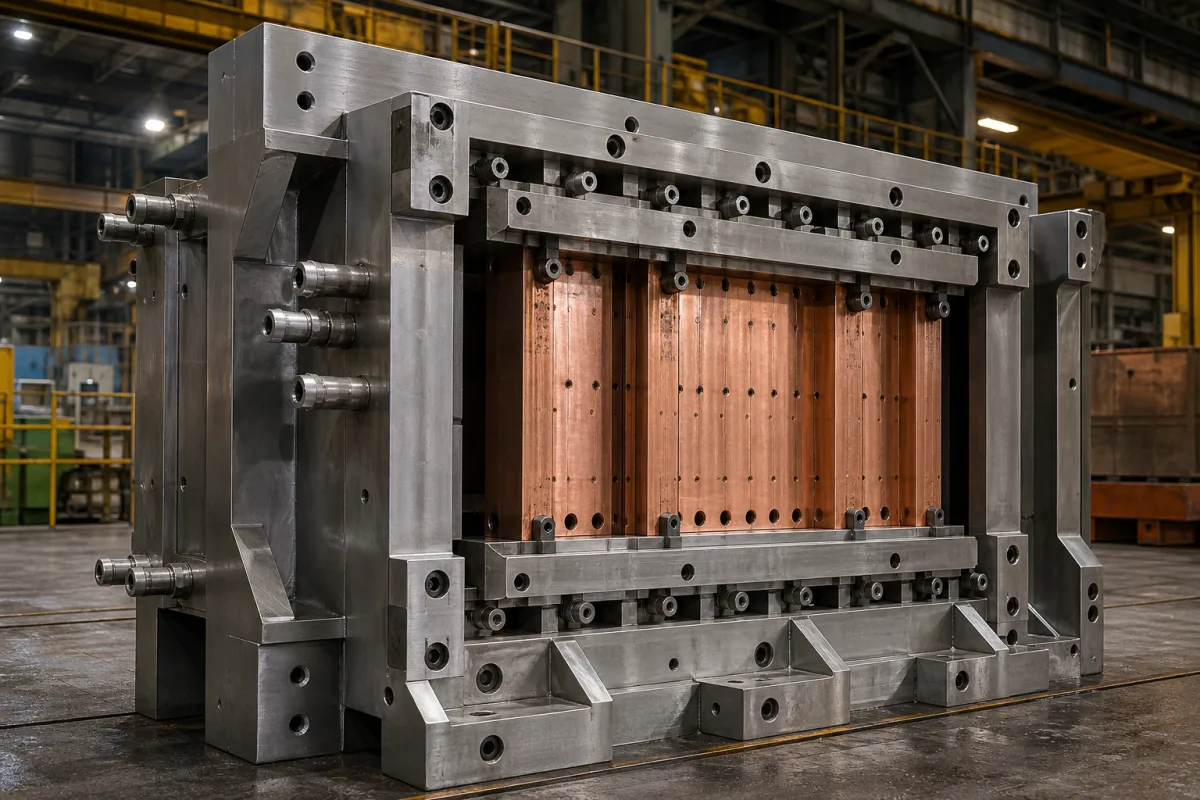
Mold Backplate / Support Structure

Based on aggregated insights from multiple verified factory profiles within the CNFX directory, the standard Mold Backplate / Support Structure used in the Machinery and Equipment Manufacturing sector typically supports operational capacities ranging from standard industrial configurations to heavy-duty production requirements.

Technical Definition & Core Assembly

A canonical Mold Backplate / Support Structure is characterized by the integration of Mounting Holes and Cooling Channel Mounts. In industrial production environments, manufacturers listed on CNFX commonly emphasize Carbon Steel construction to support stable, high-cycle operation across diverse manufacturing scenarios.

Structural component providing rigidity and mounting support for water-cooled copper mold assemblies
Product Specifications

Technical details and manufacturing context for Mold Backplate / Support Structure

Definition
A critical structural element in water-cooled copper mold systems that serves as the foundational mounting platform and reinforcement structure. It provides mechanical stability, ensures proper alignment of mold components, and withstands operational stresses during continuous casting or molding processes. The backplate/support structure maintains dimensional accuracy and prevents deformation under thermal cycling and mechanical loads.
Working Principle
The backplate/support structure functions as the primary load-bearing framework for the water-cooled copper mold assembly. It distributes mechanical forces evenly across the mold system, provides secure mounting points for cooling channels and mold plates, and maintains structural integrity during thermal expansion and contraction cycles. By offering rigid support, it ensures consistent mold geometry and prevents warping that could affect product quality.
Common Materials
Carbon Steel, Alloy Steel, Stainless Steel
Technical Parameters
  • Overall dimensions including thickness, width, and length; mounting hole patterns and locations; flatness tolerance; load-bearing capacity (mm) Per Request
Components / BOM
  • Mounting Holes
    Provide attachment points for securing the backplate to the mold assembly frame and connecting other components
    Material: Same as base material
  • Cooling Channel Mounts
    Interface points for connecting water cooling system pipes and manifolds to the copper mold
    Material: Steel with corrosion-resistant coating
  • Alignment Features
    Precision machined surfaces and reference edges that ensure proper positioning of mold components
    Material: Hardened steel
  • Reinforcement Ribs
    Structural elements that increase rigidity and prevent bending or twisting under load
    Material: Same as base material
Engineering Reasoning
0-150 MPa compressive stress, 20-300°C temperature, 0.1-1.0 mm deflection tolerance
Yield strength exceedance at 250 MPa (AISI 4140 steel), thermal distortion beyond 1.5 mm at 350°C, fatigue crack initiation at 10^6 cycles under 180 MPa alternating stress
Design Rationale: Thermal-mechanical fatigue from cyclic heating (300°C) and cooling (50°C) during casting cycles, stress concentration at bolt holes (Kt=3.2), creep deformation above 0.4Tm (Tm=melting point)
Risk Mitigation (FMEA)
Trigger Thermal gradient exceeding 250°C across plate thickness during casting cycle
Mode: Warpage-induced mold misalignment exceeding 0.5 mm, causing slab surface defects
Strategy: Optimized cooling channel layout with 15 mm pitch spacing, thermal barrier coating (ZrO2) on hot face
Trigger Resonant vibration at 85-120 Hz from strand oscillation system
Mode: Fatigue cracking at stress concentration points, bolt loosening with 0.3 mm play
Strategy: Dynamic stiffness tuning with rib reinforcement (30 mm thickness), vibration dampers with 0.15 damping ratio

Industry Taxonomies & Aliases

Commonly used trade names and technical identifiers for Mold Backplate / Support Structure.

Applied To / Applications

This component is essential for the following industrial systems and equipment:

Industrial Ecosystem & Supply Chain DNA

Complementary Systems
Downstream Applications
Specialized Tooling

Application Fit & Sizing Matrix

Operational Limits
pressure: 0 to 10 bar (operating), 15 bar (max burst)
flow rate: Up to 200 L/min per cooling circuit
temperature: -20°C to 150°C (operating), -40°C to 200°C (peak)
slurry concentration: Up to 40% solids by weight (non-abrasive)
Media Compatibility
✓ Industrial water/glycol mixtures ✓ Hydraulic oil systems ✓ Non-corrosive process fluids
Unsuitable: Chlorinated or highly acidic environments (pH < 4)
Sizing Data Required
  • Mold assembly weight and dimensions
  • Required cooling circuit count and layout
  • Maximum expected thermal load (kW)

Reliability & Engineering Risk Analysis

Failure Mode & Root Cause
Fatigue cracking
Cause: Cyclic thermal and mechanical stresses from mold heating/cooling cycles and clamping forces, leading to crack initiation and propagation at stress concentrators like bolt holes or sharp corners.
Distortion/warping
Cause: Uneven thermal expansion due to non-uniform heating or cooling, or residual stresses from improper machining/heat treatment, causing loss of dimensional stability and alignment.
Maintenance Indicators
  • Visible cracks or surface crazing around bolt holes, edges, or high-stress areas
  • Audible creaking or popping sounds during mold clamping or temperature cycling
Engineering Tips
  • Implement controlled heating/cooling rates and uniform temperature distribution during operation to minimize thermal gradients and stress concentrations.
  • Apply periodic non-destructive testing (e.g., dye penetrant or ultrasonic inspection) at high-stress locations to detect early-stage cracks before catastrophic failure.

Compliance & Manufacturing Standards

Reference Standards
ISO 9001:2015 - Quality Management Systems ASTM A36/A36M - Standard Specification for Carbon Structural Steel CE Marking - EU Machinery Directive 2006/42/EC
Manufacturing Precision
  • Flatness: ≤0.1mm per 1000mm
  • Bore diameter tolerance: H7/g6 (ISO 286-2)
Quality Inspection
  • Dimensional Verification with CMM (Coordinate Measuring Machine)
  • Magnetic Particle Inspection (ASTM E1444/E1444M)

Factories Producing Mold Backplate / Support Structure

Verified manufacturers with capability to produce this product in China

✓ 95% Supplier Capability Match Found

P Project Engineer from Brazil Jan 01, 2026
★★★★★
"Found 19+ suppliers for Mold Backplate / Support Structure on CNFX, but this spec remains the most cost-effective."
Technical Specifications Verified
S Sourcing Manager from Canada Dec 29, 2025
★★★★★
"The technical documentation for this Mold Backplate / Support Structure is very thorough, especially regarding technical reliability."
Technical Specifications Verified
P Procurement Specialist from United States Dec 26, 2025
★★★★★
"Reliable performance in harsh Machinery and Equipment Manufacturing environments. No issues with the Mold Backplate / Support Structure so far."
Technical Specifications Verified
Verification Protocol

“Feedback is collected from verified sourcing managers during RFQ (Request for Quote) and factory evaluation processes on CNFX. These reports represent historical performance data and technical audit summaries from our B2B manufacturing network.”

7 sourcing managers are analyzing this specification now. Last inquiry for Mold Backplate / Support Structure from Thailand (1h ago).

Supply Chain Compatible Machinery & Devices

Automated Assembly Line System

Integrated production system for sequential component assembly operations

Explore Specs →
Automated Powder Coating System

Integrated industrial system for applying dry powder coatings to metal substrates.

Explore Specs →
Centrifugal Pump Impeller

Rotating component that transfers energy to fluid in centrifugal pumps.

Explore Specs →
High-Precision CNC Laser Cutting Machine

Computer-controlled industrial machine using focused laser beams to cut sheet metal with micron-level accuracy.

Explore Specs →

Frequently Asked Questions

What materials are used for mold backplates in heavy machinery?

Mold backplates are typically manufactured from carbon steel, alloy steel, or stainless steel to provide the necessary strength, durability, and corrosion resistance for industrial applications.

How does a mold backplate improve mold assembly performance?

The backplate provides structural rigidity, precise alignment through features, secure mounting via holes, and supports cooling channel integration, ensuring stable and efficient mold operation.

What are the key components of a mold support structure BOM?

A complete bill of materials includes alignment features for precision, cooling channel mounts for temperature control, mounting holes for secure installation, and reinforcement ribs for added strength.

Can I contact factories directly on CNFX?

CNFX is an open directory, not a transaction platform. Each factory profile provides direct contact information and production details to help you initiate direct inquiries with Chinese suppliers.

Get Quote for Mold Backplate / Support Structure

Request technical pricing, lead times, or customized specifications for Mold Backplate / Support Structure directly from verified manufacturing units.

Your business information is encrypted and only shared with verified Mold Backplate / Support Structure suppliers.

Thank you! Your message has been sent. We'll respond within 1–3 business days.

Need to Manufacture Mold Backplate / Support Structure?

Connect with verified factories specializing in this product category

Add Your Factory Contact Us
Previous Product
Moisture Separator
Next Product
Mold Box Clamping System