Industry-Verified Manufacturing Data (2026)

Water-Cooled Copper Mold

Based on aggregated insights from multiple verified factory profiles within the CNFX directory, the standard Water-Cooled Copper Mold used in the Basic Metal Manufacturing sector typically supports operational capacities ranging from standard industrial configurations to heavy-duty production requirements.

Technical Definition & Core Assembly

A canonical Water-Cooled Copper Mold is characterized by the integration of Copper Plate / Liner and Water Jacket / Cooling Channel System. In industrial production environments, manufacturers listed on CNFX commonly emphasize Copper (often with chromium or silver alloying) construction to support stable, high-cycle operation across diverse manufacturing scenarios.

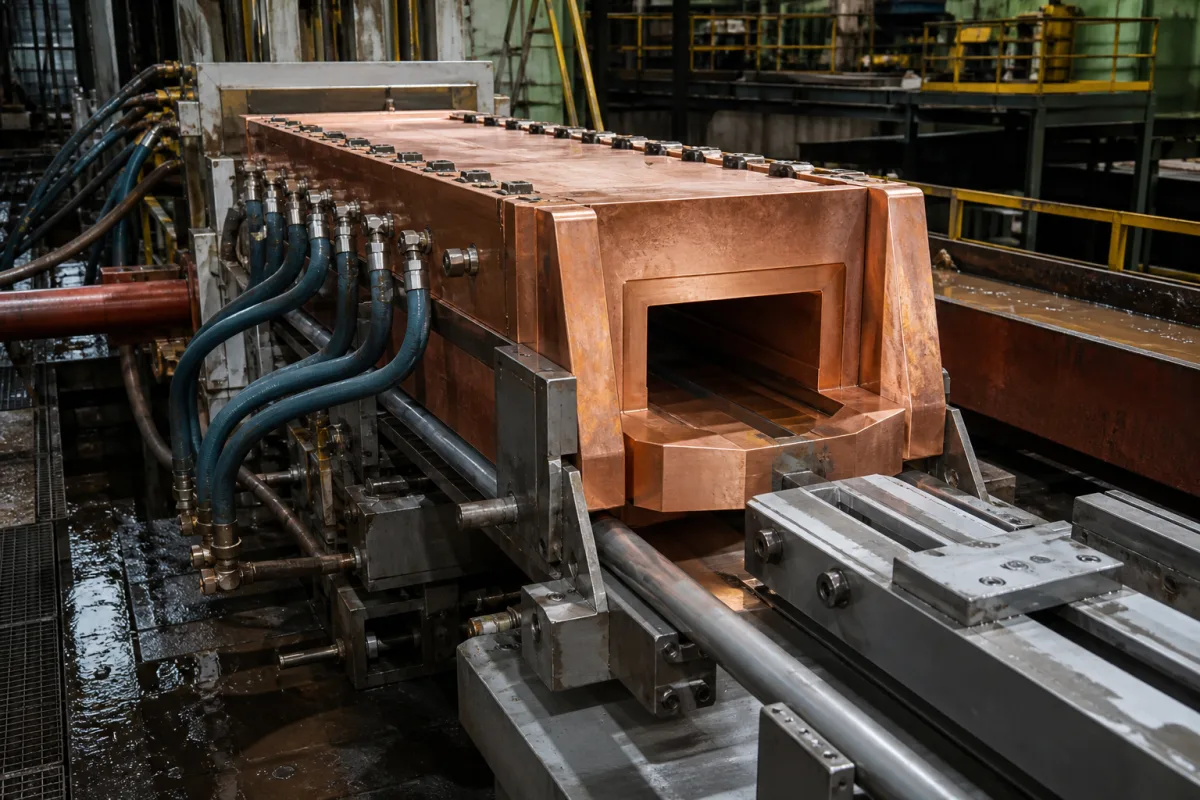
A copper mold with internal water cooling channels used in continuous casting to solidify molten steel into a specific cross-sectional shape.
Product Specifications

Technical details and manufacturing context for Water-Cooled Copper Mold

Definition
A critical component in the continuous casting system of integrated steelmaking, the water-cooled copper mold receives molten steel from the tundish and initiates solidification through rapid heat extraction via internal water circulation. It forms the initial solidified shell that maintains the desired cross-section (e.g., slab, bloom, billet) as the strand moves downward, ensuring dimensional accuracy and surface quality before entering the secondary cooling zone.
Working Principle
Molten steel flows into the mold cavity from the tundish. Copper's high thermal conductivity, combined with pressurized water circulating through channels within the mold walls, rapidly extracts heat from the steel. This causes a thin, solidified shell to form against the mold walls. The shell thickens as it descends, supported by the mold until it is strong enough to exit and enter secondary cooling. Oscillation of the mold prevents sticking and facilitates smooth strand withdrawal.
Common Materials
Copper (often with chromium or silver alloying), Stainless Steel (for structural components/backplate)
Technical Parameters
  • Mold internal dimensions (width, thickness) defining the final product cross-section (e.g., slab: 1500x250mm). (mm) Standard Spec
Components / BOM
  • Copper Plate / Liner
    Forms the primary heat-transfer surface in contact with molten steel. Contains water channels.
    Material: Copper alloy (e.g., CuCrZr, CuAg)
  • Water Jacket / Cooling Channel System
    Network of machined passages within the copper plate for pressurized water circulation.
    Material: Integral to copper plate
  • Mold Backplate / Support Structure
    Provides structural rigidity, houses water inlet/outlet manifolds, and attaches to the oscillator.
    Material: Stainless steel
  • Water Inlet/Outlet Manifolds
    Distribute and collect cooling water to/from the channel system.
    Material: Stainless steel
Engineering Reasoning
0.8-2.5 MPa (8-25 bar) water pressure, 15-35°C inlet temperature, 0.5-3.0 m/s water velocity
Copper temperature exceeds 350°C (recrystallization threshold), water pressure drops below 0.5 MPa (5 bar) causing flow separation, thermal gradient exceeds 200°C/cm across mold wall
Design Rationale: Thermal fatigue from cyclic stress (Δσ > 150 MPa) due to 1200°C molten steel contact alternating with 30°C cooling water, causing crack initiation at grain boundaries; cavitation erosion when local pressure drops below water vapor pressure (2.34 kPa at 20°C) in high-velocity zones
Risk Mitigation (FMEA)
Trigger Calcium aluminosilicate inclusion buildup (0.1-0.5 mm thickness) on copper surface
Mode: Thermal resistance increase (0.001-0.005 m²·K/W) causing local copper temperature rise to 400°C
Strategy: Periodic electromagnetic stirring (50-100 Hz, 0.1-0.3 T) to prevent inclusion adhesion, mold powder optimization (viscosity 0.1-0.3 Pa·s at 1300°C)
Trigger Water channel scaling (CaCO₃ deposition > 0.2 mm thickness) reducing heat transfer coefficient by 15-30%
Mode: Localized boiling at copper-water interface creating vapor blanket (thermal conductivity 0.02 W/m·K vs water's 0.6 W/m·K)
Strategy: Deionized water treatment (conductivity < 5 μS/cm), periodic citric acid cleaning (3-5% concentration, 50-60°C, 4-6 hour cycles)

Industry Taxonomies & Aliases

Commonly used trade names and technical identifiers for Water-Cooled Copper Mold.

Applied To / Applications

This component is essential for the following industrial systems and equipment:

Industrial Ecosystem & Supply Chain DNA

Complementary Systems
Downstream Applications
Specialized Tooling

Application Fit & Sizing Matrix

Operational Limits
pressure: Max water pressure: 10-15 bar, typical operating: 4-8 bar
flow rate: Water flow: 100-500 L/min per meter of mold length
temperature: Operating: 20-80°C, Molten steel contact: up to 1600°C (surface)
slurry concentration: Not applicable (clean water systems only)
Media Compatibility
✓ Continuous casting of carbon steels ✓ Continuous casting of low-alloy steels ✓ Clean, treated cooling water systems
Unsuitable: High-chloride or acidic cooling water environments
Sizing Data Required
  • Required casting cross-section dimensions (width x thickness)
  • Desired casting speed (m/min)
  • Required cooling capacity (kW) based on steel grade and throughput

Reliability & Engineering Risk Analysis

Failure Mode & Root Cause
Thermal fatigue cracking
Cause: Repeated heating and cooling cycles from molten metal contact and water cooling, leading to stress concentration and crack initiation at grain boundaries.
Corrosion and scaling
Cause: Chemical attack from water impurities (chlorides, sulfates) and oxidation from high-temperature exposure, reducing heat transfer efficiency and structural integrity.
Maintenance Indicators
  • Visible surface cracks or discoloration on the copper mold face
  • Abnormal water flow fluctuations or audible water hammering in cooling channels
Engineering Tips
  • Implement strict water quality control with pH monitoring and chemical treatment to prevent scaling and corrosion in cooling channels
  • Apply protective coatings or surface treatments to the copper mold face to enhance thermal fatigue resistance and reduce oxidation

Compliance & Manufacturing Standards

Reference Standards
ISO 9001:2015 - Quality Management Systems ASTM B152/B152M - Standard Specification for Copper Sheet, Strip, Plate, and Rolled Bar EN 10204:2004 - Metallic Products - Types of Inspection Documents
Manufacturing Precision
  • Bore Diameter: +/-0.02mm
  • Surface Flatness: 0.1mm per 300mm length
Quality Inspection
  • Dye Penetrant Test for surface defects
  • Hydrostatic Pressure Test for cooling channel integrity

Factories Producing Water-Cooled Copper Mold

Verified manufacturers with capability to produce this product in China

✓ 94% Supplier Capability Match Found

P Project Engineer from United Arab Emirates Jan 29, 2026
★★★★★
"Great transparency on the Water-Cooled Copper Mold components. Essential for our Basic Metal Manufacturing supply chain."
Technical Specifications Verified
S Sourcing Manager from Australia Jan 26, 2026
★★★★★
"The Water-Cooled Copper Mold we sourced perfectly fits our Basic Metal Manufacturing production line requirements."
Technical Specifications Verified
P Procurement Specialist from Singapore Jan 23, 2026
★★★★★
"Found 11+ suppliers for Water-Cooled Copper Mold on CNFX, but this spec remains the most cost-effective."
Technical Specifications Verified
Verification Protocol

“Feedback is collected from verified sourcing managers during RFQ (Request for Quote) and factory evaluation processes on CNFX. These reports represent historical performance data and technical audit summaries from our B2B manufacturing network.”

9 sourcing managers are analyzing this specification now. Last inquiry for Water-Cooled Copper Mold from USA (1h ago).

Supply Chain Compatible Machinery & Devices

Electromagnetic Induction Heater

Industrial heating device using electromagnetic induction for metal processing

Explore Specs →
Vacuum Induction Melting Furnace

Industrial furnace for melting metals under vacuum using electromagnetic induction

Explore Specs →
Electroslag Remelting Furnace

Secondary refining furnace for high-quality metal ingots

Explore Specs →
Molten Metal Flow Control Valve

Precision valve for regulating molten metal flow in casting and pouring operations.

Explore Specs →

Frequently Asked Questions

What are the advantages of water-cooled copper molds in continuous casting?

Water-cooled copper molds provide rapid and uniform heat extraction, ensuring consistent solidification of molten steel, reducing defects, and extending mold life through efficient cooling.

What materials are typically used in water-cooled copper molds?

The primary material is copper, often alloyed with chromium or silver for enhanced thermal conductivity and durability, while stainless steel is used for structural components like backplates and support structures.

How does the water cooling system work in these molds?

The system features internal water channels or jackets that circulate cooling water through the mold, absorbing heat from the molten steel to control solidification rates and maintain optimal casting conditions.

Can I contact factories directly on CNFX?

CNFX is an open directory, not a transaction platform. Each factory profile provides direct contact information and production details to help you initiate direct inquiries with Chinese suppliers.

Get Quote for Water-Cooled Copper Mold

Request technical pricing, lead times, or customized specifications for Water-Cooled Copper Mold directly from verified manufacturing units.

Your business information is encrypted and only shared with verified Water-Cooled Copper Mold suppliers.

Thank you! Your message has been sent. We'll respond within 1–3 business days.

Need to Manufacture Water-Cooled Copper Mold?

Connect with verified factories specializing in this product category

Add Your Factory Contact Us
Previous Product
Water Jacket / Cooling System
Next Product
Water-Cooled Crucible