Industry-Verified Manufacturing Data (2026)

Mold Box Clamping System

Based on aggregated insights from multiple verified factory profiles within the CNFX directory, the standard Mold Box Clamping System used in the Machinery and Equipment Manufacturing sector typically supports operational capacities ranging from standard industrial configurations to heavy-duty production requirements.

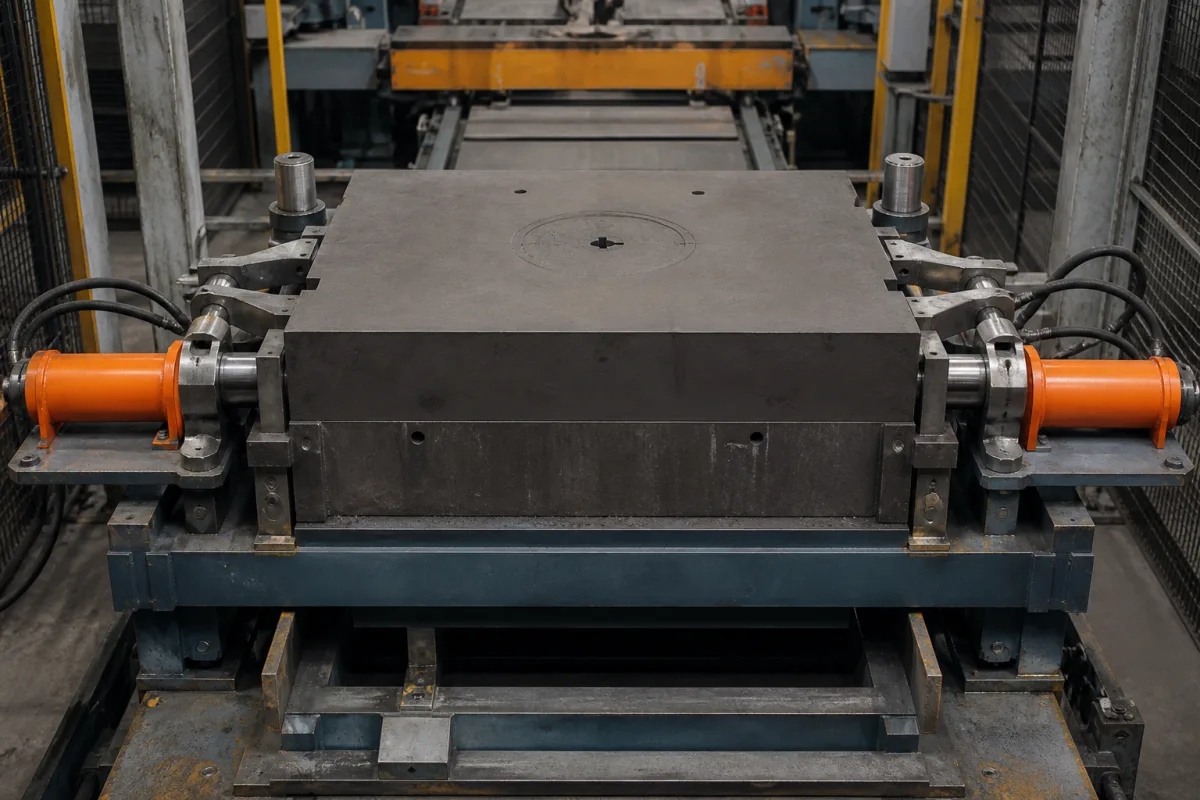
Technical Definition & Core Assembly

A canonical Mold Box Clamping System is characterized by the integration of Clamping Cylinder / Actuator and Clamping Arm / Plate. In industrial production environments, manufacturers listed on CNFX commonly emphasize Carbon Steel construction to support stable, high-cycle operation across diverse manufacturing scenarios.

A mechanical system that securely holds and aligns the cope and drag mold boxes during the sand molding process.

Product Specifications

Technical details and manufacturing context for Mold Box Clamping System

Definition
The Mold Box Clamping System is a critical component of a Sand Molding Machine, responsible for applying precise and uniform clamping force to the upper (cope) and lower (drag) halves of the mold box. This ensures the boxes remain perfectly aligned and sealed during the crucial stages of pattern removal, sand compaction, and mold handling, preventing sand spillage, mold shift, and ensuring dimensional accuracy of the final casting.
Working Principle
The system typically uses hydraulic or pneumatic cylinders, mechanical toggle clamps, or screw mechanisms to generate clamping force. Actuators apply pressure to clamping arms or plates that engage with the mold box flanges. A control system manages the clamping sequence, force application, and release, often integrating with the overall machine cycle for automated operation.
Common Materials
Carbon Steel, Alloy Steel
Technical Parameters
  • Maximum Clamping Force (kN) Customizable
Components / BOM
  • Clamping Cylinder / Actuator
    Generates the linear force required for clamping.
    Material: Steel, Seals (Rubber/Polyurethane)
  • Clamping Arm / Plate
    Directly interfaces with the mold box flanges to apply and distribute the clamping force.
    Material: Alloy Steel
  • Guide Rails / Columns
    Ensures precise, linear motion and alignment of the clamping mechanism.
    Material: Hardened Steel
  • Force Sensor / Pressure Gauge
    Monitors and provides feedback on the applied clamping force.
    Material: Steel, Electronic Components
  • Control Valve Manifold
    Directs hydraulic/pneumatic fluid to control the clamping sequence (extend, hold, retract).
    Material: Aluminum, Steel, Seals
Engineering Reasoning
15-80 bar hydraulic pressure, 0.02-0.05 mm alignment tolerance, 20-150 kN clamping force
Hydraulic pressure exceeding 85 bar causes seal extrusion, alignment deviation beyond 0.08 mm creates mold mismatch, clamping force below 18 kN allows mold separation during pouring
Design Rationale: Seal failure occurs via extrusion when hydraulic pressure exceeds the seal material's yield strength (typically 25 MPa for HNBR). Mold mismatch results from cumulative tolerance stack-up exceeding the sand mold's elastic deformation limit (approximately 0.1% strain). Insufficient clamping force allows mold separation when molten metal pressure (approximately 0.2-0.4 MPa) exceeds the friction force between mold halves.
Risk Mitigation (FMEA)
Trigger Hydraulic fluid contamination with particulate matter exceeding ISO 4406 18/16/13 cleanliness level
Mode: Spool valve sticking in directional control valve causing incomplete clamping cylinder extension
Strategy: Install dual 3-micron absolute filtration with pressure differential monitoring and automatic bypass at 2 bar ΔP
Trigger Thermal expansion differential between cast iron mold boxes (α=11.0×10⁻⁶/°C) and steel alignment pins (α=12.0×10⁻⁶/°C)
Mode: Binding at alignment pin-bush interface during temperature cycling between 20-180°C
Strategy: Implement tapered alignment pins with 0.5° included angle and PTFE-coated bearing surfaces

Industry Taxonomies & Aliases

Commonly used trade names and technical identifiers for Mold Box Clamping System.

Industrial Ecosystem & Supply Chain DNA

Complementary Systems
Downstream Applications
Specialized Tooling

Application Fit & Sizing Matrix

Operational Limits
pressure: Up to 10 bar (145 psi) clamping force
other spec: Mold box dimensions: 500mm to 2000mm typical range, Alignment tolerance: ±0.5mm
temperature: Ambient to 150°C (302°F) - typical foundry environment
Media Compatibility
✓ Green sand molds ✓ Resin-bonded sand molds ✓ Cold box molds
Unsuitable: High-pressure die casting environments with molten metal exposure
Sizing Data Required
  • Mold box dimensions (length x width x height)
  • Required clamping force per mold box
  • Production cycle time (clamping/unclamping frequency)

Reliability & Engineering Risk Analysis

Failure Mode & Root Cause
Hydraulic cylinder seal degradation
Cause: Contamination from mold release agents or particulates causing abrasive wear, compounded by thermal cycling leading to material hardening and loss of elasticity.
Clamping mechanism misalignment
Cause: Wear in guide pins/bushings from repeated cyclic loading, or foundation settling causing uneven stress distribution and binding.
Maintenance Indicators
  • Audible hissing or squealing during clamping cycles indicating hydraulic leaks or insufficient lubrication
  • Visible misalignment or uneven gap between mold halves during clamping, suggesting mechanical wear or hydraulic pressure imbalance
Engineering Tips
  • Implement proactive filtration maintenance on hydraulic fluid with regular particle count analysis and moisture control to preserve seal integrity
  • Establish laser alignment verification during PM shutdowns and monitor clamping force consistency through pressure transducer trending to detect early wear patterns

Compliance & Manufacturing Standards

Reference Standards
ISO 12165:1995 (Components for moulds and dies) ANSI B11.19-2019 (Performance requirements for safeguarding) DIN 16760 (Moulds for plastics processing)
Manufacturing Precision
  • Guide pin bore diameter: +/-0.01mm
  • Platen mounting surface flatness: 0.05mm per 300mm
Quality Inspection
  • Hardness testing (Rockwell C scale) for wear surfaces
  • Dimensional verification with coordinate measuring machine (CMM)

Factories Producing Mold Box Clamping System

Verified manufacturers with capability to produce this product in China

✓ 97% Supplier Capability Match Found

P Procurement Specialist from Canada Feb 20, 2026
★★★★★
"Reliable performance in harsh Machinery and Equipment Manufacturing environments. No issues with the Mold Box Clamping System so far."
Technical Specifications Verified
T Technical Director from United States Feb 17, 2026
★★★★★
"Testing the Mold Box Clamping System now; the technical reliability results are within 1% of the laboratory datasheet."
Technical Specifications Verified
P Project Engineer from United Arab Emirates Feb 14, 2026
★★★★★
"Impressive build quality. Especially the technical reliability is very stable during long-term operation."
Technical Specifications Verified
Verification Protocol

“Feedback is collected from verified sourcing managers during RFQ (Request for Quote) and factory evaluation processes on CNFX. These reports represent historical performance data and technical audit summaries from our B2B manufacturing network.”

19 sourcing managers are analyzing this specification now. Last inquiry for Mold Box Clamping System from Thailand (20m ago).

Supply Chain Compatible Machinery & Devices

Hydraulic Press

Industrial machine using hydraulic pressure to compress, form, or assemble materials

Explore Specs →
Heavy-Duty CNC Plasma Cutting Machine

Industrial machine for precision metal cutting using plasma arc technology

Explore Specs →
Automated Assembly Line System

Integrated production system for sequential component assembly operations

Explore Specs →
Automated Powder Coating System

Integrated industrial system for applying dry powder coatings to metal substrates.

Explore Specs →

Frequently Asked Questions

What materials are used in the Mold Box Clamping System?

The system is constructed from durable carbon steel and alloy steel components to withstand the demanding conditions of foundry environments while providing reliable clamping force.

How does the clamping system improve mold box alignment?

The system utilizes guide rails and columns to precisely align cope and drag mold boxes, while the clamping arms and cylinders apply uniform pressure to maintain perfect registration throughout the sand molding process.

What safety features are included in the clamping system?

The system includes force sensors and pressure gauges to monitor clamping force, control valve manifolds for precise operation, and mechanical stops to prevent over-clamping and ensure operator safety.

Can I contact factories directly on CNFX?

CNFX is an open directory, not a transaction platform. Each factory profile provides direct contact information and production details to help you initiate direct inquiries with Chinese suppliers.

Get Quote for Mold Box Clamping System

Request technical pricing, lead times, or customized specifications for Mold Box Clamping System directly from verified manufacturing units.

Your business information is encrypted and only shared with verified Mold Box Clamping System suppliers.

Thank you! Your message has been sent. We'll respond within 1–3 business days.

Need to Manufacture Mold Box Clamping System?

Connect with verified factories specializing in this product category

Add Your Factory Contact Us
Previous Product
Mold Backplate / Support Structure
Next Product
Monitoring Module