Industry-Verified Manufacturing Data (2026)

Orientation Track / Escapement

Based on aggregated insights from multiple verified factory profiles within the CNFX directory, the standard Orientation Track / Escapement used in the Machinery and Equipment Manufacturing sector typically supports operational capacities ranging from standard industrial configurations to heavy-duty production requirements.

Technical Definition & Core Assembly

A canonical Orientation Track / Escapement is characterized by the integration of Guide Rail and Escapement Gate. In industrial production environments, manufacturers listed on CNFX commonly emphasize Stainless Steel construction to support stable, high-cycle operation across diverse manufacturing scenarios.

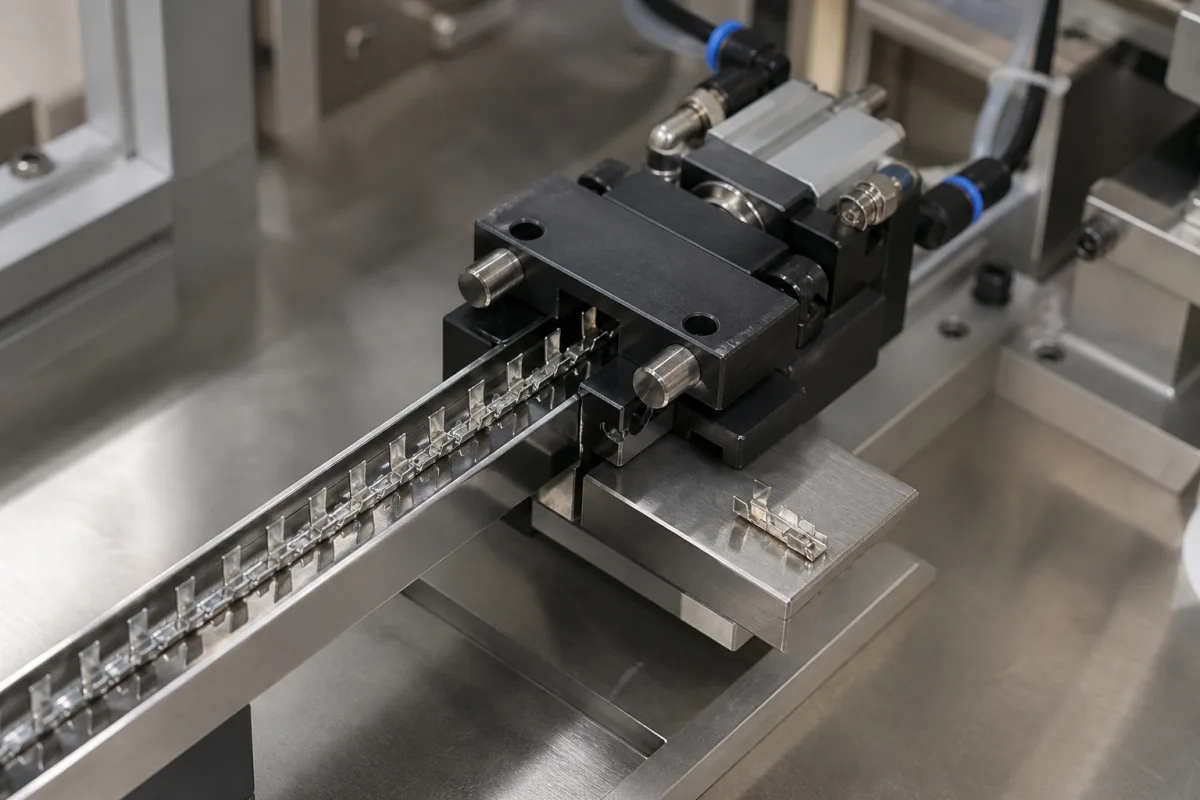
A mechanical component within a terminal feeder that guides and precisely releases oriented components for downstream assembly.
Product Specifications

Technical details and manufacturing context for Orientation Track / Escapement

Definition
The orientation track/escapement is a critical sub-assembly of a terminal feeder system responsible for receiving pre-oriented components from vibratory bowls or other feeding mechanisms, maintaining their correct orientation through a guided track, and then releasing them individually at precise intervals using an escapement mechanism to ensure reliable transfer to subsequent assembly stations.
Working Principle
Components enter the orientation track from a feeder bowl, sliding or rolling along a precisely shaped channel that maintains their specific orientation. At the end of the track, an escapement mechanism (often a rotating gate, sliding block, or pneumatic actuator) sequentially releases one component at a time based on signals from the downstream process, preventing jams and ensuring controlled flow.
Common Materials
Stainless Steel, Aluminum Alloy, Engineering Plastic (e.g., POM, UHMW)
Technical Parameters
  • Track width and height must match component dimensions with minimal clearance to prevent tumbling or jamming. (mm) Per Request
Components / BOM
  • Guide Rail
    Forms the channel that constrains component orientation during transit.
    Material: Stainless Steel
  • Escapement Gate
    Movable barrier that opens to release one component and closes to block the next.
    Material: Hardened Steel or Aluminum Alloy
  • Actuator
    Provides the motion to operate the escapement gate (pneumatic cylinder, solenoid, servo motor).
    Material: Various (based on actuator type)
  • Mounting Bracket
    Secures the track/escapement assembly to the feeder or machine frame.
    Material: Aluminum or Steel
Engineering Reasoning
0.5-2.5 N·m torque, 0.01-0.05 mm positional tolerance, 15-35°C ambient temperature
Exceeding 3.2 N·m torque causes permanent deformation of guide rails, positional error exceeding 0.08 mm disrupts component release timing, temperature exceeding 45°C causes thermal expansion beyond 0.12 mm
Design Rationale: Plastic deformation of hardened steel guide rails (yield strength 1200 MPa exceeded), cumulative wear at contact surfaces (Archard's wear coefficient K=2.5×10⁻⁷), thermal expansion mismatch between aluminum housing (α=23×10⁻⁶/°C) and steel components (α=12×10⁻⁶/°C)
Risk Mitigation (FMEA)
Trigger Abrasive particle contamination (ISO 4406 18/16/13) in lubrication
Mode: Increased coefficient of friction from 0.15 to >0.35, causing jamming at release point
Strategy: Integrate 5 μm absolute filtration with differential pressure monitoring at 0.3 bar threshold
Trigger Cyclic loading at 2.1 Hz exceeding 2.8×10⁶ cycles (S-N curve for 4140 steel)
Mode: Fatigue crack initiation at stress concentration points (Kt=2.8), leading to guide rail fracture
Strategy: Implement fillet radius optimization to reduce Kt to 1.3, apply shot peening to induce 400 MPa compressive residual stress

Industry Taxonomies & Aliases

Commonly used trade names and technical identifiers for Orientation Track / Escapement.

Applied To / Applications

This component is essential for the following industrial systems and equipment:

Industrial Ecosystem & Supply Chain DNA

Complementary Systems
Downstream Applications
Specialized Tooling

Application Fit & Sizing Matrix

Operational Limits
pressure: Atmospheric to 0.5 bar gauge
other spec: Component size range: 0.5mm to 25mm, Feed rate: 10-500 parts/min, Vibration tolerance: < 5g RMS
temperature: -20°C to 80°C
Media Compatibility
✓ Small electronic components (SMD chips, resistors) ✓ Precision mechanical parts (gears, pins, fasteners) ✓ Pharmaceutical capsules/tablets
Unsuitable: Abrasive slurries or corrosive chemical environments
Sizing Data Required
  • Component dimensions and geometry
  • Required feed rate (parts per minute)
  • Orientation accuracy tolerance

Reliability & Engineering Risk Analysis

Failure Mode & Root Cause
Misalignment-induced wear
Cause: Improper installation or thermal expansion causing track components to deviate from specified alignment, leading to accelerated abrasive wear and binding
Lubrication failure
Cause: Inadequate or contaminated lubrication resulting in increased friction, overheating, and eventual seizure of escapement mechanisms
Maintenance Indicators
  • Audible grinding or scraping noises during operation indicating metal-on-metal contact
  • Visible misalignment or irregular motion patterns in the track system
Engineering Tips
  • Implement laser alignment verification during installation and periodic inspections to maintain precise track geometry
  • Establish a proactive lubrication schedule using manufacturer-specified lubricants with contamination monitoring

Compliance & Manufacturing Standards

Reference Standards
ISO 286-1:2010 (Geometrical product specifications - Limits and fits) ANSI B4.1-1967 (Preferred Limits and Fits for Cylindrical Parts) DIN 7184-1 (Tolerances and fits for plain bearings)
Manufacturing Precision
  • Track width: +/-0.01mm
  • Surface finish: Ra 0.4μm max
Quality Inspection
  • Coordinate Measuring Machine (CMM) dimensional verification
  • Surface roughness profilometer test

Factories Producing Orientation Track / Escapement

Verified manufacturers with capability to produce this product in China

✓ 93% Supplier Capability Match Found

T Technical Director from Germany Jan 22, 2026
★★★★★
"Testing the Orientation Track / Escapement now; the technical reliability results are within 1% of the laboratory datasheet."
Technical Specifications Verified
P Project Engineer from Brazil Jan 19, 2026
★★★★☆
"Impressive build quality. Especially the technical reliability is very stable during long-term operation. (Delivery took slightly longer than expected, but technical support was excellent.)"
Technical Specifications Verified
S Sourcing Manager from Canada Jan 16, 2026
★★★★★
"As a professional in the Machinery and Equipment Manufacturing sector, I confirm this Orientation Track / Escapement meets all ISO standards."
Technical Specifications Verified
Verification Protocol

“Feedback is collected from verified sourcing managers during RFQ (Request for Quote) and factory evaluation processes on CNFX. These reports represent historical performance data and technical audit summaries from our B2B manufacturing network.”

16 sourcing managers are analyzing this specification now. Last inquiry for Orientation Track / Escapement from Mexico (41m ago).

Supply Chain Compatible Machinery & Devices

Automated Assembly Line System

Integrated production system for sequential component assembly operations

Explore Specs →
Automated Powder Coating System

Integrated industrial system for applying dry powder coatings to metal substrates.

Explore Specs →
Centrifugal Pump Impeller

Rotating component that transfers energy to fluid in centrifugal pumps.

Explore Specs →
High-Precision CNC Laser Cutting Machine

Computer-controlled industrial machine using focused laser beams to cut sheet metal with micron-level accuracy.

Explore Specs →

Frequently Asked Questions

What is the primary function of an orientation track/escapement in machinery?

The orientation track/escapement precisely guides and releases oriented components from terminal feeders to downstream assembly processes, ensuring accurate positioning and timing for automated manufacturing.

What materials are commonly used for orientation track components?

Common materials include stainless steel for durability, aluminum alloy for lightweight strength, and engineering plastics like POM or UHMW for wear resistance and smooth operation in high-cycle applications.

How does the escapement gate work in this system?

The escapement gate acts as a controlled release mechanism, opening at precise intervals to allow single oriented components to pass from the guide rail to the next assembly stage, preventing jams and ensuring consistent flow.

Can I contact factories directly on CNFX?

CNFX is an open directory, not a transaction platform. Each factory profile provides direct contact information and production details to help you initiate direct inquiries with Chinese suppliers.

Get Quote for Orientation Track / Escapement

Request technical pricing, lead times, or customized specifications for Orientation Track / Escapement directly from verified manufacturing units.

Your business information is encrypted and only shared with verified Orientation Track / Escapement suppliers.

Thank you! Your message has been sent. We'll respond within 1–3 business days.

Need to Manufacture Orientation Track / Escapement?

Connect with verified factories specializing in this product category

Add Your Factory Contact Us
Previous Product
Orientation Track & Tooling
Next Product
Orientation Track/Selector