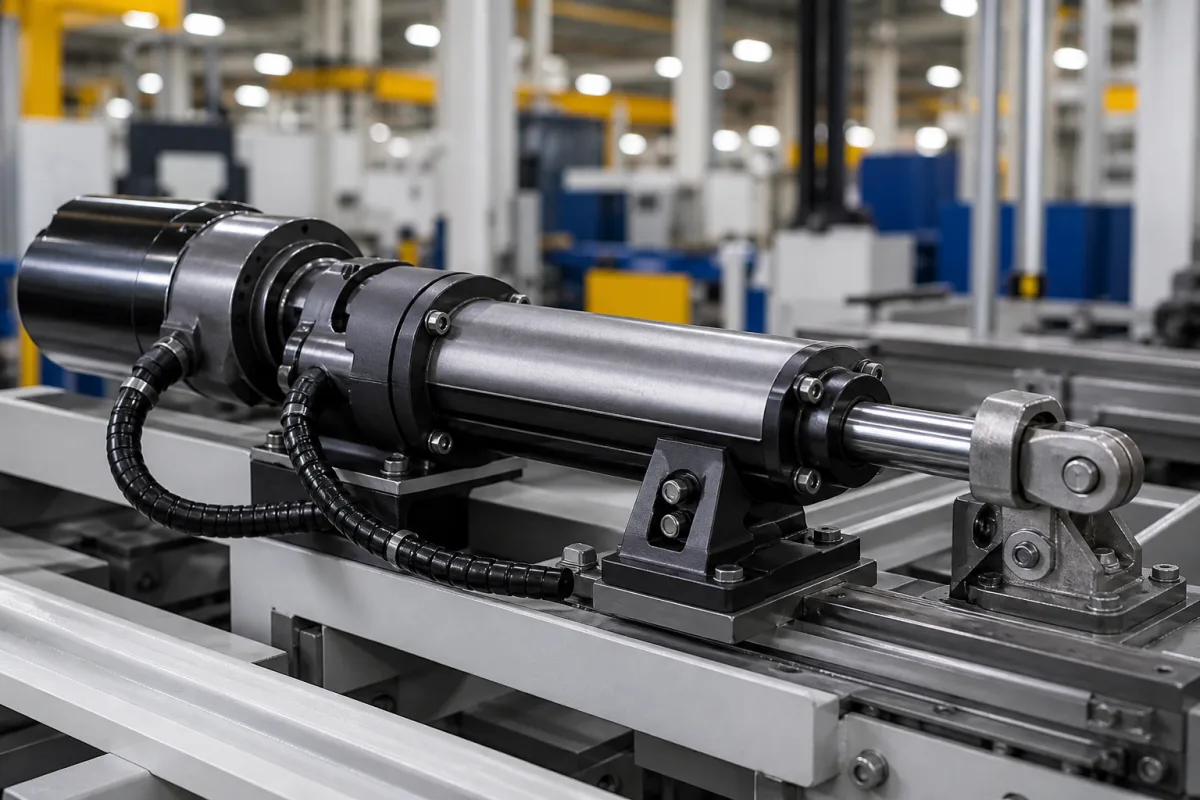
High-force roller screw actuator: an electric rod actuator, driven by a servo motor through a planetary roller screw, built to take the place of a hydraulic cylinder at 22 to 250 kN
High-force electric actuator with a planetary roller screw · 22–250 kN rod actuators that replace hydraulic cylinders: force, L10 travel life, lead, speed, sealing and mounting
When a machine needs tens or hundreds of kilonewtons of thrust, the traditional answer is a hydraulic cylinder with a power unit, valves and hoses. A high-force electric actuator does the same job with a servo motor turning a planetary roller screw inside a sealed rod cylinder, as in the picture: motor in line at the back, body on a foot mount, rod and clevis at the front. This page covers that class of actuator: the forces the published frames carry, how their travel life is calculated and limited, and what changes when one replaces a hydraulic cylinder.
Electric rod actuators with planetary roller screws for continuous forces of about 22 to 250 kN, used in place of hydraulic cylinders for pressing, forming, clamping, tensioning, positioning and testing, with in-line or parallel motor drives and cylinder-style mounts. Electric linear actuators for general automation (rod-style and rodless, ball screw or belt) are covered on the Linear actuators (electric, for automation) page; 12–48 V DC adjustment actuators on the Adjustment actuator page; servo press modules with built-in force sensors on the Servo motor actuator for press-fitting page; quarter-turn valve actuators on the Pneumatic actuator page; hydraulic servo cylinders on the Valve-on-cylinder actuator assembly page; air-over-oil cylinders on the Hydro-pneumatic intensifier cylinder page; ball screw assemblies sold alone on the Ball screw assembly page; and application-built drives on the Servo actuator unit for continuous casting mould oscillation and the Injection drive and control system for plastics injection moulding machines pages.
CNFX editorial research · Sources checked October 13, 2026 · 3 sources
Four FTX frames from 22.2 to 177.9 kN, and 250 kN on Rexroth's largest EMC-HP sizes
Curtiss-Wright presents its Exlar FTX series as designed for migrating from hydraulic to electric actuation, claiming up to 15 times the life and twice the force density of ball-screw electric actuators. The catalogue's frame tables show how force, lead and speed trade against each other. [1]
Bosch Rexroth's EMC-HP sizes 190 and 220 take axial forces up to 250 kN through a direct drive or a parallel spur-gear drive, with strokes up to 1,500 mm and IP 65 protection; the PLSA planetary screw assembly inside covers dynamic load capacities up to 473 kN and a top speed of 0.83 m/s. Rexroth names pressing, forming, riveting, tensioning, positioning and testing, and specifically calendering in battery production, wood panel pressing and sheet metal forming, as applications, and offers an oil bath as a lubrication option for continuous-load use. [2]
At the screw level, Moog lists planetary roller screws in ISO 3408-3 classes 1–3, 15 to 100 mm diameter, 2 to 42 mm pitch, lengths up to 4,000 mm, dynamic loads up to 1,230 kN, static loads up to 3,500 kN and acceleration up to 40 m/s². [3]
Editorial calculation: screw speed × lead gives linear speed, so the FTX095 with a 5 mm lead at 4,500 rpm moves 4,500 × 5 / 60 = 375 mm/s, matching the 373 mm/s in the table. The ideal torque to push 22.2 kN on a 5 mm lead is 22,200 × 0.005 / 2π ≈ 17.7 Nm; if the catalogue's 22.1 Nm maximum input torque for that lead is the torque at maximum force, the screw and bearings run at about 17.7 / 22.1 ≈ 80 % efficiency.
Give the supplier the continuous (RMS) force over the cycle as well as the peak, the stroke, the highest speed needed and whether the motor can sit in line or must be folded alongside on a belt or gear drive.
02
Travel life from the cube of Ca over the cubic-mean load: 392 km at full force on the 5 mm FTX095, and where the formula stops applying
Exlar gives the L10 life of a roller screw actuator as the travel distance that 90 % of properly maintained roller screws are expected to meet or exceed: L10 = (Ca / Fcml)³ × lead, where Ca is the dynamic load rating and Fcml the cubic mean applied load. At maximum force the catalogue lists 392, 626 and 1,440 km for the FTX095 with 5, 10 and 20 mm leads, 249.2 and 486.3 km for the FTX125, 154.9 to 416.6 km for the FTX160 and 78.7 to 414.3 km for the FTX215. Ca is reduced for strokes longer than 900 mm, for example from 163.7 to 143.4 kN on the 5 mm FTX125. [1]
The estimates assume lubrication of sufficient quality and quantity, bearing and screw temperatures between 20 and 40 °C, no hard stops or impact loads and no side loads. Exlar states that they do not apply to short-stroke, high-frequency work such as fatigue testing, or to short-stroke, high-force work such as pressing. [1]
Editorial calculation: for the FTX095 with 5 mm lead, (95.2 / 22.2)³ × 5 mm ≈ 78.9 × 5 mm ≈ 394 mm × 10⁶, or 394 km, agreeing with the listed 392 km. Because life goes with the cube of load, running the same actuator at half its maximum force (11.1 kN) multiplies the L10 travel by 2³ = 8, to about 3,100 km.
Send the full force–stroke cycle, not one force value, so the supplier can calculate the cubic-mean load; flag any short-stroke pressing or high-frequency duty, where catalogue life figures do not apply.
03
Taking the place of a hydraulic cylinder: IP65S sealing, 0–85 °C, flange, clevis, eye or trunnion mounts and 0.06 mm backlash
Exlar seals all FTX models to IP65S and rates them for 0 to 85 °C ambient, with a low-temperature grease option to −40 °C. The construction shown in the catalogue has an epoxy-coated aluminium housing, angular-contact thrust bearings, a grease port, a chrome-plated rod with stainless rod end and a field-replaceable front seal bushing; oil-lubricated versions have oil ports. Mounting choices are front flange, rear clevis, rear eye and rear trunnion, with an in-line direct drive or a parallel drive through a 1:1 or 2:1 belt. [1]
The catalogue's accuracy figures are 0.030 mm screw travel variation, 0.025 mm lead error per 300 mm and 0.06 mm screw lead backlash. [1] Rexroth adds a sensor and display package on the EMC-HP that shows a relubrication recommendation or the oil-bath temperature, depending on the version. [2]
Editorial calculation: the FTX095 base unit weighs 10 kg at zero stroke plus 0.39 kg per 25 mm of stroke, so a 300 mm stroke unit is about 10 + 12 × 0.39 ≈ 14.7 kg before the 2.9 kg in-line adder (motor excluded) and the mounting adder. [1]
Give the supplier the existing cylinder's mounting style and pin centres, rod-end thread, ambient temperature range, washdown or dust exposure, and the lubrication interval the maintenance team can support.
04
What to send for a high-force roller screw actuator
Paste it into your enquiry below or into an email to a maker, then replace every bracket.
Force: [peak; continuous or RMS; full force–stroke cycle]
Motion: [stroke; speed; acceleration; positioning accuracy]
Duty: [cycles per hour; short-stroke pressing or high-frequency work]
Drive: [in-line or parallel; motor and drive brand if fixed]
Mounting: [flange, clevis, eye or trunnion; rod-end thread; side load]
Environment: [ambient range; IP; washdown]
Lubrication: [grease or oil bath; service interval]
Explore company information and manufacturing capabilities, then discuss the scope of your project with a relevant supplier.
Share this page
Compiled and source-reviewed by the CNFX editorial team.
Each manufacturer above links to the page on that company's own website where the product is listed, with the date we checked it. How we source and review
· Page last updated 13 October 2026
Buyer questions
How much force can an electric roller screw actuator deliver?
Exlar's FTX frames are rated 22.2, 44.5, 89.0 and 177.9 kN; Bosch Rexroth's EMC-HP sizes 190 and 220 reach 250 kN. [1][2]
How is roller screw actuator life calculated?
Exlar gives L10 travel life = (Ca / cubic-mean load)³ × lead, valid with good lubrication, 20–40 °C screw temperature and no impact or side loads, and not for short-stroke pressing. [1]
How large do planetary roller screws get?
Moog lists diameters from 15 to 100 mm with dynamic loads up to 1,230 kN and static loads up to 3,500 kN. [3]
Sources and what still needs a direct check
Sources checked 2026-10-13. Frame forces, life formula, sealing, mounting and accuracy come from Curtiss-Wright's Exlar FTX catalogue; the 250 kN sizes and PLSA screw from Bosch Rexroth's EMC-HP press release; roller screw size and load limits from Moog.