Industry-Verified Manufacturing Data (2026)

Permanent Magnet Assembly

Based on aggregated insights from multiple verified factory profiles within the CNFX directory, the standard Permanent Magnet Assembly used in the Machinery and Equipment Manufacturing sector typically supports operational capacities ranging from standard industrial configurations to heavy-duty production requirements.

Technical Definition & Core Assembly

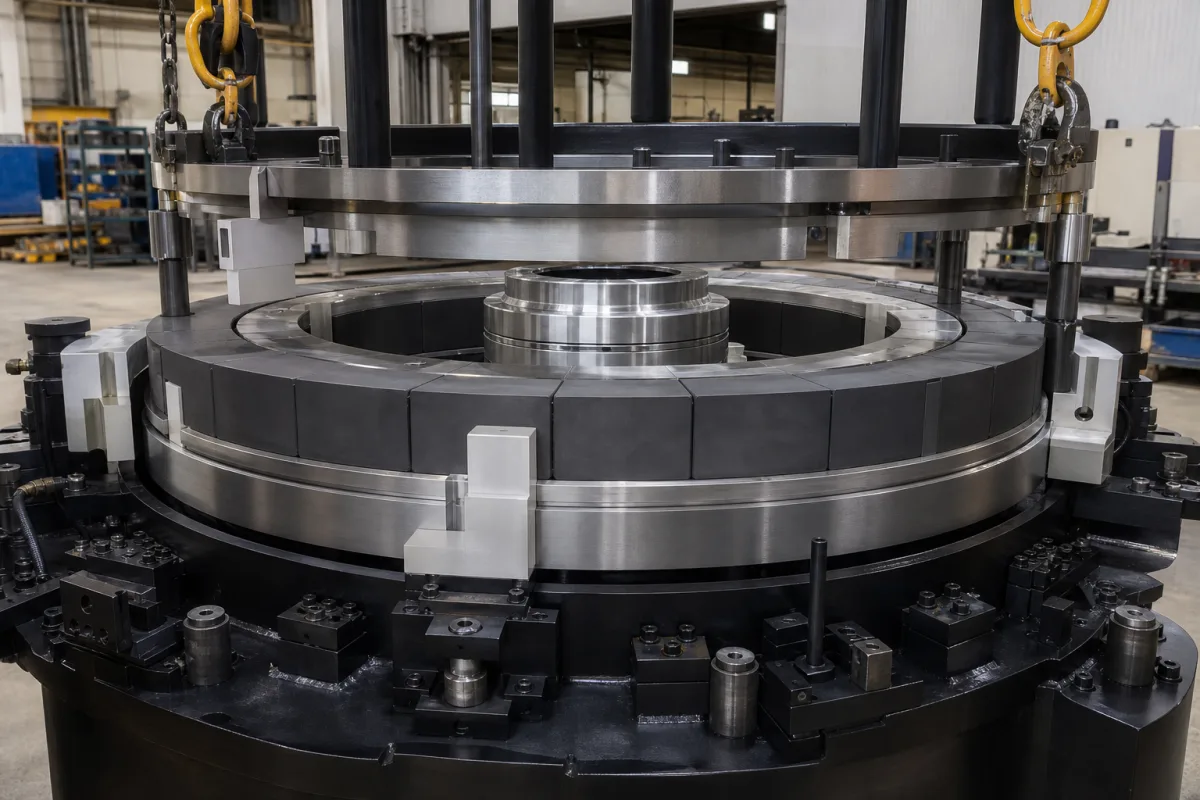
A canonical Permanent Magnet Assembly is characterized by the integration of Permanent Magnet Blocks and Magnetic Yoke/Frame. In industrial production environments, manufacturers listed on CNFX commonly emphasize Neodymium Iron Boron (NdFeB) construction to support stable, high-cycle operation across diverse manufacturing scenarios.

A magnetic field generation component within electromagnetic vibration testing equipment
Product Specifications

Technical details and manufacturing context for Permanent Magnet Assembly

Definition
A permanent magnet assembly is a critical component of Industrial Electromagnetic Vibration Testing Systems that provides a stable, constant magnetic field without requiring external power. It works in conjunction with electromagnetic coils to generate controlled vibration forces for testing materials, components, and assemblies under simulated operational conditions.
Working Principle
The permanent magnet assembly creates a fixed magnetic field that interacts with alternating currents in adjacent electromagnetic coils. This interaction produces Lorentz forces that generate precise, controllable vibrations. The permanent magnets maintain a constant magnetic flux density, ensuring consistent force generation and system stability during testing operations.
Common Materials
Neodymium Iron Boron (NdFeB), Samarium Cobalt (SmCo), Alnico, Ferrite
Technical Parameters
  • Overall dimensions including length, width, and height of the magnet assembly (mm) Per Request
Components / BOM
  • Permanent Magnet Blocks
    Generate the primary magnetic field through their inherent magnetic properties
    Material: Rare-earth magnets (NdFeB/SmCo) or ceramic magnets
  • Magnetic Yoke/Frame
    Provides structural support and directs magnetic flux efficiently
    Material: Low-carbon steel or soft magnetic composites
  • Pole Pieces
    Shape and concentrate the magnetic field in the air gap
    Material: High-permeability steel or specialized alloys
  • Mounting Hardware
    Secures the magnet assembly within the vibration testing system
    Material: Stainless steel or non-magnetic alloys
Engineering Reasoning
0.5-2.0 Tesla magnetic flux density at 20-80°C ambient temperature
Curie temperature of 310°C for NdFeB magnets, causing irreversible demagnetization at 350°C
Design Rationale: Thermal demagnetization due to exceeding Curie temperature, where thermal energy overcomes magnetic domain alignment energy (exchange interaction energy ~10^-21 J/atom)
Risk Mitigation (FMEA)
Trigger Eddy current heating from AC magnetic fields at frequencies >100 Hz
Mode: Progressive thermal demagnetization reducing magnetic flux by 15% per 50°C above 150°C
Strategy: Laminated rare-earth magnet construction with 0.5 mm silicon steel laminations to reduce eddy currents by 85%
Trigger Mechanical shock exceeding 500 g acceleration for 2 ms duration
Mode: Crack propagation through brittle NdFeB material leading to magnetic circuit disruption
Strategy: Epoxy encapsulation with 3 mm thickness and shock-absorbing mounting using 70 durometer silicone isolators

Industry Taxonomies & Aliases

Commonly used trade names and technical identifiers for Permanent Magnet Assembly.

Applied To / Applications

This component is essential for the following industrial systems and equipment:

Industrial Ecosystem & Supply Chain DNA

Complementary Systems
Downstream Applications
Specialized Tooling

Application Fit & Sizing Matrix

Operational Limits
pressure: Atmospheric to 2 bar absolute (vacuum/overpressure limited by housing)
other spec: Max magnetic field decay: <0.5% per decade, Vibration tolerance: Up to 100 g RMS, Humidity: 0-95% non-condensing
temperature: -40°C to +150°C (operating), up to +180°C (peak)
Media Compatibility
✓ Dry air/nitrogen environments ✓ Non-conductive cooling fluids (e.g., dielectric oil) ✓ Clean vacuum conditions
Unsuitable: Corrosive/conductive fluids (e.g., saltwater, acids) or ferromagnetic particle-laden environments
Sizing Data Required
  • Required magnetic field strength (Tesla or Gauss)
  • Gap/clearance dimensions for test specimen
  • Dynamic force/displacement requirements of vibration test

Reliability & Engineering Risk Analysis

Failure Mode & Root Cause
Demagnetization
Cause: Exposure to temperatures above the magnet's Curie point, strong opposing magnetic fields, or mechanical shock/vibration causing domain misalignment.
Corrosion and physical degradation
Cause: Lack of proper protective coating (e.g., nickel, epoxy) in harsh environments (moisture, chemicals), leading to oxidation, pitting, or coating delamination that weakens magnetic properties and structural integrity.
Maintenance Indicators
  • Visible corrosion, cracks, or coating damage on the magnet surface
  • Audible rattling or abnormal vibration indicating loose magnet segments or detachment from the assembly
Engineering Tips
  • Implement strict temperature monitoring and control to keep the assembly below the magnet's maximum operating temperature, and avoid exposure to strong external magnetic fields during handling or operation.
  • Apply and regularly inspect robust protective coatings suitable for the operating environment, and ensure proper mechanical mounting (e.g., using non-magnetic fasteners, adhesive bonding) to minimize stress and vibration.

Compliance & Manufacturing Standards

Reference Standards
ISO 9001:2015 - Quality management systems ASTM A977/A977M - Standard Specification for Permanent Magnet Assemblies IEC 60404-8-1 - Magnetic materials - Part 8-1: Specifications for individual materials - Magnetically hard materials
Manufacturing Precision
  • Bore diameter: +/-0.02mm
  • Flatness: 0.1mm per 100mm
Quality Inspection
  • Magnetic flux density measurement (Gauss meter test)
  • Dimensional verification with coordinate measuring machine (CMM)

Factories Producing Permanent Magnet Assembly

Verified manufacturers with capability to produce this product in China

✓ 93% Supplier Capability Match Found

T Technical Director from Germany Feb 27, 2026
★★★★★
"Testing the Permanent Magnet Assembly now; the technical reliability results are within 1% of the laboratory datasheet."
Technical Specifications Verified
P Project Engineer from Brazil Feb 24, 2026
★★★★☆
"Impressive build quality. Especially the technical reliability is very stable during long-term operation. (Delivery took slightly longer than expected, but technical support was excellent.)"
Technical Specifications Verified
S Sourcing Manager from Canada Feb 21, 2026
★★★★★
"As a professional in the Machinery and Equipment Manufacturing sector, I confirm this Permanent Magnet Assembly meets all ISO standards."
Technical Specifications Verified
Verification Protocol

“Feedback is collected from verified sourcing managers during RFQ (Request for Quote) and factory evaluation processes on CNFX. These reports represent historical performance data and technical audit summaries from our B2B manufacturing network.”

10 sourcing managers are analyzing this specification now. Last inquiry for Permanent Magnet Assembly from Germany (53m ago).

Supply Chain Compatible Machinery & Devices

Automated Assembly Line System

Integrated production system for sequential component assembly operations

Explore Specs →
Automated Powder Coating System

Integrated industrial system for applying dry powder coatings to metal substrates.

Explore Specs →
Centrifugal Pump Impeller

Rotating component that transfers energy to fluid in centrifugal pumps.

Explore Specs →
High-Precision CNC Laser Cutting Machine

Computer-controlled industrial machine using focused laser beams to cut sheet metal with micron-level accuracy.

Explore Specs →

Frequently Asked Questions

What materials are used in permanent magnet assemblies for vibration testing equipment?

Our assemblies use premium magnetic materials including Neodymium Iron Boron (NdFeB), Samarium Cobalt (SmCo), Alnico, and Ferrite, selected based on specific temperature, strength, and corrosion resistance requirements.

What components are included in a permanent magnet assembly BOM?

The bill of materials includes Magnetic Yoke/Frame for structural support, Mounting Hardware for secure installation, Permanent Magnet Blocks as the core magnetic elements, and Pole Pieces to shape and direct the magnetic field.

How do permanent magnet assemblies function in electromagnetic vibration testing equipment?

These assemblies generate stable, consistent magnetic fields that interact with electromagnetic coils to produce controlled vibrations, enabling precise testing of materials, components, and systems for durability and performance validation.

Can I contact factories directly on CNFX?

CNFX is an open directory, not a transaction platform. Each factory profile provides direct contact information and production details to help you initiate direct inquiries with Chinese suppliers.

Get Quote for Permanent Magnet Assembly

Request technical pricing, lead times, or customized specifications for Permanent Magnet Assembly directly from verified manufacturing units.

Your business information is encrypted and only shared with verified Permanent Magnet Assembly suppliers.

Thank you! Your message has been sent. We'll respond within 1–3 business days.

Need to Manufacture Permanent Magnet Assembly?

Connect with verified factories specializing in this product category

Add Your Factory Contact Us
Previous Product
Peristaltic or Piston Filling Pump
Next Product
Pick-and-Place Head