Industry-Verified Manufacturing Data (2026)

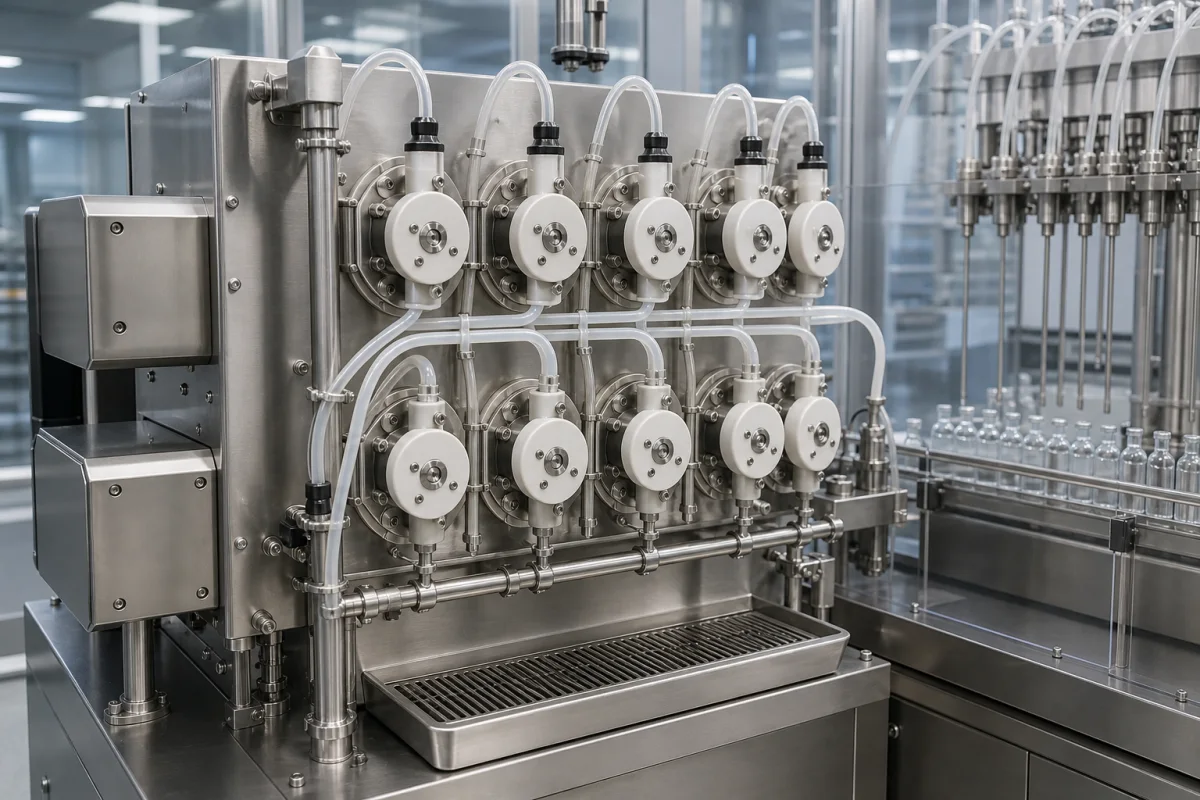
Peristaltic or Piston Filling Pump

Based on aggregated insights from multiple verified factory profiles within the CNFX directory, the standard Peristaltic or Piston Filling Pump used in the Machinery and Equipment Manufacturing sector typically supports operational capacities ranging from standard industrial configurations to heavy-duty production requirements.

Technical Definition & Core Assembly

A canonical Peristaltic or Piston Filling Pump is characterized by the integration of Pump Head / Drive Mechanism and Fluid Path Assembly. In industrial production environments, manufacturers listed on CNFX commonly emphasize 316L Stainless Steel construction to support stable, high-cycle operation across diverse manufacturing scenarios.

A precision fluid transfer component within an aseptic filling system that accurately meters and dispenses pharmaceutical liquids into vials or syringes using either peristaltic or piston pumping mechanisms.

Product Specifications

Technical details and manufacturing context for Peristaltic or Piston Filling Pump

Definition
The Peristaltic or Piston Filling Pump is a critical component of a Pharmaceutical Aseptic Filling and Sealing System. Its primary role is to ensure the accurate, sterile, and repeatable transfer of liquid pharmaceuticals (such as vaccines, biologics, or injectable drugs) from a bulk container into individual primary packaging units (e.g., vials, cartridges, or syringes) under aseptic conditions. It maintains product integrity by preventing contamination and ensuring precise fill volume control, which is paramount for dosage accuracy and regulatory compliance in pharmaceutical manufacturing.
Working Principle
Operates by one of two primary mechanisms: 1) Peristaltic Action: A rotating roller or shoe compresses a flexible tube, creating a moving occlusion that pushes the fluid forward in a gentle, low-shear manner, with the tube acting as a sterile, disposable fluid path. 2) Piston Action: A precision piston reciprocates within a cylinder. On the retraction stroke, it draws fluid into the cylinder through an inlet valve; on the forward stroke, it dispenses the fluid through an outlet valve, offering high accuracy and pressure. The system is integrated with controls for speed, stroke length/volume, and is often part of a CIP/SIP (Clean-in-Place/Sterilize-in-Place) loop.
Common Materials
316L Stainless Steel, PTFE (Teflon), Silicone or Platinum-Cured Silicone Tubing, Ceramic, ETFE
Technical Parameters
  • Nominal fill volume per cycle, with a typical accuracy range of ±0.5% to ±1% of setpoint. (ml) Per Request
Components / BOM
  • Pump Head / Drive Mechanism
    Houses the motor and mechanism (rollers for peristaltic, crank/cam for piston) that generates the pumping action.
    Material: 316L Stainless Steel
  • Fluid Path Assembly
    For peristaltic pumps: the disposable tubing set. For piston pumps: the precision cylinder, piston, and check valves. Provides the sterile conduit for the product.
    Material: Silicone/PTFE (Peristaltic) or 316L SS/Ceramic (Piston)
  • Volume Adjustment Mechanism
    Allows precise calibration of the dispensed volume (e.g., adjustment of roller position, piston stroke length, or servo control).
    Material: Stainless Steel, Anodized Aluminum
Engineering Reasoning
0.1-10 bar (10-1000 kPa) with flow rates of 0.1-500 mL/min
Pressure exceeding 15 bar (1500 kPa) for piston pumps or flow pulsation exceeding ±5% of setpoint for peristaltic pumps
Design Rationale: For piston pumps: Seal extrusion failure due to exceeding 15 MPa compressive stress on PTFE seals. For peristaltic pumps: Tube fatigue failure at >10⁶ compression cycles with 50% occlusion ratio causing 120°C localized heating.
Risk Mitigation (FMEA)
Trigger Particulate contamination >5 μm in pharmaceutical fluid
Mode: Check valve seat erosion with 0.1 mm/year wear rate causing 15% flow accuracy deviation
Strategy: Install 0.2 μm absolute filtration with differential pressure monitoring at 0.5 bar threshold
Trigger Ambient temperature cycling between 15-35°C at >2°C/min rate
Mode: Thermal expansion mismatch between 316L stainless steel (17.3 μm/m·K) and PTFE seals (135 μm/m·K) causing 0.05 mm clearance loss
Strategy: Implement active temperature control maintaining 22±1°C with Peltier cooling and PID control (Kp=5, Ki=0.1, Kd=0.5)

Industry Taxonomies & Aliases

Commonly used trade names and technical identifiers for Peristaltic or Piston Filling Pump.

Industrial Ecosystem & Supply Chain DNA

Complementary Systems
Downstream Applications
Specialized Tooling

Application Fit & Sizing Matrix

Operational Limits
pressure: Up to 6 bar (peristaltic), up to 10 bar (piston)
flow rate: 0.1 mL/min to 10 L/min (depending on pump type and configuration)
temperature: 2°C to 40°C (operating), -20°C to 80°C (sterilization)
slurry concentration: Not recommended for slurries >5% solids; particle size <100 μm
Media Compatibility
✓ Sterile aqueous solutions (buffers, vaccines) ✓ Viscous biologics (monoclonal antibodies, cell therapies) ✓ Low-viscosity solvents (ethanol-based disinfectants)
Unsuitable: Abrasive slurries with high solids content or corrosive chemicals (e.g., concentrated acids, strong oxidizers)
Sizing Data Required
  • Required fill volume accuracy (e.g., ±0.5% of target)
  • Fluid viscosity range (cP) and shear sensitivity
  • Target throughput (vials/hour) and batch size

Reliability & Engineering Risk Analysis

Failure Mode & Root Cause
Tube/Tube Fatigue Failure
Cause: Material degradation due to chemical incompatibility, excessive compression, or cyclic stress from rollers leading to cracks, leaks, or complete rupture.
Piston Seal Wear or Failure
Cause: Abrasion from particulate in fluid, chemical attack on seal material, or improper lubrication causing loss of prime, leakage, or reduced accuracy.
Maintenance Indicators
  • Audible: Unusual knocking, grinding, or squealing noises indicating mechanical wear or cavitation.
  • Visual: Fluid leakage around pump head, seals, or fittings, or inconsistent/discolored discharge suggesting contamination or seal failure.
Engineering Tips
  • Implement a preventive maintenance schedule for tube replacement (peristaltic) or seal inspection (piston) based on runtime hours and fluid compatibility charts.
  • Install inlet filters/strainers to prevent abrasive particles and ensure proper suction conditions to avoid cavitation and reduce mechanical stress.

Compliance & Manufacturing Standards

Reference Standards
ISO 28580:2011 (Pumps - General requirements) ANSI/ASME B46.1 (Surface Texture) DIN EN 809 (Pumps and pump units for liquids)
Manufacturing Precision
  • Bore diameter: +/-0.01mm
  • Flatness of mounting surfaces: 0.05mm
Quality Inspection
  • Dye Penetrant Test for surface defects
  • Spectrographic Analysis for material composition

Factories Producing Peristaltic or Piston Filling Pump

Verified manufacturers with capability to produce this product in China

✓ 93% Supplier Capability Match Found

T Technical Director from Germany Feb 15, 2026
★★★★★
"Found 54+ suppliers for Peristaltic or Piston Filling Pump on CNFX, but this spec remains the most cost-effective."
Technical Specifications Verified
P Project Engineer from Brazil Feb 12, 2026
★★★★☆
"The technical documentation for this Peristaltic or Piston Filling Pump is very thorough, especially regarding technical reliability. (Delivery took slightly longer than expected, but technical support was excellent.)"
Technical Specifications Verified
S Sourcing Manager from Canada Feb 09, 2026
★★★★★
"Reliable performance in harsh Machinery and Equipment Manufacturing environments. No issues with the Peristaltic or Piston Filling Pump so far."
Technical Specifications Verified
Verification Protocol

“Feedback is collected from verified sourcing managers during RFQ (Request for Quote) and factory evaluation processes on CNFX. These reports represent historical performance data and technical audit summaries from our B2B manufacturing network.”

7 sourcing managers are analyzing this specification now. Last inquiry for Peristaltic or Piston Filling Pump from India (1h ago).

Supply Chain Compatible Machinery & Devices

Automated Assembly Line System

Integrated production system for sequential component assembly operations

Explore Specs →
Automated Powder Coating System

Integrated industrial system for applying dry powder coatings to metal substrates.

Explore Specs →
Centrifugal Pump Impeller

Rotating component that transfers energy to fluid in centrifugal pumps.

Explore Specs →
High-Precision CNC Laser Cutting Machine

Computer-controlled industrial machine using focused laser beams to cut sheet metal with micron-level accuracy.

Explore Specs →

Frequently Asked Questions

What are the main differences between peristaltic and piston mechanisms in this filling pump?

Peristaltic pumps use rotating rollers to compress tubing, creating a gentle, contamination-free flow ideal for shear-sensitive fluids. Piston pumps use a reciprocating plunger for higher precision and pressure, better suited for viscous liquids. Both maintain aseptic conditions with 316L stainless steel and PTFE fluid paths.

How does this pump ensure accuracy in pharmaceutical liquid dispensing?

The pump features a precision volume adjustment mechanism and calibrated drive system that delivers consistent fill volumes within ±0.5% accuracy. The 316L stainless steel and ceramic components provide dimensional stability, while the PTFE and silicone tubing prevent fluid retention and ensure repeatable dosing.

What maintenance is required for the fluid path components?

The pump requires minimal maintenance: periodic inspection of tubing for wear (typically 1,000+ hours for platinum-cured silicone), cleaning of 316L stainless steel surfaces with pharmaceutical-grade sanitizers, and lubrication of drive mechanisms per manufacturer guidelines. All wetted parts are designed for easy replacement without tools.

Can I contact factories directly on CNFX?

CNFX is an open directory, not a transaction platform. Each factory profile provides direct contact information and production details to help you initiate direct inquiries with Chinese suppliers.

Get Quote for Peristaltic or Piston Filling Pump

Request technical pricing, lead times, or customized specifications for Peristaltic or Piston Filling Pump directly from verified manufacturing units.

Your business information is encrypted and only shared with verified Peristaltic or Piston Filling Pump suppliers.

Thank you! Your message has been sent. We'll respond within 1–3 business days.

Need to Manufacture Peristaltic or Piston Filling Pump?

Connect with verified factories specializing in this product category

Add Your Factory Contact Us
Previous Product
Perforated Diffuser Panel
Next Product
Permanent Magnet Assembly