The friction joints that make an articulated arm stay where it is put
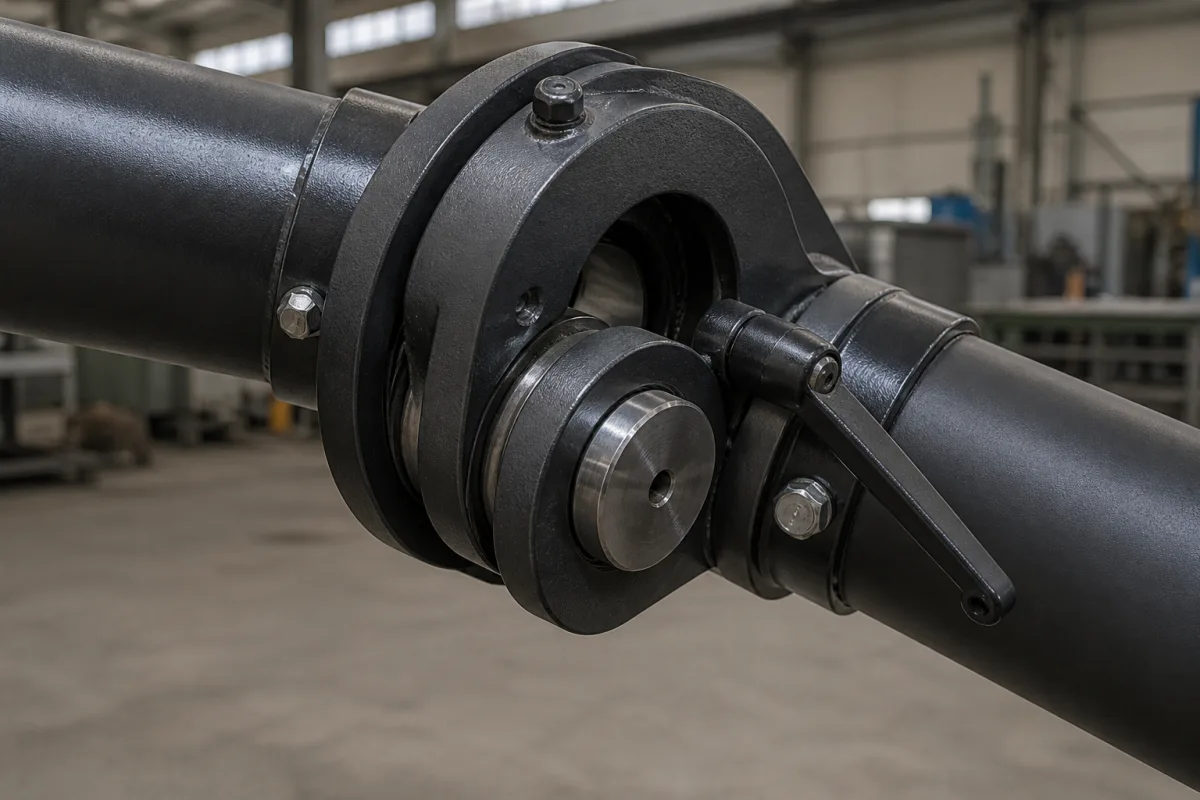
The illustrated joint links two tubular arm sections with a ring-shaped housing, a central pivot boss and a clamping lever. An articulated arm like this has to move freely under the operator's hand and then stay put, with nothing but the joints holding it against its own weight. Fume extraction arms are the clearest documented case: a manufacturer's manual gives the setting procedure, and two Swedish extraction-arm patents describe the joint designs.
Covers pivot joints of self-supporting articulated arms that are positioned by hand and held by joint friction or spring assistance, with fume extraction arms as the documented example: friction brakes and collars, external middle joints, bolt locking, spring-assisted joints and their adjustment. Spherical plain bearings and rod ends are on the Pivot bearing page (6744); spring-balanced lamp arms on 3645; welding fume extraction systems as a whole on 4082; flexure pivots on 9555. Pivot joints for aluminium profile frames share the name and are outside this page.
CNFX editorial research · Sources checked October 13, 2026 · 3 sources
Plymovent's KUA extraction-arm manual gives the adjustment as a maintenance procedure, joint by joint, for an arm that will not stay where it is put.
The method sets each joint at the lightest friction that still holds the arm in its worst case, fully extended and horizontal, where the moment about the joint is largest (editorial reading of the procedure).
On installation the same manual lists 'adjust all friction joints to correct tension' as a step after the arm is hung on its bracket and before the hoses are fitted.
Symptom (Plymovent KUA)
Procedure
Arm will not stay in position
Loosen the hose, pull the arm to full length and angle it horizontally; loosen the friction brake until the arm drops towards the floor, then tighten until it no longer drops
Arm hard to move sideways, or moves sideways on its own
Adjust the friction collar by loosening or tightening its screw with an Allen key
Outer arm will not stay in position
Angle the outer arm horizontally; loosen its friction brake until it drops, then tighten until it no longer drops
Hood will not stay in position
Loosen the hose and adjust the hood friction until the hood stays in the exact position
Figures for the KUA arms: 2, 3 or 4 m long, 160 mm tubes and hose, 800–1,200 m³/h recommended airflow; the ATEX versions weigh 20, 23.5 and 25 kg.
02
Joint designs: external middle joints and bolts that hold their setting
Two Swedish extraction-arm patents show how the joint itself is built to keep its friction.
Placing the middle joint outside the tubes, as in the Plymoth patent and the KUA-S, puts the adjustment where the operator can reach it; Plymovent's description of the KUA-S says its external joint is adjusted by hand without tools.
The clamping lever in the illustration plays the same role as the knobs in the Plymoth patent: a hand control on the joint's friction (editorial reading of the image).
Patent
Joint design
Problem it addresses
US 5,211,602 (J H Plymoth AB, 1993)
External middle joint of two sheet-metal halves clamped on the inner and outer arm ends, with a hose bridging the gap; leg members articulated by bolts with threaded knobs and a driving member
Bolts of the joint unscrewing, which would lose the friction set by brake linings and with it the joint function
US 5,211,602 (prior approach described)
Two needle bearings on each bolt connection
Cannot give full security: the bearings are hard to lubricate and may seize, loosening the joint
US 4,541,327 (Fumex AB, 1985)
Hinged supporting arm turning about vertical axles, with an operating arm connected by a friction joint with a stepped catch
Great reach independent of the room's ceiling height
03
Where springs and bearings take over
Friction alone has to hold the whole arm; Plymovent's standing KUA-S version splits the work.
The ATEX versions add a joint-related limit: rotation must stay below 360°, and the arm may not be used with dusts whose minimum ignition energy is below 5 mJ.
Spring assistance carries part of the arm's weight, so the friction joints need less holding torque and the arm moves more lightly (editorial reading).
KUA-S feature (Plymovent)
Effect stated
Lower joint spring-assisted, in a double ball-bearing mount
Smooth, flexible movement
Ball-bearing mountings and spring assistance
Easy to move
Aluminium inner and outer arm tubes
Mechanical strength with low weight
Ring handle at the hood
Positioning from all sides
Reach
Above mounting height, 360° manoeuvrable; up to 6 m with stanchions
04
What to give an articulated arm supplier
Paste it into your enquiry below or into an email to a maker, then replace every bracket.
Give the arm length and number of joints, the load at the end (hood, tool or device) and its weight, the working envelope and mounting height, how often the arm is repositioned, and the environment (fumes, oil mist, explosive zones). Ask for joint type (friction, spring-assisted, ball-bearing), how each joint is adjusted and with what tool, how the bolts are prevented from unscrewing, rotation limits, replacement brake linings or friction parts, and the adjustment procedure in the manual.
Explore company information and manufacturing capabilities, then discuss the scope of your project with a relevant supplier.
Share this page
Compiled and source-reviewed by the CNFX editorial team.
Each manufacturer above links to the page on that company's own website where the product is listed, with the date we checked it. How we source and review
· Page last updated 13 October 2026
Buyer questions
How do you adjust a friction joint on an extraction arm?
Plymovent's KUA manual: extend the arm horizontally, loosen the friction brake until the arm drops, then tighten until it no longer drops. [1]
Why do friction joints lose their setting?
US 5,211,602 addresses joint bolts unscrewing, which would lose the friction set by the brake linings; needle bearings on the bolts were a prior approach that could seize without lubrication. [2]
How do extraction arms reach far without high ceilings?
US 4,541,327 uses a hinged supporting arm on vertical axles with an operating arm on a friction joint with a stepped catch. [3]
Sources and what still needs a direct check
Sources checked 2026-10-13. Plymovent's KUA extraction-arm manual, and two Swedish extraction-arm patents (J H Plymoth AB and Fumex AB) on joint design.