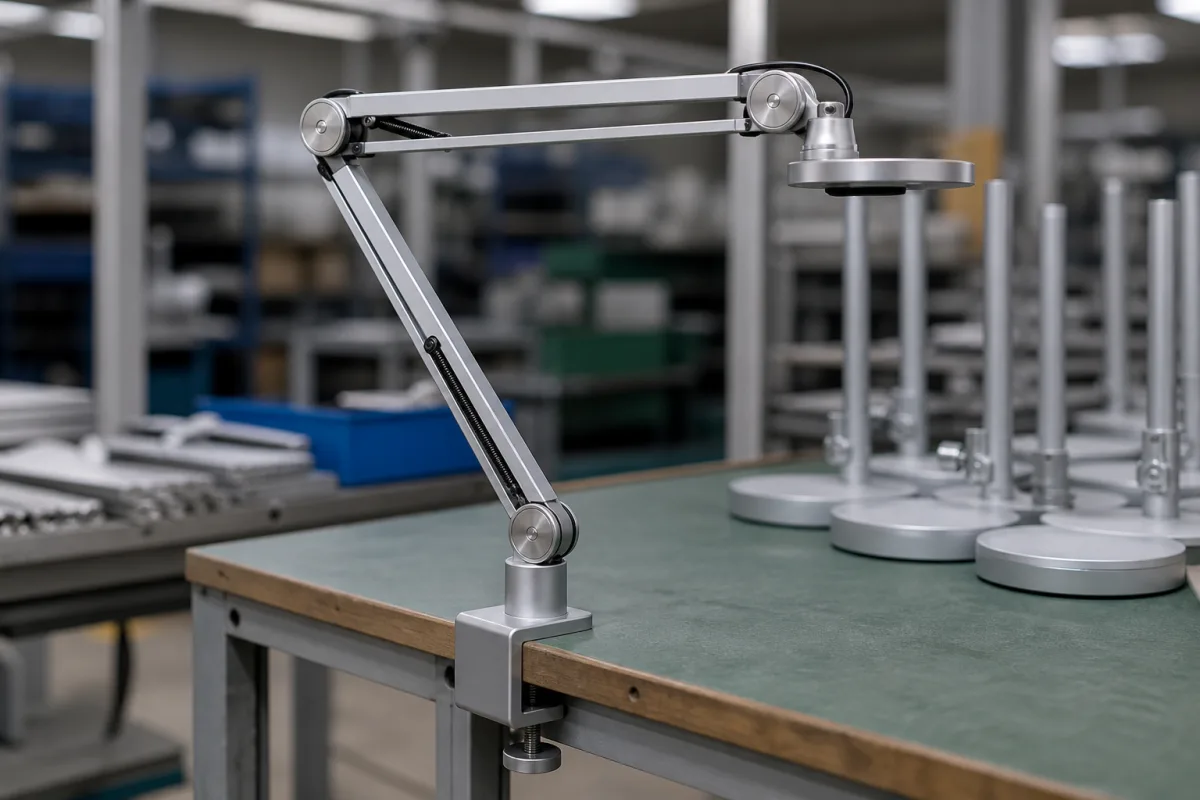
Adjustable arm for task lamps: the spring-balanced, multi-pivot arm and desk clamp that hold a lamp head in any position, from 66 cm to 41-inch reach
The spring-balanced, multi-pivot arm that holds a task-lamp head where it is left · Carwardine's spring law, reach and clamp range on two classic arms, and why head weight decides the balance
A lamp arm that stays where it is pushed, without a knob to tighten, is a balancing problem. The weight of the head and arm segments acts at a changing distance from each pivot as the arm moves, and springs have to cancel that moment in every position. The arrangement that solved it for task lamps was patented by George Carwardine in the 1930s: springs pre-tensioned so that their pull is proportional to their length, hooked between points chosen so the balance holds through the whole travel. Buying such an arm means agreeing the reach, the number of pivots, the mounting, the head weight it is balanced for, and how the spring tension is set. The picture shows one: a two-section aluminium arm with exposed tension springs along each section, round pivot hubs, a small round head and a screw desk clamp on a bench, with round lamp bases on stems in the background.
Spring-balanced articulated arms for task and desk lamps, with their pivots, tension springs, parallel links, spring adjustment and mounting (desk clamp, insert, wall bracket), and the head weight and reach they are balanced for. Complete household and office LED desk lamps with their light sources and smart controls are covered on the Smart LED desk lamp page. Monitor arms, gas-spring arms for medical or industrial equipment, and magnifier lamps are outside this page.
CNFX editorial research · Sources checked October 13, 2026 · 4 sources
Carwardine's constant-balance spring: pull proportional to length, coils closed at rest
Carwardine's patents set out the law the springs must follow and where they must be attached; the rest of the arm's design follows from that.
In US 2,090,439 (published 1937) George Carwardine describes an equipoising mechanism in which helical springs are applied so that their varying forces set up a constant balancing moment against gravity on a mass pivoted away from its centre of gravity. [1] The spring is pre-set so that, unstressed, its coils are drawn tightly together, and its pull is proportional to the distance between its two attachment points: the patent's example is 100 lb at two inches, 200 lb at four inches and 300 lb at six inches. [1] One attachment point lies on the centre line of a link and the other vertically above or below that link's pivot. [1]
Tension is adjusted to suit different masses by moving one end of the spring between a row of spaced holes in one of the members; in the patent's lamp, pairs of springs act on each lever, with a cross-member hooked into those holes to set the initial tension. [1] His companion patent US 2,076,446 calls the springs overwound helical springs, wound so that their force is proportional to their length, and hinges their ends so they stay straight and act along a line between the hinges; the arm then shows no tendency to move from any angle it is left at. [2]
Editorial calculation: in the patent's example the spring rate is 50 lb per inch at every length (100 ÷ 2, 200 ÷ 4, 300 ÷ 6), which is what a spring whose pull is proportional to its whole length means: its force would extrapolate to zero at zero length. [1]
Ask whether the arm's springs are pre-tensioned constant-balance springs, how many act on each section, and how tension is adjusted for a different head.
02
Reach, pivots and mounting on two classic arms, and the head weight the balance depends on
The two sheets below give the figures a buyer can compare; neither gives a spring rate or holding torque.
Anglepoise's note that bulb weight is critical for balance fits the spring law in Carwardine's patents, where spring tension is set to suit the mass being balanced. [3][1] Luxo states that the L-1 was designed in 1937 by Jac Jacobsen, the year Carwardine's two US patents were published. [4][1]
Editorial calculation: the 35 g spread in Anglepoise's permitted bulb weights (60 − 25), held at the full 66 cm reach with the arm horizontal as an example position, changes the moment about the base pivot by about 0.23 N·m (0.035 kg × 9.81 m/s² × 0.66 m). Luxo's 41 in arm is about 104 cm, some 1.6 times Anglepoise's 66 cm reach. [3][4]
Figure
Anglepoise Type 75 (UK sheet)
Luxo L-1 / L-1 LED (info sheet)
Arm
Aluminium arms; Anglepoise constant tension spring technology [3]
Cast iron base Ø19.5 cm; desk clamp (depth 9 cm, Ø8 cm) for desks 1.5 to 6 cm thick on the drawing; wall bracket; desk insert Ø6 cm [3]
Standard with table (edge) clamp; panel-mount and tool-tile brackets as accessories [4]
Head load
Permitted bulb 21 W max; bulb weight 25–60 g, stated as critical for balance [3]
L-1 certified for 60 W max; L-1 LED uses an 8 W integrated module [4]
Electrical
220/240 V, Class II, E27 holder, inline switch 34 cm from product, cable 270 cm [3]
Plug-in 120 V supply; L-1 LED 3000 K, CRI 90, 9/4 hour auto shut-off [4]
Give the weight of the head (with its LED module, driver or diffuser), the reach and height needed, the mounting surface and its thickness, and whether the head must rotate.
03
Data for a lamp arm enquiry
Paste it into your enquiry below or into an email to a maker, then replace every bracket.
Head: [weight; dimensions; cable or wiring through arm]
Reach and height: [cm]
Number of sections and pivots
Balance: [springs per section; adjustable tension]
Mounting: [desk clamp and thickness range; insert; wall; base]
Materials and finish: [aluminium; steel; paint]
Head rotation: [tilt; swivel]
Quantity and target cost
Explore company information and manufacturing capabilities, then discuss the scope of your project with a relevant supplier.
Share this page
Compiled and source-reviewed by the CNFX editorial team.
Each manufacturer above links to the page on that company's own website where the product is listed, with the date we checked it. How we source and review
· Page last updated 13 October 2026
Buyer questions
Why does a spring-balanced lamp arm stay where it is left?
Carwardine's patents use pre-tensioned springs whose pull is proportional to their length, attached so the spring moment balances the weight moment at every angle; the arm then has no tendency to move. [1][2]
How far does a task-lamp arm reach?
Anglepoise gives 66 cm from base to shade for the Type 75; Luxo describes a 41-inch three-pivot arm on the L-1. [3][4]
Does the weight of the lamp head matter?
Yes. Anglepoise states that bulb weight is critical for balance and gives 25–60 g for the Type 75. [3]
How thick a desk will the clamp fit?
The Anglepoise Type 75 sheet shows its desk clamp for a minimum of 1.5 cm and a maximum of 6 cm. [3]
Sources and what still needs a direct check
Sources checked 2026-10-13. Four documents from three publishers: George Carwardine's two US equipoising-mechanism patents of 1937, Anglepoise's UK technical specification sheet for the Type 75, and Luxo's L-1 / L-1 LED information sheet.