Gasketed plate-and-frame units · gasket temperature and pressure limits, plate thickness, gap and chevron angle, AHRI 400 tolerances
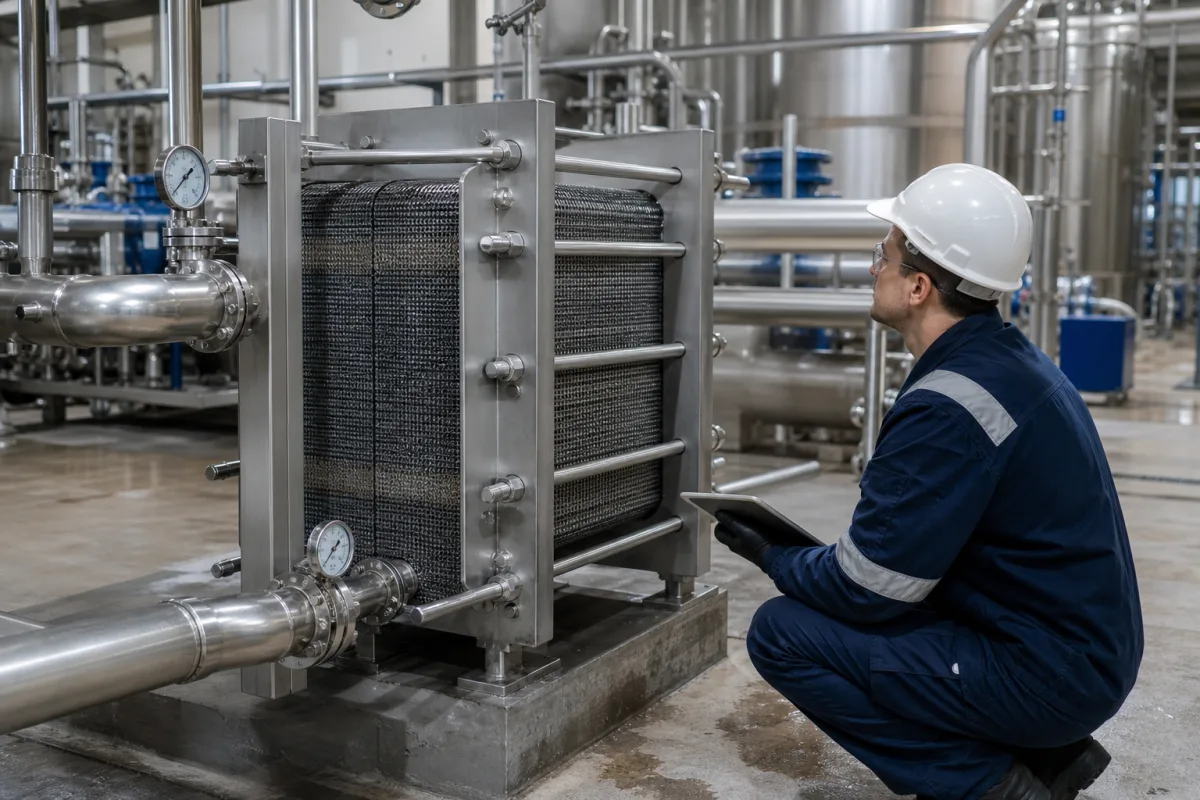
A gasketed plate-and-frame heat exchanger is a pack of corrugated metal plates clamped by tie bolts between a fixed frame plate and a movable pressure plate, with elastomer gaskets sealing each channel and steering the two fluids into alternate gaps. Because it can be opened, the gaskets set its pressure and temperature limits. Ask three things first: which gasket material and attachment suit the fluids and design temperature, what plate thickness, gap and corrugation the duty needs, and whether thermal and pressure-drop ratings are certified.
Gasketed plate-and-frame heat exchangers: corrugated plates clamped between a fixed and a movable frame plate, sealed by elastomer gaskets and opened for cleaning. The full range of industrial exchanger types, including brazed and welded plate units, shell-and-tube, spiral and finned-tube designs, and duty-based type selection, are covered on the Heat exchanger page. Pillow-plate exchangers and replacement gaskets sold alone are outside this page.
CNFX editorial research · Sources checked October 12, 2026 · 3 sources
Choose the gasket from design temperature, pressure and fluid
R. Pramanik of Fluor Daniel India, writing in Gas Processing News (2016), states that the design pressure of a gasketed PHE is governed by the gasket material and is limited to approximately 16 barg, in some cases up to 25 barg. Design temperature is also gasket-limited: approximately 135 °C with nitrile butyl rubber (NBR) and approximately 180 °C with ethylene propylene terpolymer (EPT), rising to approximately 260 °C with compressed asbestos fibre. [1]
The same article names EPT and NBR as the standard gaskets, EPT for non-fatty or non-oily duties and NBR for oil and fat, with HNBR and FKM as other options, and notes that gaskets are fixed to plates by glue or by mechanical means. Where the vendor lacks experience with a gasket, it describes an immersion test at operating temperature on a piece no more than 8 mm thick for at least 15 days, with hardness change no more than 15 IRHD for fluoropolymers and 10 IRHD for others, and volume change no more than 15%. For glue, the final peel strength in newtons should be five times the gasket width in millimetres. [1]
Elekheat's published gasket table gives NBR −15 to 130 °C for water, seawater, mineral oil and salt water, and EPDM −25 to 150 °C for hot water, steam, acid and alkali. [3] Editorial note: the two sources give different upper limits for the same rubber family, so ask the gasket supplier for the rated continuous temperature of the exact compound.
Editorial calculation: for an assumed 10 mm wide glued gasket, the peel-strength rule gives 5 × 10 = 50 N. [1]
Give the supplier both fluids and their chemistry, oil or fat content, design and operating temperatures and pressures, cleaning chemicals and temperatures, and whether glued or clip-on gaskets are required.
02
Specify plate thickness, gap and chevron angle
Pramanik notes that plates carry no corrosion allowance; thickness depends on the differential pressure across the plate, the corrugation and the material's ductility, and lies between 0.5 mm and 1 mm, with the minimum specified by API 662. The gap between adjacent plates is 2.5–5 mm, and the chevron angle β1 lies between 25° and 65°, governing heat transfer and pressure drop. [1]
For fouling, the article cites API 662 Appendix A for a minimum 10% fouling margin, possibly 25% for crude oil service, and a recommended minimum wall shear stress of 50 Pa; it warns that adding channels or plate width lowers velocity and can raise fouling. [1]
As one published example, Elekheat lists a plate of 604 × 266 × 0.5 mm with 0.109 m² heat transfer area, 4 mm plate spacing, 50 mm corner holes, DN40 flanges, working temperature up to 180 °C and working pressure of 0.6, 1.0 or 1.6 MPa. [3]
Editorial calculation: at 0.109 m² per plate, 10 m² of heat transfer area needs about 10 ÷ 0.109 ≈ 92 plates, before the supplier adds or removes plates for end plates and pass arrangement. [3]
03
Ask for certified thermal and pressure-drop ratings
Bell & Gossett explains that the AHRI Liquid to Liquid Heat Exchanger programme under ANSI/AHRI Standard 400 certifies gasketed plate heat exchangers by third-party witnessed laboratory testing. Tested total heat transfer must be at least 95% of the published value and tested pressure drop no more than 115% of it; before August 2015 the pressure-drop limit was 110%. [2]
Bell & Gossett gives the programme scope as gasketed plate units using water or sea water (glycols not yet included), capacity up to 240,000,000 Btu/h and flow up to 20,000 gpm, for HVAC in the U.S., its territories and Canada. It adds that ASHRAE Standard 90.1 has required waterside economizers to comply with AHRI Standard 400 since its 2010 version. [2]
Editorial calculation: 240,000,000 Btu/h × 0.29307 W per Btu/h ≈ 70.3 MW, and 20,000 gpm × 0.2271 m³/h per gpm ≈ 4,540 m³/h. [2]
04
Elekheat TG frame sizes: port size, flow, design pressure and plate area
Ask each supplier for the plate model, pattern and chevron angle, plate and gasket materials, number of plates and passes, and the thermal calculation against your duty.
12 companies list this product among what they make. Company figures are quoted from each
company's own website; every card states where the relationship came from.
Guangdong Jiema Energy Saving Technology Co.,Ltd
Manufacturing site to be confirmed for the order
Lists plate and frame heat exchangers with shell-and-tube and spiral plate units.
Explore company information and manufacturing capabilities, then discuss the scope of your project with a relevant supplier.
Share this page
Compiled and source-reviewed by the CNFX editorial team.
Each manufacturer above links to the page on that company's own website where the product is listed, with the date we checked it. How we source and review
· Page last updated 13 October 2026
Buyer questions
What limits the pressure and temperature of a gasketed plate heat exchanger?
The gaskets. A Fluor engineer's guide gives about 16 barg (up to 25 barg) and about 135 °C for NBR or 180 °C for EPT. [1]
How thick are the plates?
Between 0.5 mm and 1 mm, with the minimum set by API 662, according to the same guide. [1]
What does AHRI 400 certification guarantee?
Per Bell & Gossett, tested heat transfer of at least 95% and pressure drop no more than 115% of the published values. [2]
Sources and what still needs a direct check
Sources checked 2026-10-12. Gas Processing News carries an engineering contractor's specification guide citing API 662; Bell & Gossett, a certified participant, explains the AHRI 400 programme; Elekheat is a maker publishing its own plate, frame and gasket data.