Editorial Technical Reference

Intelligent Beverage Pasteurization System

This page explains how Intelligent Beverage Pasteurization System is classified within Beverage Manufacturing. Technical values and manufacturer relationships are research references; confirm the current specification and supplier evidence for each order.

Technical Definition & Core Assembly

Automated thermal processing system for beverage microbial safety and quality preservation

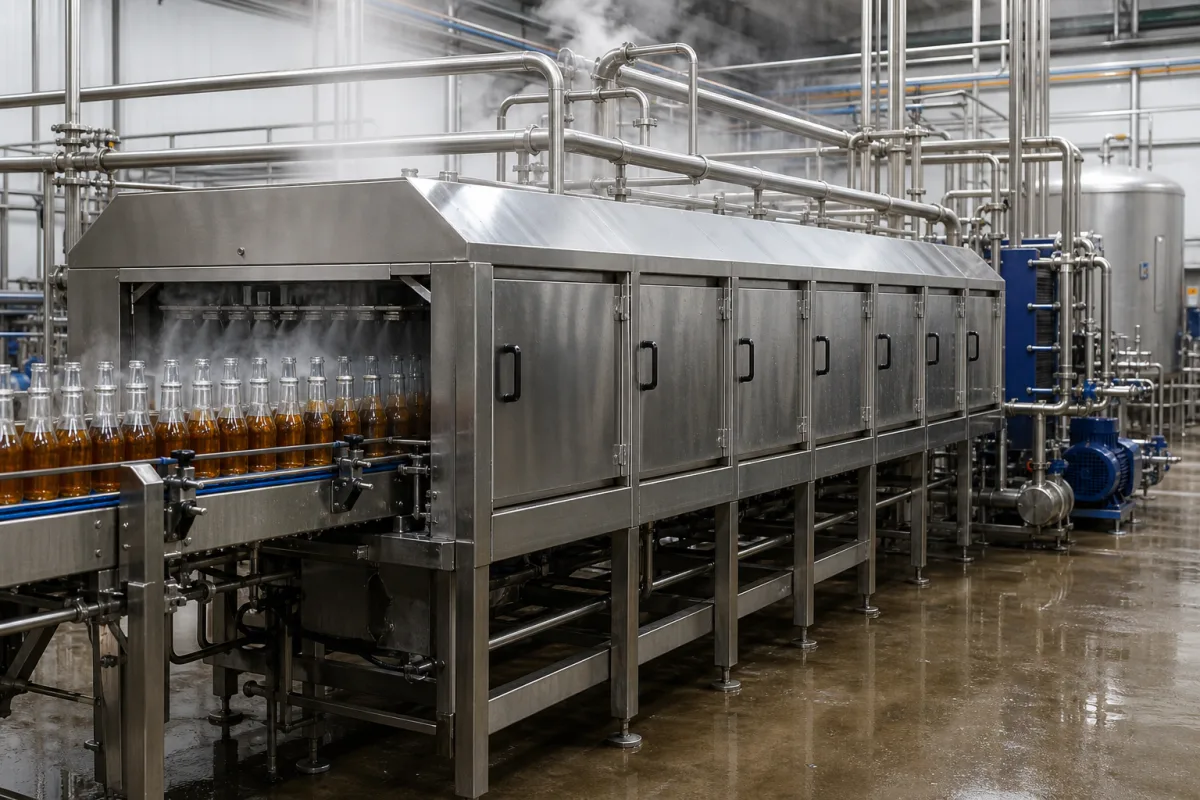
Representative product image. Confirm appearance and specifications with the manufacturer.

Product Specifications

Technical details and manufacturing context for Intelligent Beverage Pasteurization System

Definition
The Intelligent Beverage Pasteurization System is a complete industrial system designed for precise thermal treatment of beverages to eliminate pathogens and spoilage microorganisms while preserving flavor, color, and nutritional value. It integrates heating, holding, and cooling stages with real-time monitoring and control. The system is engineered for continuous flow operation in beverage production lines, ensuring consistent product quality and compliance with food safety regulations. It features modular design for flexible integration with existing bottling or canning lines. The system is constructed with stainless steel 316L for product contact surfaces, food-grade silicone gaskets, a PLC control unit, and temperature sensors. Key parameters include a flow rate of 5–50 L/h, heating temperature of 70–95 °C, holding time of 15–30 seconds, cooling temperature of 4–10 °C, power supply of 380–480 V/Hz (IEC 60038), operating pressure of 1.0–1.6 MPa, temperature control accuracy of ±0.5 °C, ingress protection rating of IP54–IP65 (IEC 60529), weight of 1500–3500 kg, and dimensions of 3000×1500×1800 mm. These values are reference ranges for directory purposes and must be confirmed for the specific model and application. The system is designed for integration into beverage production lines, with interfaces for upstream and downstream equipment. Verification questions should address actual capacity, utility requirements, and compliance with local food safety regulations. Maintenance signals include temperature deviations, pressure drops, and seal wear. Failure boundaries include operation outside specified pressure or temperature ranges, which may compromise microbial safety. Always verify model-specific values and standards with the legal manufacturer or supplier.
Working Principle
Beverage flows through heat exchangers for rapid heating to target temperature, maintains temperature in holding tube for specified time, then cools quickly through regeneration and final cooling stages. The system uses a PLC control unit and temperature sensors to monitor and adjust the process in real time, ensuring that the product is held at the required temperature for the required duration. The regeneration stage recovers heat from the hot product to preheat incoming cold beverage, improving energy efficiency. The final cooling stage brings the product to the specified cooling temperature before it exits the system. The entire process is continuous, allowing for high throughput and consistent quality.
Common Materials
stainless steel 316L, food-grade silicone gaskets, PLC control unit, temperature sensors
Technical Parameters
ParameterTypical rangeNotes & selection driver
Flow RateRequired5–50 L/hMaximum processing capacity
Heating TemperatureRequired70–95 °CTarget pasteurization temperature
Holding TimeRequired15–30 secondsMinimum time at target temperature
Cooling TemperatureRequired4–10 °CFinal product temperature
Power SupplyRequired380–480 V/HzElectrical requirementsIEC 60038
Temperature Control Accuracy±0.5 °CEnsures consistent pasteurization
Material (Product Contact)316LStainless steel for corrosion resistanceASTM A240
Ingress Protection RatingIP54–IP65Higher rating for washdown environmentsIEC 60529
Weight1500–3500 kgDepends on configuration and capacity
Dimensions (L×W×H)3000×1500×1800 mmFootprint varies with options

Ranges are indicative industry figures for RFQ preparation, not a supplier commitment. Confirm every value and standard with the legal manufacturer before ordering.

Components / BOM
  • Plate Heat Exchanger
    Rapid heating and cooling of beverage
    Material: Stainless Steel 316L
  • Holding Tube Part
    Maintains temperature for required time
    Material: Stainless Steel 316L
  • PLC Control Panel
    Automated temperature and flow control
    Material: Stainless Steel/IP65 enclosure
  • Temperature Sensors Part
    Real-time temperature monitoring
    Material: Food-grade stainless steel
  • Regeneration Section Optional
    Energy recovery from hot product to cold incoming beverage
    Material: Stainless Steel 316L
  • CIP System Optional
    Clean-in-place cleaning capability
    Material: Stainless Steel 316L

Industry Taxonomies & Aliases

Commonly used trade names and technical identifiers for Intelligent Beverage Pasteurization System.

Industrial Ecosystem & Supply Chain Structure

Complementary Systems
Downstream Applications
Specialized Tooling

Application Fit & Sizing Matrix

Operational Limits
pressure: Up to 6 bar (87 psi)
flow rate: Up to 20,000 L/h (5,283 gal/h)
temperature: 60-95°C (140-203°F)
slurry concentration: Up to 30% solids by weight
Media Compatibility
✓ Fruit juices and nectars ✓ Dairy-based beverages ✓ Carbonated soft drinks
Unsuitable: Highly viscous or particulate-laden slurries exceeding 30% solids
Sizing Data Required
  • Required production capacity (L/h or gal/h)
  • Target beverage viscosity and particulate size
  • Required pasteurization temperature and hold time

Reliability & Engineering Risk Analysis

Failure Mode & Root Cause
Thermal fatigue cracking
Cause: Cyclic heating and cooling during pasteurization cycles causes repeated expansion and contraction of heat exchanger plates and piping, leading to stress cracks over time, especially at welds and connections.
Fouling and scaling buildup
Cause: Mineral deposits from water and organic residues from beverages accumulate on heat transfer surfaces, reducing thermal efficiency, increasing pressure drop, and creating localized corrosion sites.
Maintenance Indicators
  • Audible hissing or gurgling sounds from heat exchangers indicating steam trap failure or air ingress
  • Visible beverage leakage at pipe joints or heat exchanger gaskets accompanied by temperature/pressure fluctuations
Engineering Tips
  • Implement automated chemical cleaning cycles with validated CIP (Clean-in-Place) protocols using food-grade acids and chelants to prevent scaling without damaging surfaces
  • Install corrosion-resistant thermal expansion joints in piping systems and use predictive maintenance tools like infrared thermography to detect early-stage thermal stress anomalies

Indicative industry ranges for design and RFQ preparation. Confirm the exact figures and applicable standard with the manufacturer before specifying.

Compliance & Manufacturing Standards

Applicable Standards
ANSI/NSF 51-2021 - Food equipment materials DIN EN 1672-2:2020 - Food processing machinery safety requirements

Quoted from the published standard.

Manufacturing Precision
  • Temperature control: +/-0.5°C
  • Pressure vessel weld seam alignment: +/-0.3mm
Quality Inspection
  • Microbiological efficacy validation test
  • Pressure vessel hydrostatic test

Manufacturers of Intelligent Beverage Pasteurization System

Manufacturer profiles associated with Intelligent Beverage Pasteurization System.

Sourcing Intelligent Beverage Pasteurization System from China?
Tell us your specification and target quantity — we will match it against manufacturer records and come back with the factories that fit.
Request manufacturers We manufacture this

Manufacturer listings support early research and capability understanding. They are not certification, ranking, or transaction guarantees.

Technical documentation
Request current drawings, revision history, and a signed specification sheet.
Manufacturing capability
Verify equipment lists, process limits, capacity, and representative production evidence.
Inspection readiness
Confirm test methods, calibrated equipment, sampling plans, and traceable reports.
Supplier transparency
Check the legal entity, factory address, ownership, certifications, and direct contacts.

CNFX does not score or rank suppliers. Buyers must verify all claims and documents with the legal manufacturer before ordering.

Supply Chain Core Equipment in this System

Automated Beverage Container Leak Detection System

The Automated Beverage Container Leak Detection System is an industrial device designed for integration into bottling or canning lines.

Explore Specs →
Automated Beverage Container Depalletizing Machine

Industrial machine that automatically removes beverage containers from pallets for production line feeding

Explore Specs →
Regeneration Section

A dedicated section within an industrial system designed to restore or renew the functional properties of materials, media, or components through controlled processes.

Explore Specs →
High-Speed Rotary Bottle Filling Machine

Automated industrial machine for precise liquid filling of beverage containers at high production rates.

Explore Specs →

Frequently Asked Questions

What is the typical flow rate range for this system?

The directory lists a flow rate range of 5–50 L/h. However, the actual capacity depends on the specific configuration and application. Confirm the required flow rate with the manufacturer or supplier.

What materials are used for product contact surfaces?

Product contact surfaces are made of stainless steel 316L, which is specified in the directory. This material is selected for corrosion resistance and compliance with food safety standards. Verify the exact material grade with the supplier.

How is temperature control accuracy maintained?

The system is designed with a temperature control accuracy of ±0.5 °C, achieved through PLC control and temperature sensors. This ensures consistent pasteurization. However, actual performance may vary; verify with the manufacturer.

Data Basis

Editorial classification, named public sources where available, and source-reviewed manufacturer records.

Preliminary Technical Classification
This page supports structured research, RFQ preparation, and supplier evaluation. It does not replace buyer-led supplier qualification, standards review, or technical approval.
Buyer enquiry

Request manufacturing insight for Intelligent Beverage Pasteurization System

Ask for use case, specification boundaries, supplier type, and RFQ preparation information for this product.

Where it goes
Straight to the CNFX editorial desk, and to the manufacturer if this product is linked to a claimed profile. Nothing is broadcast to a supplier list.
Your details stay here
We do not sell or rent enquiry data, and we do not add you to a mailing list. Used only to answer this request.
No commission, no middleman
CNFX is a directory. We take no cut of any order and never negotiate on a supplier's behalf.
What we don't claim
A listing is not an endorsement. Qualify every supplier and verify every figure yourself before ordering.

Your business information is used only to process this request.

Thank you! Your message has been sent. We'll respond within 1–3 business days.
Sorry, we couldn't send your message. Please try again, or email us at contact@cnfx.com.

Need to Manufacture Intelligent Beverage Pasteurization System?

Compare manufacturer profiles with relevant product and process capability.

Previous Product
Vacuum Gripper End-Effector
Last Product
Get QuotesChat