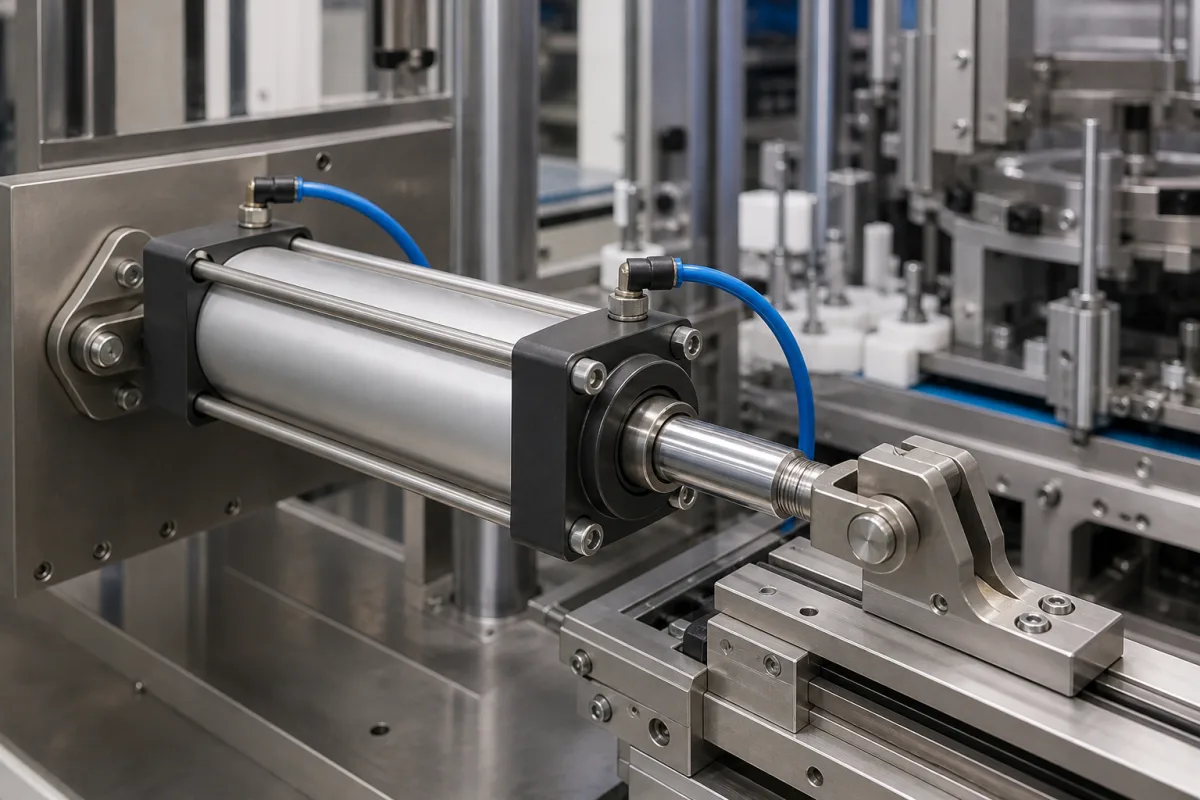
Pneumatic actuation · Bore, load factor and stroke-end impact
A cylinder sized only on theoretical force will stall, bounce or bend. Divide the force you need by a load factor that leaves margin for friction and acceleration, use the regulated pressure rather than the compressor pressure, check the weaker retract side, and make sure the stroke-end impact, side load and buckling are within the cylinder's limits.
Double-acting and single-acting pneumatic cylinders: tie-rod, profile, compact, mini and guided types, with air cushions or bumpers. Rotary actuators and valve actuators are outside this page.
CNFX editorial research · Sources checked October 12, 2026 · 4 sources
Size the bore from load factor and regulated pressure
SMC's air cylinder selection data starts with a load factor for the purpose: 0.7 or less for static operation such as clamping, 1 or less for moving a load horizontally on a guide, and 0.5 or less for vertical and horizontal movement of a load, reduced further (to 0.4, 0.3, 0.2 or less) for high-speed operation. It advises setting the regulator to about 85% of source air pressure. [1]
SMC's examples: holding a workpiece with at least 1,000 N on the extending side at 0.5 MPa and load factor 0.7 gives a 63 mm bore; moving 30 kg horizontally on a guide at 0.4 MPa and load factor 1 gives 40 mm; lifting 100 kg vertically at 0.5 MPa and load factor 0.5 gives 80 mm. [1]
As an editorial check of the first example: a 63 mm bore at 0.5 MPa gives a theoretical extending force of about 0.5 × 10⁶ × π × 0.0315² ≈ 1,560 N; at a load factor of 0.7 that is about 1,090 N, just above the 1,000 N required.
Give the supplier the force or mass, direction of motion, stroke, cycle time, available pressure at the machine and whether the load is guided. The bore follows from these, not from the old cylinder's size.
02
Check which direction carries the load
SMC separates the extending side from the retracting side, where the piston rod area reduces the force; when the same load is pushed and pulled in horizontal operation, it advises sizing on the retracting side. [1]
Ask the supplier for theoretical output on both sides at your pressure, and for rod diameter options if the retract force is short.
03
Absorb the stroke-end impact and check side load and buckling
SMC says to take the impact at the stroke end into account: either fit an external stopper such as a shock absorber with enough absorption capacity, or check the cylinder's own cushion capacity, either a urethane rubber bumper that prevents metal-to-metal contact or an air cushion that compresses exhaust air before the stroke end to absorb the load's kinetic energy. [1]
It also says to check that any lateral load on the piston rod is within the allowable range, and, for relatively long strokes where buckling force acts on the rod or tube, that the stroke or operating pressure is within a safe range. Guide the load separately where side loads are significant. [1]
04
Work out air consumption for the compressor and piping
SMC uses air consumption to select the compressor and calculate running cost, and required air volume to size the filter, regulator and upstream piping. [1]
Ask the supplier for air consumption per cycle at your pressure, including tubing between valve and cylinder, and multiply by cycles per minute and number of cylinders to check the compressed-air supply.
05
SDA thin, DNC-type, MAL mini, custom and rotary cylinders on supplier sites
AKS lists SDA thin, DNC-type and MAL mini cylinders; Fescolo lists custom cylinders by application and feature; Autorun lists pneumatic and rotary cylinders. Confirm bore, stroke and mounting dimensions against the standard you need, such as ISO 15552 or ISO 6432, which were not read for this page. [2][3][4]
06
Barrel, piston and seals, rod, end covers with cushions, and mountings
The rod row is why the retract side is weaker: SMC notes that the piston rod area reduces the retracting force. [1]
12 companies list this product among what they make. Company figures are quoted from each
company's own website; every card states where the relationship came from.
AKS Pneumatic Components Co., Ltd.
Manufacturing site to be confirmed for the order
Lists SDA thin, DNC-type and MAL mini pneumatic cylinders.
Explore company information and manufacturing capabilities, then discuss the scope of your project with a relevant supplier.
Share this page
Compiled and source-reviewed by the CNFX editorial team.
Each manufacturer above links to the page on that company's own website where the product is listed, with the date we checked it. How we source and review
· Page last updated 13 October 2026
Buyer questions
What load factor should I use for a pneumatic cylinder?
SMC suggests 0.7 or less for static clamping, 1 or less for horizontal movement on a guide, 0.5 or less for vertical and horizontal movement of the load, and lower still for high speed. [1]
Why size on the retract side?
SMC notes the piston rod reduces the pressure area on retraction; when the same load is pushed and pulled horizontally, size on the retracting side. [1]
Do I need a shock absorber?
SMC says to check stroke-end impact: use an external stopper with enough capacity, or confirm the cylinder's rubber bumper or air cushion can absorb the load's kinetic energy. [1]
Sources and what still needs a direct check
Sources checked 2026-10-12. SMC is a pneumatic component manufacturer; its selection data apply to its air cylinders and are used here as worked guidance. Supplier pages describe their own offers. ISO 15552 and ISO 6432 were not read for this page.