Industry-Verified Manufacturing Data (2026)

Pneumatic System

Based on aggregated insights from multiple verified factory profiles within the CNFX directory, the standard Pneumatic System used in the Leather and Related Product Manufacturing sector typically supports operational capacities ranging from standard industrial configurations to heavy-duty production requirements.

Technical Definition & Core Assembly

A canonical Pneumatic System is characterized by the integration of Air Compressor and Pressure Regulator. In industrial production environments, manufacturers listed on CNFX commonly emphasize Aluminum alloy construction to support stable, high-cycle operation across diverse manufacturing scenarios.

A system that uses compressed air to generate and transmit power for mechanical motion and control in industrial machinery.

Product Specifications

Technical details and manufacturing context for Pneumatic System

Definition
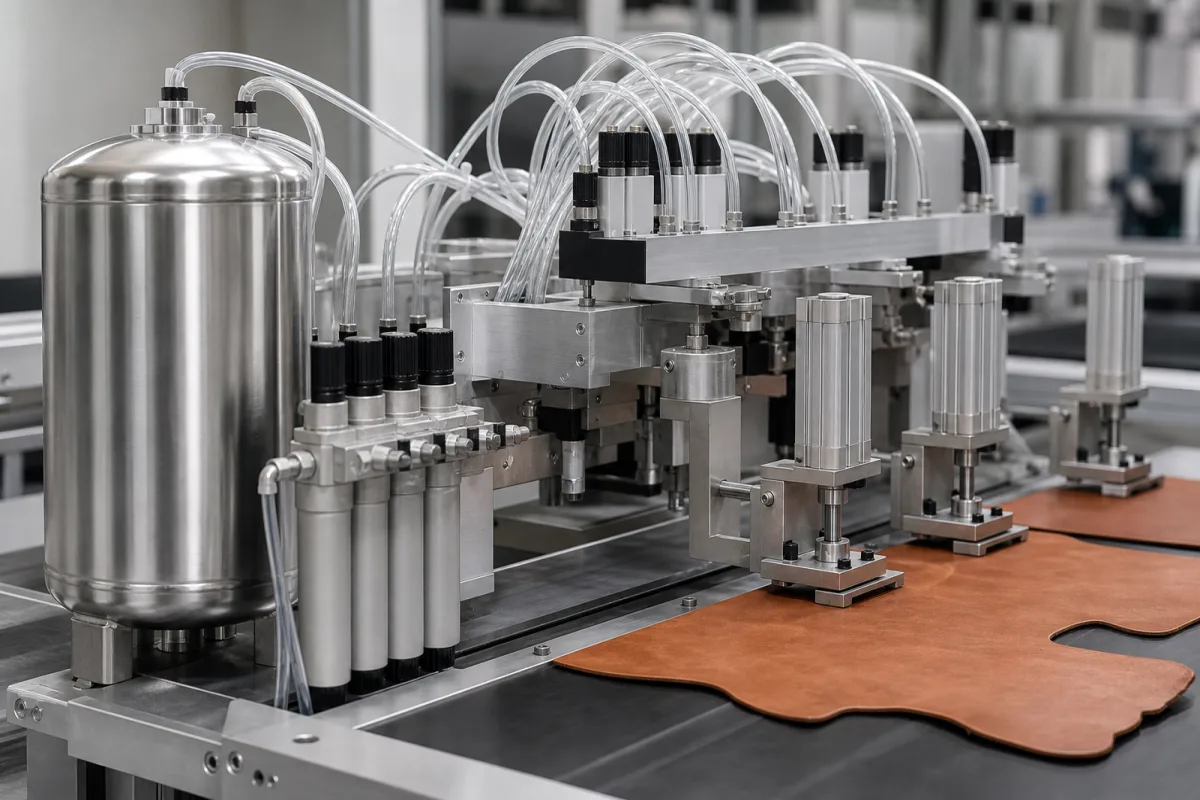
The pneumatic system in an Industrial Footwear Upper Stretching Machine is responsible for providing controlled air pressure to actuate stretching mechanisms, precisely manipulate the shoe upper material during the stretching process, and ensure consistent tension application for uniform shaping of footwear components.
Working Principle
Compressed air is generated by a compressor, filtered and regulated to precise pressure levels, then directed through valves and tubing to pneumatic cylinders or actuators. These actuators convert the air pressure into linear or rotational motion to operate the stretching mechanisms that shape the shoe upper material.
Common Materials
Aluminum alloy, Stainless steel, Synthetic rubber, Polyurethane
Technical Parameters
  • Operating pressure range for optimal stretching performance (bar) Customizable
Components / BOM
  • Air Compressor
    Generates compressed air by reducing volume and increasing pressure
    Material: Cast iron, Steel
  • Pressure Regulator
    Maintains consistent air pressure regardless of input fluctuations
    Material: Brass, Aluminum
  • Pneumatic Cylinder
    Converts air pressure into linear mechanical motion for stretching
    Material: Stainless steel, Aluminum
  • Control Valves
    Directs air flow to different parts of the system for precise control
    Material: Brass, Plastic composites
  • Air Filter
    Removes contaminants and moisture from compressed air
    Material: Polyester, Stainless steel mesh
Engineering Reasoning
6-10 bar (0.6-1.0 MPa) for standard industrial applications, 1-6 bar (0.1-0.6 MPa) for low-pressure control systems
Compressor discharge temperature exceeding 120°C causes lubricant breakdown; pressure exceeding 150% of rated pressure (typically 15 bar/1.5 MPa) causes component rupture
Design Rationale: Adiabatic compression heating exceeding lubricant flash point (200°C for mineral oils); pressure exceeding yield strength of aluminum (55 MPa) or steel (250 MPa) components
Risk Mitigation (FMEA)
Trigger Particulate contamination exceeding ISO 8573-1 Class 4 (40 μm particle size, 5 mg/m³ concentration)
Mode: Spool valve stiction causing 500 ms response delay or complete actuator lock
Strategy: Install coalescing filters with 5 μm absolute rating and automatic drains at compressor outlet
Trigger Relative humidity exceeding 80% at 40°C ambient temperature
Mode: Corrosion-induced leakage reaching 15% flow loss in aluminum actuators within 2000 operating hours
Strategy: Integrate refrigerant dryers maintaining dew point at -40°C and install corrosion-resistant coatings (e.g., PTFE lining)

Industry Taxonomies & Aliases

Commonly used trade names and technical identifiers for Pneumatic System.

Industrial Ecosystem & Supply Chain DNA

Complementary Systems
Downstream Applications
Specialized Tooling

Application Fit & Sizing Matrix

Operational Limits
pressure: Up to 10 bar (150 psi)
flow rate: 0.1 to 1000 SCFM
temperature: -20°C to 80°C
slurry concentration: Not applicable (clean, dry air only)
Media Compatibility
✓ Clean, dry compressed air ✓ Inert gases (nitrogen, argon) ✓ Non-corrosive gases
Unsuitable: Wet, corrosive, or explosive atmospheres
Sizing Data Required
  • Required force/torque (N or Nm)
  • Operating pressure (bar or psi)
  • Cycle rate/duty cycle (cycles/min and % on-time)

Reliability & Engineering Risk Analysis

Failure Mode & Root Cause
Valve Stiction
Cause: Contaminant buildup (oil, water, particulates) on valve spools or seals, often due to inadequate filtration or improper lubrication
Air Leakage
Cause: Degraded seals/O-rings from thermal cycling, chemical attack, or mechanical wear; loose fittings from vibration or improper installation
Maintenance Indicators
  • Audible hissing at connections or components indicating air leaks
  • Slow or erratic actuator movement (visual/performance signal)
Engineering Tips
  • Implement proactive filtration maintenance: Use coalescing filters with automatic drains and monitor differential pressure; maintain air quality to ISO 8573-1 Class standards
  • Establish predictive maintenance: Conduct ultrasonic leak detection surveys quarterly and monitor system pressure decay rates to identify leaks before they cause failures

Compliance & Manufacturing Standards

Reference Standards
ISO 6431: Pneumatic fluid power - Standard cylinders ANSI/NFPA T3.21.3: Pneumatic fluid power - Cylinders - Mounting dimensions DIN ISO 15552: Pneumatic fluid power - Cylinders with detachable mountings, 1,000 kPa (10 bar) series
Manufacturing Precision
  • Bore diameter: +/-0.02 mm
  • Cylinder rod straightness: 0.1 mm per 100 mm length
Quality Inspection
  • Pressure decay leak test (per ISO 19973-1)
  • Dimensional verification with coordinate measuring machine (CMM)

Factories Producing Pneumatic System

Verified manufacturers with capability to produce this product in China

✓ 98% Supplier Capability Match Found

T Technical Director from Singapore Feb 11, 2026
★★★★★
"As a professional in the Leather and Related Product Manufacturing sector, I confirm this Pneumatic System meets all ISO standards."
Technical Specifications Verified
P Project Engineer from Germany Feb 08, 2026
★★★★☆
"Standard OEM quality for Leather and Related Product Manufacturing applications. The Pneumatic System arrived with full certification. (Delivery took slightly longer than expected, but technical support was excellent.)"
Technical Specifications Verified
S Sourcing Manager from Brazil Feb 05, 2026
★★★★★
"Great transparency on the Pneumatic System components. Essential for our Leather and Related Product Manufacturing supply chain."
Technical Specifications Verified
Verification Protocol

“Feedback is collected from verified sourcing managers during RFQ (Request for Quote) and factory evaluation processes on CNFX. These reports represent historical performance data and technical audit summaries from our B2B manufacturing network.”

11 sourcing managers are analyzing this specification now. Last inquiry for Pneumatic System from Mexico (28m ago).

Supply Chain Compatible Machinery & Devices

Leather Moisture Content Analyzer

Non-destructive analyzer measuring moisture content in leather during processing

Explore Specs →
Edge Preparation Unit

A specialized component within an industrial system designed to prepare material edges for subsequent processing or assembly operations.

Explore Specs →
Pattern Processing Unit

A specialized component within an industrial system that analyzes, modifies, or generates patterns on materials or products during manufacturing processes.

Explore Specs →
Heat Transfer Assembly

A modular component within an industrial system designed to facilitate the controlled transfer of thermal energy between different media or process streams.

Explore Specs →

Frequently Asked Questions

How does a pneumatic system improve efficiency in leather manufacturing?

Pneumatic systems provide precise, rapid mechanical motion for cutting, embossing, and pressing operations, reducing cycle times and increasing production consistency in leather processing.

What maintenance is required for pneumatic systems in leather production environments?

Regular air filter cleaning/replacement, lubrication of moving parts, and inspection of synthetic rubber seals for wear from leather dust and tannins are essential for optimal performance.

Why use stainless steel components in leather manufacturing pneumatic systems?

Stainless steel resists corrosion from humidity and chemical exposure common in leather processing, ensuring longevity and reliability of valves, cylinders, and regulators.

Can I contact factories directly on CNFX?

CNFX is an open directory, not a transaction platform. Each factory profile provides direct contact information and production details to help you initiate direct inquiries with Chinese suppliers.

Get Quote for Pneumatic System

Request technical pricing, lead times, or customized specifications for Pneumatic System directly from verified manufacturing units.

Your business information is encrypted and only shared with verified Pneumatic System suppliers.

Thank you! Your message has been sent. We'll respond within 1–3 business days.

Need to Manufacture Pneumatic System?

Connect with verified factories specializing in this product category

Add Your Factory Contact Us
Previous Product
pH Monitoring Probe
Next Product
Precision Sole Attacher