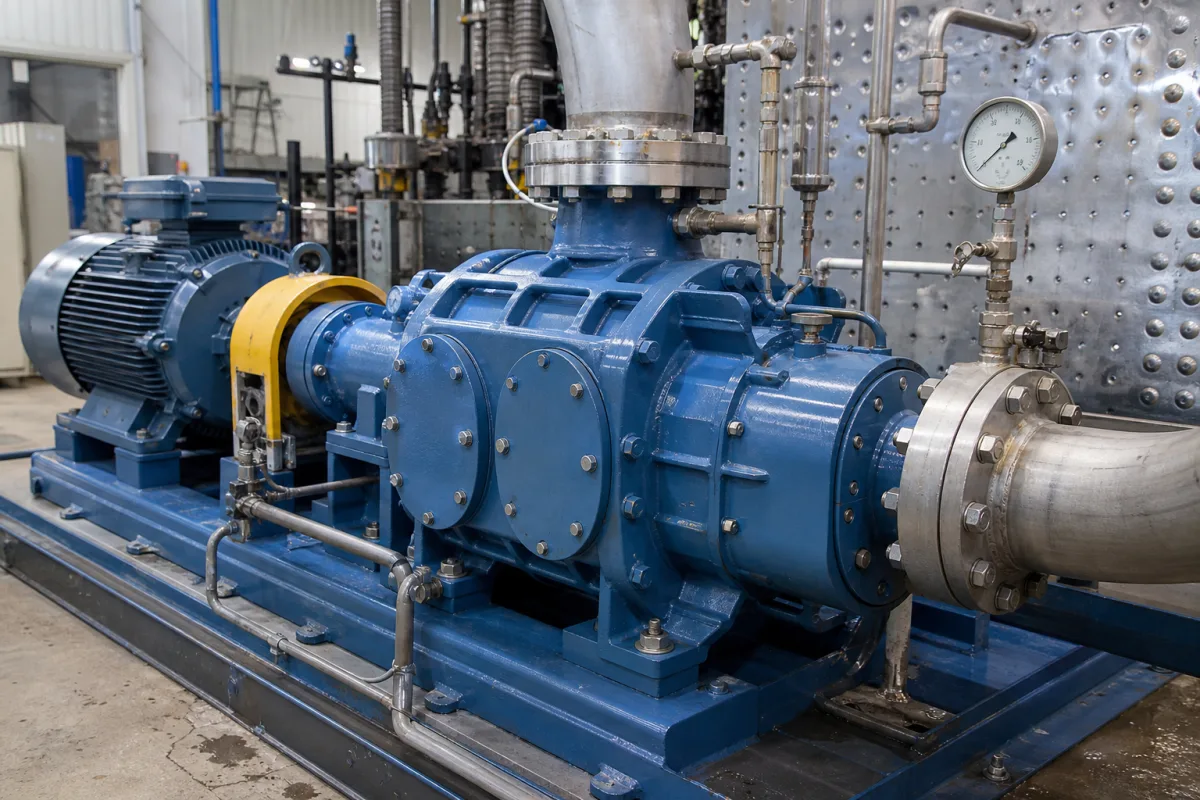
Rotary lobe positive displacement pump for viscous and solids-laden transfer
Rotary lobe pumps · Displacement per revolution and speed, differential pressure, solids and wear, rotor form and hygienic build
A rotary lobe pump is a positive displacement transfer pump in which two non-contacting lobed rotors, driven by timing gears, carry pockets of liquid from suction to discharge. Flow follows speed rather than pressure, so it is chosen for viscous, shear-sensitive or solids-bearing liquids. Ask three things first: what displacement per revolution and speed give your flow, what differential pressure the head is rated for, and how the rotor form and inlet protection handle your solids.
Rotary lobe pumps used to transfer food, beverage, cosmetic and chemical products and municipal or industrial sludge, including hygienic and heavy-duty versions, their rotor forms, shaft seals and drives. Metering pumps that dose a set volume of chemical (diaphragm, plunger, peristaltic and gear types) are covered on the Metering pump page. Piston fillers, progressive cavity pumps and centrifugal pumps are outside this page.
CNFX editorial research · Sources checked October 12, 2026 · 3 sources
Size by displacement per revolution, speed and pressure
Alfa Laval's OptiLobe leaflet lists ten pump heads from 0.06 L/rev (model 12, 25 mm ports) to 1.72 L/rev (model 53, 100 mm ports), each rated for 8 bar (115 psi) differential pressure, with maximum speed of 1,000 rpm up to model 43 and 750 rpm for models 52 and 53. It gives a maximum temperature of 266 °F and flow up to 383 US gal/min for the range. [1]
Editorial calculation: theoretical flow is displacement × speed. The model 53 at 750 rpm gives 1.72 × 750 = 1,290 L/min, or about 77 m³/h; the model 33 (0.40 L/rev) at 500 rpm gives 200 L/min, or 12 m³/h. Real delivery is lower by the internal slip at your viscosity and pressure, so ask the supplier for a curve at your duty. [1]
ACE's product page states that its flow table is measured on water, that speed is set between 200 and 900 rpm with a variable-speed motor or frequency converter, and that motor power must be increased for high-viscosity liquids. ACE claims its pumps can move products up to 1,000,000 cP. [2]
Give the supplier the product, its viscosity at pumping temperature (and whether it thins under shear), density, solids size and content, required flow range, suction and discharge pipework with static heads, temperature, CIP or SIP needs and the duty cycle.
02
Protect against hard solids, wear and pipe friction
LobePro applies its rotary lobe pumps to wastewater sludge at flows up to 2,000 gpm and pressures up to 150 psi once hard solids over 1/8 in (3 mm) and grit have been removed; where such solids are consistently present it suggests an in-line grinder, filter or knock-out tank. It states that pump speed affects wear exponentially and that lobe tip speed is the best measure of speed for wear. [3]
LobePro states the pumps can self-prime with swan-necked suction and discharge fittings, with suction lift depending on speed, viscosity and specific gravity. It warns that pipe friction losses for some sludges exceed those for water and asks for head calculations that allow for this; it notes that the EPA friction curve it reproduces is a rough guideline only for pipe velocities of 2.5–8 ft/s, and that restarting a line shut down for over a day can need unusually high pressure. [3]
Editorial calculation: 2,000 gpm is about 454 m³/h and 150 psi about 10.3 bar, against 77 m³/h and 8 bar for the largest OptiLobe head, so hygienic food heads and sludge heads cover different duty ranges. [3][1]
03
Choose rotor form, seals and materials
ACE lists four rotor forms: single-lobe for products with large solid particles, butterfly rotors for fillings and viscous products with solids, three-lobe rotors for general viscous transfer, and multi-lobe rotors, which it says improve delivery but can break the product. Options include 304 or 316L stainless steel, drives from 0.55 to 55 kW, 110–600 V, heating jackets and trolleys. [2]
The OptiLobe head is 316L with EPDM or FPM product elastomers, a single carbon/stainless-steel shaft seal (single-flush option at a maximum flush pressure of 7 psi and 8 gph), duplex stainless shafts and a front-loading seal that can be changed without disturbing pipework. Alfa Laval states the range is EHEDG-certified as CIP cleanable and conforms to 3-A. [1]
04
Sanitary lobe pumps for food and cosmetics, and heavy-duty units for sludge
Listings range from sanitary lobe pumps with a choice of rotor forms for food and cosmetics to heavy-duty lobe pumps for wastewater sludge.
Displacement, speed, differential pressure, viscosity and port size for a rotary lobe pump
Flow follows displacement per revolution times speed, for example 0.06 to 1.72 L/rev across the OptiLobe heads, so ask for the curve at your viscosity rather than water flow. [1]
Field
What it means and published values
Ask the supplier for
Flow Rate (m³/h)
OptiLobe up to 77 m³/h (editorial calculation); LobePro sludge up to 2,000 gpm. [1][3]
2 companies list this product among what they make. Company figures are quoted from each
company's own website; every card states where the relationship came from.
ACE LOBE PUMP
Manufacturing site to be confirmed for the order
Lists sanitary rotary lobe pumps with single, butterfly, three- and multi-lobe rotors, 0.55–55 kW drives and heating-jacket options.
Explore company information and manufacturing capabilities, then discuss the scope of your project with a relevant supplier.
Share this page
Compiled and source-reviewed by the CNFX editorial team.
Each manufacturer above links to the page on that company's own website where the product is listed, with the date we checked it. How we source and review
· Page last updated 13 October 2026
Buyer questions
How do I estimate a lobe pump's flow?
Multiply displacement per revolution by speed: an OptiLobe 53 at 1.72 L/rev and 750 rpm gives about 77 m³/h before slip (editorial calculation). [1]
What solids can a rotary lobe pump handle?
LobePro says its sludge pumps suit duties once hard solids over 1/8 in (3 mm) are removed, and suggests a grinder, filter or knock-out tank where they are present; ACE offers single-lobe rotors for large particles. [3][2]
What pressure is a hygienic lobe pump rated for?
Alfa Laval's OptiLobe range is rated for 8 bar (115 psi) differential pressure. [1]
Sources and what still needs a direct check
Sources checked 2026-10-12. Alfa Laval, ACE and LobePro are pump makers; their leaflets and product pages describe their own pumps. LobePro's notes reproduce an EPA sludge friction curve as a rough guideline.