Industry-Verified Manufacturing Data (2026)

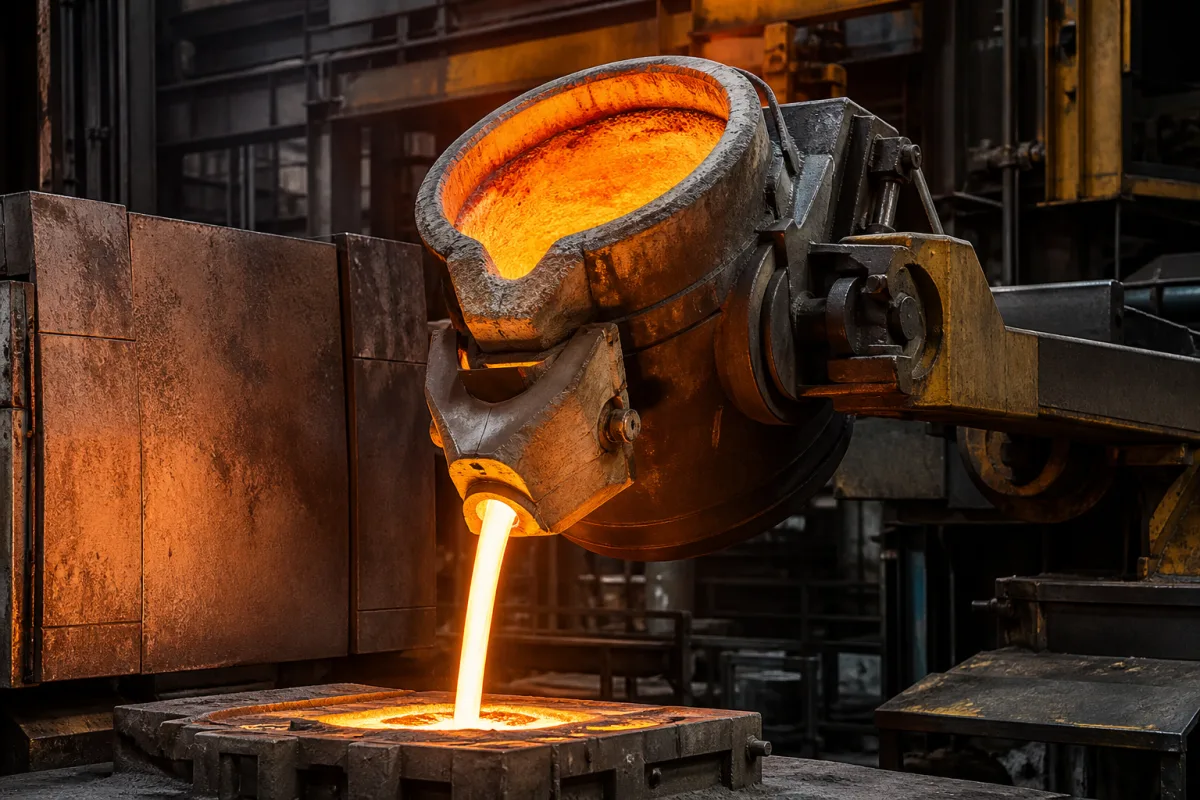
Pouring Ladle/Nozzle

Based on aggregated insights from multiple verified factory profiles within the CNFX directory, the standard Pouring Ladle/Nozzle used in the Machinery and Equipment Manufacturing sector typically supports operational capacities ranging from standard industrial configurations to heavy-duty production requirements.

Technical Definition & Core Assembly

A canonical Pouring Ladle/Nozzle is characterized by the integration of Nozzle Tip and Valve Mechanism. In industrial production environments, manufacturers listed on CNFX commonly emphasize Stainless steel construction to support stable, high-cycle operation across diverse manufacturing scenarios.

A precision pouring component that controls the flow and direction of molten material in automated pouring systems.
Product Specifications

Technical details and manufacturing context for Pouring Ladle/Nozzle

Definition
The pouring ladle/nozzle is a critical component of robotic pouring systems designed for precise, automated material transfer. It functions as the terminal interface that directly contacts and controls the flow of molten substances (such as metals, plastics, or other materials) from the reservoir to the mold or target container. This component ensures accurate pouring volume, controlled flow rates, and directional precision while minimizing spillage and material waste in industrial manufacturing processes.
Working Principle
The pouring ladle/nozzle operates by receiving molten material from the robotic arm's reservoir system. Through controlled tilting mechanisms (for ladles) or valve systems (for nozzles), it regulates the flow rate and direction of material discharge. The component maintains thermal stability to prevent premature solidification while ensuring smooth, laminar flow to achieve precise filling of molds or containers in automated production lines.
Common Materials
Stainless steel, Refractory ceramics, High-temperature alloys
Technical Parameters
  • Orifice diameter or ladle capacity specifications (mm) Per Request
Components / BOM
  • Nozzle Tip
    Directs and shapes the material flow stream
    Material: Refractory ceramic
  • Valve Mechanism
    Controls flow start/stop and regulates flow rate
    Material: Stainless steel
  • Thermal Insulation Layer
    Maintains material temperature and prevents heat loss
    Material: Ceramic fiber
Engineering Reasoning
0.5-2.5 bar pressure differential, 1450-1650°C temperature range, 0.1-5.0 kg/s flow rate
Thermal stress exceeds refractory material yield strength (≥45 MPa at 1700°C), erosion depth exceeds 15mm wall thickness, nozzle clogging at ≤0.5mm orifice diameter
Design Rationale: Thermal fatigue from cyclic heating/cooling (ΔT≥300°C), erosion from high-velocity molten material flow (≥3 m/s), solidification due to heat loss below liquidus temperature (ΔT≥50°C)
Risk Mitigation (FMEA)
Trigger Refractory lining thermal shock from rapid temperature change (ΔT≥200°C/min)
Mode: Cracking and spalling of refractory material leading to molten material leakage
Strategy: Graded refractory lining with zirconia-alumina composite (thermal expansion coefficient 8.5×10⁻⁶/°C) and controlled preheating protocol (≤100°C/min)
Trigger Alumina buildup from molten aluminum oxidation (Al₂O₃ formation rate ≥0.1 mm/hour)
Mode: Nozzle orifice restriction causing flow instability and pressure fluctuations (≥±0.3 bar)
Strategy: Boride coating (TiB₂) with contact angle >120° against molten aluminum and argon gas purging at 5-10 L/min

Industry Taxonomies & Aliases

Commonly used trade names and technical identifiers for Pouring Ladle/Nozzle.

Applied To / Applications

This component is essential for the following industrial systems and equipment:

Industrial Ecosystem & Supply Chain DNA

Complementary Systems
Downstream Applications
Specialized Tooling

Application Fit & Sizing Matrix

Operational Limits
pressure: Max 0.5 bar (7.25 psi) backpressure, typically atmospheric or slight positive pressure
flow rate: 0.5-500 kg/min depending on nozzle diameter and material density
temperature: Up to 1800°C (3272°F) for molten metals, 1400°C (2552°F) for ceramics/slag
slurry concentration: Not applicable - designed for molten materials, not slurries
Media Compatibility
✓ Molten aluminum alloys (600-800°C) ✓ Molten cast iron (1200-1500°C) ✓ Molten copper alloys (1000-1200°C)
Unsuitable: Highly corrosive molten salts or reactive metals (e.g., titanium, magnesium without special lining)
Sizing Data Required
  • Required pour rate (kg/min or volume/time)
  • Molten material density and viscosity
  • Desired pour accuracy/precision (±% of target weight)

Reliability & Engineering Risk Analysis

Failure Mode & Root Cause
Thermal fatigue cracking
Cause: Repeated heating and cooling cycles during pouring operations cause expansion and contraction stresses, leading to crack initiation and propagation in refractory materials, especially at joints and nozzle interfaces.
Erosion and corrosion wear
Cause: High-temperature molten metal flow combined with chemical reactions (slag attack, oxidation) and abrasive particles in the melt gradually degrade refractory lining and nozzle geometry, compromising flow control and structural integrity.
Maintenance Indicators
  • Visible cracks, spalling, or excessive refractory wear on ladle lining or nozzle surface during inspection
  • Irregular or uncontrolled metal flow during pouring, including dripping, streaming deviations, or difficulty maintaining consistent pour rate
Engineering Tips
  • Implement controlled preheating and cooling protocols to minimize thermal shock; use graded refractory materials with matched thermal expansion coefficients at critical interfaces.
  • Establish regular refractory thickness monitoring (ultrasonic testing) and nozzle geometry checks; apply protective coatings or use erosion-resistant materials in high-wear areas.

Compliance & Manufacturing Standards

Reference Standards
ISO 9001:2015 Quality Management Systems ASTM A297/A297M-22 Standard Specification for Steel Castings, Iron-Chromium and Iron-Chromium-Nickel, Heat Resistant EN 1090-1:2009+A1:2011 Execution of steel structures and aluminium structures
Manufacturing Precision
  • Nozzle bore diameter: +/-0.05mm
  • Ladle flange flatness: 0.2mm per 300mm
Quality Inspection
  • Dye Penetrant Test for surface defects
  • Ultrasonic Testing for internal flaws

Factories Producing Pouring Ladle/Nozzle

Verified manufacturers with capability to produce this product in China

✓ 92% Supplier Capability Match Found

T Technical Director from United States Feb 15, 2026
★★★★★
"Found 24+ suppliers for Pouring Ladle/Nozzle on CNFX, but this spec remains the most cost-effective."
Technical Specifications Verified
P Project Engineer from United Arab Emirates Feb 12, 2026
★★★★☆
"The technical documentation for this Pouring Ladle/Nozzle is very thorough, especially regarding technical reliability. (Delivery took slightly longer than expected, but technical support was excellent.)"
Technical Specifications Verified
S Sourcing Manager from Australia Feb 09, 2026
★★★★★
"Reliable performance in harsh Machinery and Equipment Manufacturing environments. No issues with the Pouring Ladle/Nozzle so far."
Technical Specifications Verified
Verification Protocol

“Feedback is collected from verified sourcing managers during RFQ (Request for Quote) and factory evaluation processes on CNFX. These reports represent historical performance data and technical audit summaries from our B2B manufacturing network.”

10 sourcing managers are analyzing this specification now. Last inquiry for Pouring Ladle/Nozzle from India (1h ago).

Supply Chain Compatible Machinery & Devices

Automated Assembly Line System

Integrated production system for sequential component assembly operations

Explore Specs →
Automated Powder Coating System

Integrated industrial system for applying dry powder coatings to metal substrates.

Explore Specs →
Centrifugal Pump Impeller

Rotating component that transfers energy to fluid in centrifugal pumps.

Explore Specs →
High-Precision CNC Laser Cutting Machine

Computer-controlled industrial machine using focused laser beams to cut sheet metal with micron-level accuracy.

Explore Specs →

Frequently Asked Questions

What materials are used in this pouring ladle/nozzle for high-temperature applications?

Our pouring ladle/nozzle utilizes stainless steel for structural components, refractory ceramics for thermal insulation, and high-temperature alloys for critical wear parts to withstand molten material environments.

How does the valve mechanism in this pouring nozzle control flow precision?

The integrated valve mechanism provides precise regulation of molten material flow through automated actuation, ensuring consistent pouring rates and directional control in automated manufacturing systems.

What industries benefit from this precision pouring component?

This pouring ladle/nozzle is designed for machinery and equipment manufacturing sectors requiring automated molten material handling, including foundries, metal casting operations, and industrial processing facilities.

Can I contact factories directly on CNFX?

CNFX is an open directory, not a transaction platform. Each factory profile provides direct contact information and production details to help you initiate direct inquiries with Chinese suppliers.

Get Quote for Pouring Ladle/Nozzle

Request technical pricing, lead times, or customized specifications for Pouring Ladle/Nozzle directly from verified manufacturing units.

Your business information is encrypted and only shared with verified Pouring Ladle/Nozzle suppliers.

Thank you! Your message has been sent. We'll respond within 1–3 business days.

Need to Manufacture Pouring Ladle/Nozzle?

Connect with verified factories specializing in this product category

Add Your Factory Contact Us
Previous Product
Positive Displacement Pump
Next Product
Powder Feeding System