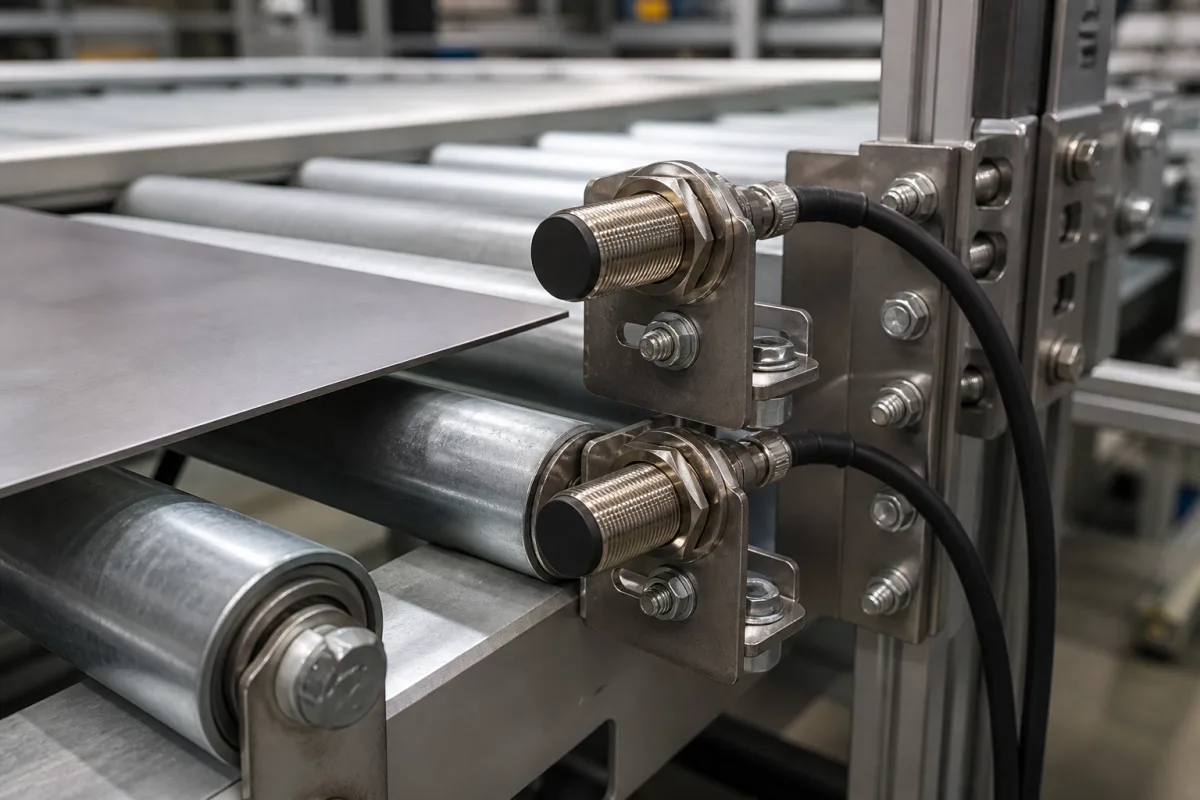
Factor 1 (all-metal) inductive proximity sensors for mixed-metal parts and sheet on conveyors
Factor 1 inductive proximity sensors · same switching distance on steel, stainless, aluminium and copper, thin-sheet targets, weld-field immunity and double switching
A standard inductive proximity sensor is rated on a steel target and switches much closer to aluminium, brass or copper, so a sensor set up for steel parts can miss a non-ferrous part on the same conveyor. Factor 1 sensors, built without a ferrite-core coil, are made to switch at the same distance on all metals. They also cost more, can double-switch on small parts passing sideways, and do not all reach factor 1 on thin sheet. Check the factor table at your target material and thickness, the switching frequency, and whether the sensor must work beside resistance welding.
Inductive proximity sensors with reduction factor 1 (all-metal sensors), in threaded barrel and block housings, including weld-field-immune versions for welding lines and sheet handling. Standard ferrite-core inductive sensors, their steel-target sensing distance, correction factors and PNP/NPN wiring are covered on the Proximity sensor page; brackets and holders for barrel sensors are covered on the Sensor mount page; Hall-effect angle sensors are covered on the Control sensor page. Capacitive, photoelectric and ultrasonic sensors are outside this page.
CNFX editorial research · Sources checked October 12, 2026 · 4 sources
Steel, stainless, aluminium and copper: how far a standard sensor's range shrinks
autosen explains that the actual sensing range for a metal is the nominal range multiplied by the correction factor in the datasheet, and lists these factors for standard inductive sensors. [1]
autosen describes the factor 1 design as replacing the single coil in a ferrite core with two electrically linked air-core coils, so the sensing range stays constant for all metals. It lists the drawbacks as a higher price and possible double switching: small objects that pass the sensor from the side can produce two switching pulses. [1]
SICK says the same of its IMR family: built without a ferrite core, the sensors give uniform sensing ranges on non-ferrous metals such as aluminium or stainless steel, and reach up to three times the distance the standard prescribes, up to 75 mm across the family. [4] Editorial note: for a line that carries only steel parts, a standard sensor already reads at its rated distance; factor 1 earns its price where steel, stainless and non-ferrous parts share one sensor position.
Target metal
Standard-sensor correction factor (autosen)
Editorial calculation: switching distance of an 8 mm rated sensor
Give the supplier every target metal and its thickness, the gap from sensor face to target, the target size and the direction it passes the sensor, flush or non-flush mounting, conveyor speed and part spacing, and any welding or strong magnetic fields nearby.
02
Factor tables at sheet thickness: what a factor 1 datasheet may still list
ipf electronic's IC18A174, an all-steel M18 flush sensor, is described as factor 1 and ticked as a material-independent sensor, with a 10 mm switching distance measured on a 30 × 30 × 1 mm plate. Its own correction table is not all 1: aluminium 1, St37 steel 1, brass 1.2, copper 0.8, and stainless steel V2A 0.5 at 1 mm and 0.9 at 2 mm. [3]
Editorial calculation: on the IC18A174's 10 mm rating those factors give 12 mm for brass, 8 mm for copper, and 5 mm for 1 mm stainless sheet against 9 mm for 2 mm sheet. The label and the table disagree for copper, brass and thin stainless, so ask the supplier to confirm the switching distance at your sheet material and thickness rather than relying on the factor 1 label. [3]
autosen's AI030 lists St37, V2A stainless, brass, aluminium and copper each at 1, with hysteresis of 3 to 15% of the real switching distance; its table does not state a test thickness. [2]
03
Three M18 factor 1 sensors: range, switching frequency and output
The three makers' M18 sensors show how far rated range and switching speed vary within the factor 1 class.
Editorial calculation: the AI030's 2000 Hz is ten times the IC18A174's 200 Hz. At 200 Hz a sensor completes at most 200 on-off cycles a second, one every 5 ms; compare that with the number of parts or teeth passing per second. [2][3] Ask for the switching frequency measured to the standard method for the model offered.
Hysteresis differs too: ipf lists 15%, autosen 3 to 15% of the real switching distance. [3][2] Editorial note: a part that stops on a conveyor near the switching point may flicker if the hysteresis band is small; set the sensing gap well inside the rated distance.
Weld-field immunity and spatter on welding and pressing lines
SICK lists IMR applications as clamping-device and presence monitoring in welding, positioning of skid conveyors, sheet-metal presence in punching, and material feed units. Without ferrite cores the sensors resist strong magnetic fields such as those from resistance welding, and a PTFE non-stick coating on the metal sleeves keeps weld spatter from sticking. [4]
autosen rates the AI030 as magnetic-field resistant up to 300 mT. [2] Editorial note: a weld-immune rating is a field strength, not a yes-or-no property; ask for the value in mT and the welding current or frequency it was tested at, and compare it with the distance from the sensor to the welding gun or transformer.
05
Send the targets, gap and line conditions together
Paste it into your enquiry below or into an email to a maker, then replace every bracket.
Targets: [metals; sheet thickness; part size]
Gap: [sensor face to target; flush or non-flush]
Motion: [direction past the sensor; speed; parts per second]
Size: [M12, M18, M30 or block]
Output: [PNP or NPN; NO or NC; IO-Link; load current]
Environment: [welding nearby and field strength; spatter; washdown IP rating; temperature]
Evidence: [factor table at your thickness; switching frequency]
Explore company information and manufacturing capabilities, then discuss the scope of your project with a relevant supplier.
Share this page
Compiled and source-reviewed by the CNFX editorial team.
Each manufacturer above links to the page on that company's own website where the product is listed, with the date we checked it. How we source and review
· Page last updated 13 October 2026
Buyer questions
What is a factor 1 inductive sensor?
An inductive proximity sensor designed to switch at the same distance on all metals; autosen describes two linked air-core coils in place of the ferrite-core coil of a standard sensor. [1]
How much closer does a standard sensor switch on aluminium?
autosen lists correction factors of 0.30–0.45 for aluminium and 0.25–0.45 for copper, against 1.00 for steel. [1]
Is a factor 1 sensor exactly 1 on every metal?
Not always: ipf's IC18A174, labelled factor 1, lists 0.8 for copper, 1.2 for brass and 0.5 for 1 mm stainless sheet. [3]
Sources and what still needs a direct check
Sources checked 2026-10-12. autosen, ipf electronic and SICK are German sensor makers publishing their own datasheets and application notes; the factor tables and ratings are their stated values for the models named.