Editorial Technical Reference

Radiator/Fan Assembly

This page explains how Radiator/Fan Assembly is classified within Machinery and Equipment Manufacturing. Technical values and manufacturer relationships are research references; confirm the current specification and supplier evidence for each order.

Technical Definition & Core Assembly

The Radiator/Fan Assembly is a component used in machinery and equipment manufacturing to manage heat in systems that generate significant thermal loads.
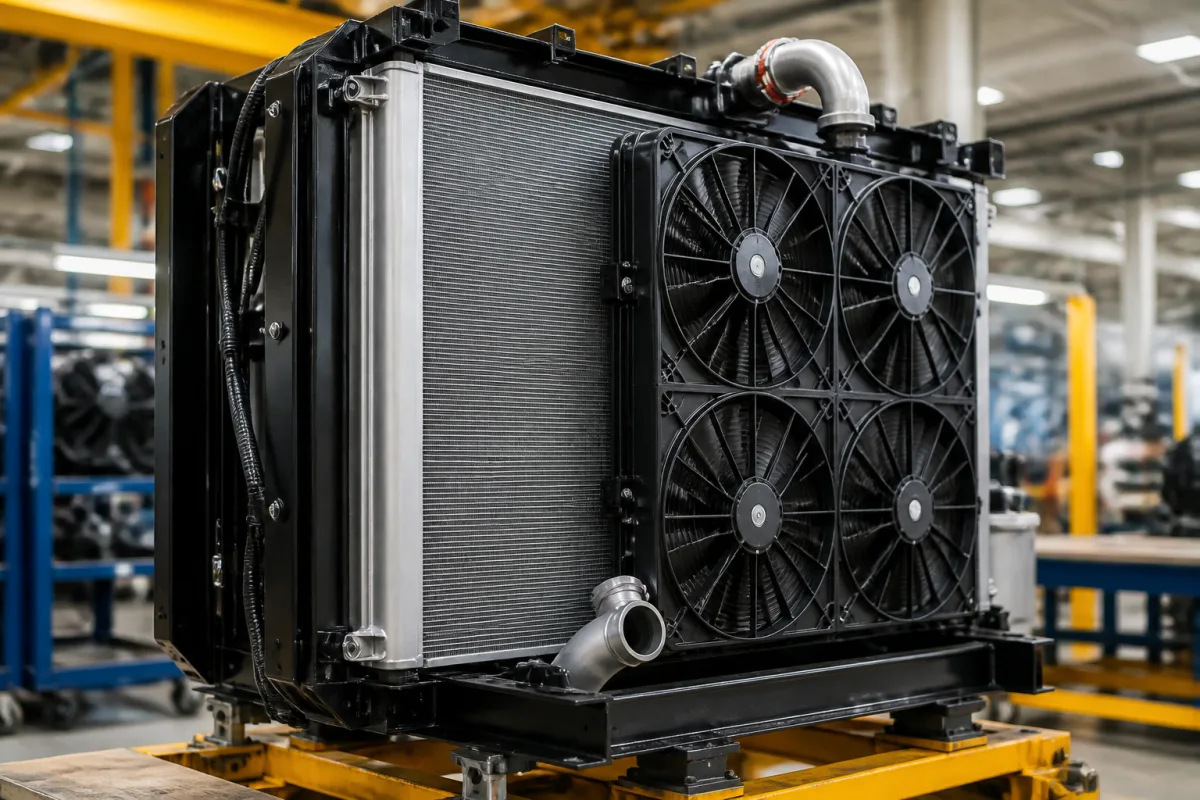
Radiator/Fan Assembly in a manufacturing environment
Representative product image. Confirm appearance and specifications with the manufacturer.

Product Specifications

Technical details and manufacturing context for Radiator/Fan Assembly

Definition
The Radiator/Fan Assembly is a component used in machinery and equipment manufacturing to manage heat in systems that generate significant thermal loads. It integrates a radiator, which acts as a heat exchanger, with one or more fans to actively dissipate heat. The radiator transfers heat from a coolant or directly from a surface to the surrounding air through conduction and convection, while the fan forces airflow across the radiator's fins and tubes, accelerating heat transfer. This assembly is critical for preventing overheating in applications such as industrial machinery, power electronics, and process equipment, ensuring reliable operation and extending component life.

The assembly is available in a range of configurations to suit different thermal management needs. Core dimensions vary from 400–1200 mm in width, 300–800 mm in height, and 40–100 mm in depth, with custom sizes available. Heat dissipation capacity ranges from 10 to 200 kW, depending on airflow and temperature difference. Airflow rate, measured at free air conditions per ISO 5801, spans 500–8000 m³/h. Fan speed ranges from 1000 to 3000 rpm, with higher speeds increasing both airflow and noise. Noise levels, measured at 1 meter distance per ISO 3744, are between 60 and 85 dB(A). Operating voltage options are 12 or 24 V DC, with other voltages available on request. Power consumption varies from 50 to 500 W, depending on fan speed and size. The assembly operates within a coolant temperature range of -40 to 85 °C and an operating pressure of 1.0–1.6 MPa. Ingress protection ratings range from IP54 to IP65 per IEC 60529 for outdoor or dusty environments. Materials include aluminum alloy, copper, plastic polymers, and steel; the core is typically aluminum with copper tubes, per ASTM B111. Weight ranges from 5 to 50 kg depending on size and material.

This directory entry provides reference values; actual model-specific specifications must be verified with the legal manufacturer or supplier.
Working Principle
Heat from the system is transferred to the radiator's fins and tubes via coolant or direct contact. The fan creates forced airflow across the radiator surfaces, accelerating heat transfer to the ambient environment through convection. The assembly maintains optimal operating temperatures by balancing heat generation with dissipation capacity. The fan speed and airflow rate are key factors in cooling efficiency, while the radiator's material and design influence thermal conductivity and pressure drop. Proper selection requires matching the assembly's heat dissipation capacity to the system's thermal load, considering ambient temperature, airflow restrictions, and available space.
Common Materials
Aluminum alloy, Copper, Plastic polymers, Steel
Technical Parameters
ParameterTypical rangeNotes & selection driver
Core Dimensions (W x H x D)400–1200 x 300–800 x 40–100 mmCustom sizes available
Heat Dissipation Capacity10–200 kWDepends on airflow and temperature difference
Airflow Rate500–8000 m³/hAt free air conditionsISO 5801
Fan Speed1000–3000 rpmHigher speed increases airflow and noise
Noise Level60–85 dB(A)At 1 m distanceISO 3744
Operating Voltage12/24 V DCOther voltages on request
Power Consumption50–500 WDepends on fan speed and size
Operating Temperature-40–85 °CCoolant temperature range
Ingress ProtectionIP54–IP65For outdoor or dusty environmentsIEC 60529
MaterialAluminum/CopperCore: aluminum; tubes: copperASTM B111
Weight5–50 kgDepends on size and material

Ranges are indicative industry figures for RFQ preparation, not a supplier commitment. Confirm every value and standard with the legal manufacturer before ordering.

Components / BOM
  • Radiator Core Part
    Primary heat exchange surface with fins/tubes for maximum thermal transfer
    Material: Aluminum or copper
  • Fan Blades Part
    Generate airflow across radiator surfaces
    Material: Plastic or aluminum
  • Motor Housing Part
    Encloses and protects fan motor assembly
    Material: Plastic or die-cast aluminum
  • Mounting Brackets Part
    Secure assembly to equipment or chassis
    Material: Steel or aluminum

Application & selection

Application Fit & Sizing Matrix

Operational Limits
pressure: 0-2 bar system pressure, 3 bar burst pressure
flow rate: 5-50 L/min coolant flow
temperature: -40°C to +85°C
slurry concentration: Not applicable - designed for clean coolant only
Media Compatibility
✓ Ethylene glycol/water mixtures (50/50) ✓ Propylene glycol solutions ✓ Deionized water with corrosion inhibitors
Unsuitable: Abrasive slurry or particulate-laden fluids
Sizing Data Required
  • Heat dissipation requirement (kW)
  • Available space dimensions (L×W×H)
  • Airflow restriction/available static pressure

Risk, maintenance & compliance

Reliability & Engineering Risk Analysis

Failure Mode & Root Cause
Fan Bearing Failure
Cause: Lubrication degradation due to heat cycling and contamination ingress, leading to increased friction and eventual seizure or excessive play.
Radiator Core Corrosion/Clogging
Cause: Electrolytic corrosion from coolant chemistry imbalance or external debris accumulation (e.g., insects, dust) restricting airflow and heat transfer.
Maintenance Indicators
  • Unusual grinding or whining noise from the fan assembly during operation
  • Visible coolant leaks at radiator seams or persistent overheating indicated by temperature gauges
Engineering Tips
  • Implement regular coolant analysis and flushing schedules to maintain proper chemical balance and prevent internal corrosion/scale buildup.
  • Establish routine cleaning of radiator fins and inspection of fan blade integrity, ensuring debris screens are intact and operational.

Indicative industry ranges for design and RFQ preparation. Confirm the exact figures and applicable standard with the manufacturer before specifying.

Compliance & Manufacturing Standards

Applicable Standards
ANSI/ASHRAE 33-2016 - Methods of Testing Forced Circulation Air Cooling and Air Heating Coils DIN EN 442-2:2014 - Radiators and convectors - Part 2: Test methods and rating

Quoted from the published standard.

Manufacturing Precision
  • Mounting Hole Alignment: +/-0.5mm
  • Fan Blade Balance: 0.1g-cm maximum imbalance
Quality Inspection
  • Airflow Performance Test (per ANSI/AMCA 210)
  • Thermal Cycling Endurance Test
Technical documentation
Request current drawings, revision history, and a signed specification sheet.
Manufacturing capability
Verify equipment lists, process limits, capacity, and representative production evidence.
Inspection readiness
Confirm test methods, calibrated equipment, sampling plans, and traceable reports.
Supplier transparency
Check the legal entity, factory address, ownership, certifications, and direct contacts.

Compare the published product scope and source details, then include your specifications and quantity in an enquiry.

Manufacturers of Radiator/Fan Assembly

Manufacturer profiles associated with Radiator/Fan Assembly.

Sourcing Radiator/Fan Assembly from China?
Tell us your specification and target quantity — we will match it against manufacturer records and come back with the factories that fit.
Request manufacturers We manufacture this

Explore company information and manufacturing capabilities, then discuss the scope of your project with a relevant supplier.

Buyer enquiry

Request manufacturing insight for Radiator/Fan Assembly

Ask for use case, specification boundaries, supplier type, and RFQ preparation information for this product.

Where it goes
Straight to the CNFX editorial desk, and to the manufacturer if this product is linked to a claimed profile. Nothing is broadcast to a supplier list.
Your details stay here
We do not sell or rent enquiry data, and we do not add you to a mailing list. Used only to answer this request.
No commission, no middleman
CNFX is a directory. We take no cut of any order and never negotiate on a supplier's behalf.
What to include
Share your product specifications, quantity, destination and target delivery date.

Your business information is used only to process this request.

Thank you! Your message has been sent. We'll respond within 1–3 business days.
Sorry, we couldn't send your message. Please try again, or email us at [email protected].

Frequently Asked Questions

What is the typical heat dissipation capacity of this assembly?

The heat dissipation capacity ranges from 10 to 200 kW, depending on airflow and temperature difference. The actual capacity for a specific model must be confirmed with the manufacturer based on your system's thermal load and operating conditions.

What are the available operating voltages?

Standard operating voltages are 12 V DC and 24 V DC. Other voltages may be available on request, but you should verify with the supplier for your specific application.

What ingress protection ratings are offered?

The assembly is available with ingress protection ratings from IP54 to IP65 per IEC 60529, suitable for outdoor or dusty environments. The required rating depends on the installation environment and must be confirmed with the manufacturer.

How do I verify that the assembly meets my requirements?

You should check the core dimensions, heat dissipation capacity, airflow rate, fan speed, noise level, operating voltage, power consumption, operating temperature, operating pressure, ingress protection, material, and weight against your system's specifications. Always confirm model-specific values and standards with the legal manufacturer or supplier.

Related equipment

Applied To / Applications

This component is essential for the following industrial systems and equipment:

Data Basis

Editorial classification, named public sources where available, and source-reviewed manufacturer records.

Preliminary Technical Classification
This page supports structured research, RFQ preparation, and supplier evaluation. It does not replace buyer-led supplier qualification, standards review, or technical approval.

Need to Manufacture Radiator/Fan Assembly?

Compare manufacturer profiles with relevant product and process capability.

Previous Product
Z-axis Ram/Spindle
Last Product
Get QuotesChat