Editorial Technical Reference

Radiation Source Rack

This page explains how Radiation Source Rack is classified within Machinery and Equipment Manufacturing. Technical values and manufacturer relationships are research references; confirm the current specification and supplier evidence for each order.

Technical Definition & Core Assembly

A structural component that securely holds and positions gamma radiation sources within an automated sterilization system.
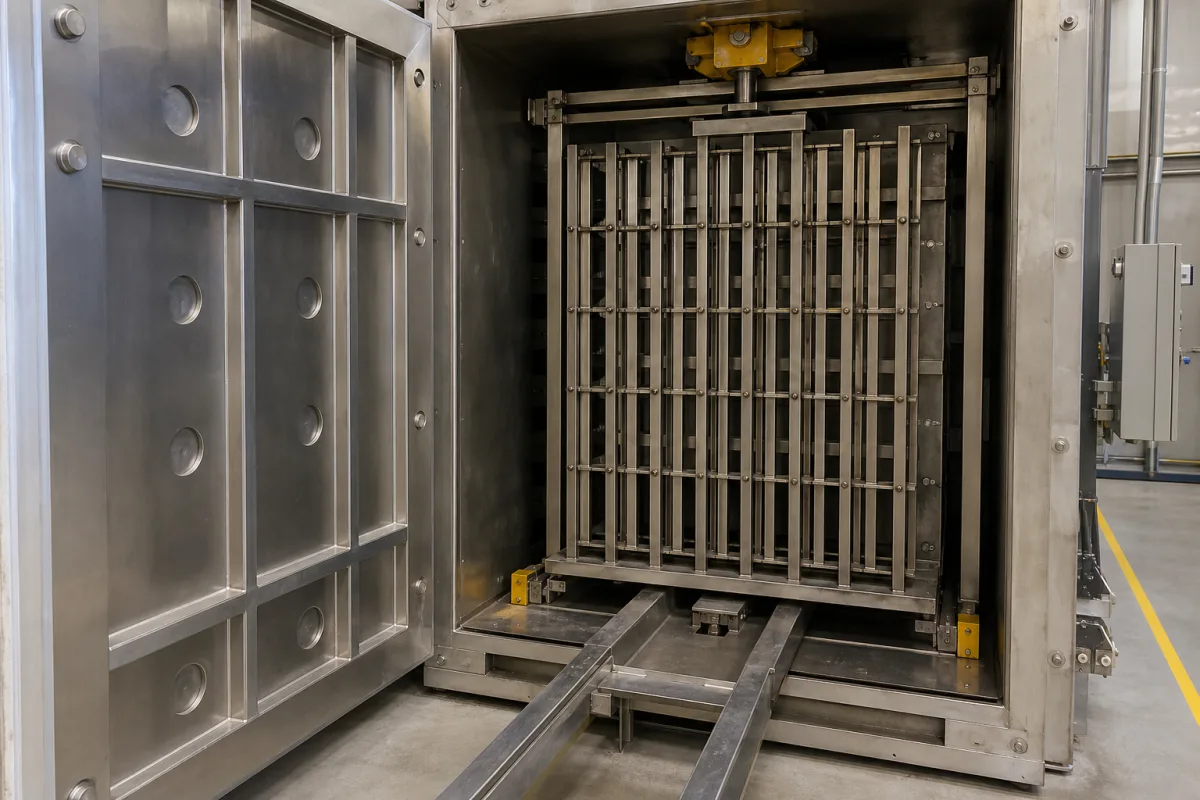
Radiation Source Rack in a manufacturing environment
Representative product image. Confirm appearance and specifications with the manufacturer.

Product Specifications

Technical details and manufacturing context for Radiation Source Rack

Definition
The Radiation Source Rack is a critical safety component of the Automated Gamma Sterilization Processing Line designed to precisely position and secure radioactive sources (typically Cobalt-60 or Cesium-137) within the sterilization chamber. It ensures proper source geometry for uniform dose distribution while providing mechanical stability and radiation shielding integration points. The rack is fabricated from materials selected for their resistance to gamma radiation and corrosion, including stainless steel grades 304L to 316L, lead shielding components, and radiation-resistant polymers. Its design accommodates a source capacity of 12 to 48 positions, with a center-to-center pitch of 50 to 100 mm. Overall dimensions range from 1200 to 2400 mm in height, 600 to 1200 mm in width, and 400 to 800 mm in depth. The rack is engineered to operate continuously at temperatures up to 150°C and to withstand a total absorbed dose of 1×10^6 Gy without degradation, as referenced in ISO 11137. Positioning tolerance is maintained within ±0.5 mm to ensure dose uniformity, and the surface finish is specified as Ra 0.8–1.6 μm to minimize contamination and facilitate cleaning. The maximum load capacity, including sources and structure, is 500 to 2000 kg. Corrosion resistance is verified through salt spray testing per ASTM B117, with a pass requirement of 500 hours. The rack's working principle involves mechanically supporting source pencils or plaques in predetermined geometric configurations. During sterilization cycles, products pass through the radiation field created by sources mounted on the rack. The design ensures consistent source positioning for reliable dose delivery while allowing for source loading and unloading during maintenance procedures. This component is integral to the safety and efficacy of the sterilization process, and its specifications must be verified with the legal manufacturer for specific models and applications.
Working Principle
The rack mechanically supports radiation source pencils or plaques in predetermined geometric configurations. During sterilization cycles, products pass through the radiation field created by sources mounted on the rack. The rack's design ensures consistent source positioning for reliable dose delivery while allowing for source loading/unloading during maintenance procedures.
Common Materials
Stainless Steel 316L, Lead Shielding Components, Radiation-Resistant Polymers
Technical Parameters
ParameterTypical rangeNotes & selection driver
Source Capacity12–48 positionsNumber of radiation source pencils the rack can hold.
Source Pitch50–100 mmCenter-to-center distance between adjacent source positions.
Rack Height1200–2400 mmOverall height of the rack assembly.
Rack Width600–1200 mmOverall width of the rack assembly.
Rack Depth400–800 mmOverall depth of the rack assembly.
Material Grade304L–316L ASTMStainless steel; 316L for higher corrosion resistance.ASTM A240
Surface FinishRa 0.8–1.6 μmSmooth finish to minimize contamination and facilitate cleaning.ISO 4287
Positioning Tolerance±0.5 mmEnsures accurate source placement for dose uniformity.ISO 2768-m
Max Operating Temperature150 °CContinuous exposure to gamma radiation and heat.
Max Load Capacity500–2000 kgTotal weight of sources and rack structure.
Corrosion ResistancePass 500hSalt spray test per ASTM B117.ASTM B117
Radiation Resistance1×10^6 GyTotal absorbed dose without degradation.ISO 11137

Ranges are indicative industry figures for RFQ preparation, not a supplier commitment. Confirm every value and standard with the legal manufacturer before ordering.

Components / BOM
  • Mounting Frame Part
    Primary structural support for all source mounting points
    Material: Stainless Steel 316L
  • Source Clamps Part
    Secure individual radiation source pencils in position
    Material: Radiation-Resistant Alloy
  • Shielding Interface Part
    Connection points for radiation shielding components
    Material: Lead Composite

Industrial Ecosystem & Supply Chain Structure

Complementary Systems
Downstream Applications
Specialized Tooling

Application Fit & Sizing Matrix

Operational Limits
pressure: Atmospheric to 2 bar
temperature: -20°C to 80°C
mechanical load: Max 500 kg static, 100 kg dynamic
radiation exposure: Up to 10^6 Gy total dose
Media Compatibility
✓ Stainless Steel 316L components ✓ Gamma-sterilized medical devices ✓ Dry inert gas environments
Unsuitable: Corrosive chemical solutions or abrasive slurry flows
Sizing Data Required
  • Number and activity of radiation sources (Ci)
  • Required source-to-product distance range (mm)
  • Maximum product payload dimensions and weight (mm, kg)

Reliability & Engineering Risk Analysis

Failure Mode & Root Cause
Source Positioning Mechanism Failure
Cause: Wear or misalignment in drive components (gears, motors, lead screws) due to mechanical stress, inadequate lubrication, or contamination from environmental debris, leading to inaccurate source positioning or complete immobilization.
Shielding Integrity Degradation
Cause: Corrosion, cracking, or deformation of shielding materials (e.g., lead, depleted uranium, tungsten) caused by thermal cycling, mechanical impact, or chemical exposure, resulting in increased radiation leakage beyond safe limits.
Maintenance Indicators
  • Unusual grinding, clicking, or stuttering noises from the rack's drive mechanism during source movement, indicating mechanical wear or obstruction.
  • Visible cracks, corrosion spots, or deformation on the shielding housing or structural components, detected during routine visual inspections.
Engineering Tips
  • Implement a strict preventive maintenance schedule for lubrication and alignment checks of all moving parts, using manufacturer-recommended lubricants and torque specifications to minimize mechanical wear.
  • Conduct regular non-destructive testing (e.g., ultrasonic testing, visual inspections with borescopes) on shielding and structural elements to detect early signs of degradation, and maintain controlled environmental conditions (temperature, humidity, cleanliness) to reduce corrosion risks.

Indicative industry ranges for design and RFQ preparation. Confirm the exact figures and applicable standard with the manufacturer before specifying.

Compliance & Manufacturing Standards

Applicable Standards
ISO 2919:2012 - Radiation protection - Sealed radioactive sources - General requirements and classification ANSI N43.6 - Sealed Radioactive Source Classification CE marking under EU Directive 2013/59/Euratom - Basic safety standards for protection against the dangers arising from exposure to ionising radiation

Quoted from the published standard.

Manufacturing Precision
  • Source positioning accuracy: +/- 0.5 mm
  • Rack structural alignment: 0.2 mm/m flatness
Quality Inspection
  • Leak test per ISO 9978:1992 - Radiation protection - Sealed radioactive sources - Leak test methods
  • Dimensional verification with coordinate measuring machine (CMM)

Manufacturers of Radiation Source Rack

Manufacturer profiles associated with Radiation Source Rack.

Sourcing Radiation Source Rack from China?
Tell us your specification and target quantity — we will match it against manufacturer records and come back with the factories that fit.
Request manufacturers We manufacture this

Manufacturer listings support early research and capability understanding. They are not certification, ranking, or transaction guarantees.

Share this page
Technical documentation
Request current drawings, revision history, and a signed specification sheet.
Manufacturing capability
Verify equipment lists, process limits, capacity, and representative production evidence.
Inspection readiness
Confirm test methods, calibrated equipment, sampling plans, and traceable reports.
Supplier transparency
Check the legal entity, factory address, ownership, certifications, and direct contacts.

CNFX does not score or rank suppliers. Buyers must verify all claims and documents with the legal manufacturer before ordering.

Supply Chain Compatible Machinery & Devices

Heavy-Duty CNC Plasma Cutting Machine

The Heavy-Duty CNC Plasma Cutting Machine is a standalone industrial device designed for cutting conductive metals such as steel, stainless steel, aluminum, and copper alloys.

Explore Specs →
Automated Powder Coating System

Integrated industrial system for applying dry powder coatings to metal substrates.

Explore Specs →
Centrifugal Pump Impeller

The centrifugal pump impeller is a critical rotating component that converts mechanical energy from the motor into kinetic energy in fluid systems.

Explore Specs →
High-Precision CNC Laser Cutting Machine

Computer-controlled industrial machine using focused laser beams to cut sheet metal with micron-level accuracy.

Explore Specs →

Frequently Asked Questions

What is the primary function of a Radiation Source Rack?

The primary function is to securely hold and position gamma radiation sources within an automated sterilization system, ensuring proper geometry for uniform dose distribution and providing mechanical stability.

What materials are typically used in the construction of a Radiation Source Rack?

Materials commonly specified include stainless steel grades 304L to 316L, lead shielding components, and radiation-resistant polymers. The exact grade and composition should be confirmed with the manufacturer for the specific model.

What are the typical dimensional ranges for a Radiation Source Rack?

Typical dimensions are: height 1200–2400 mm, width 600–1200 mm, and depth 400–800 mm. Source capacity ranges from 12 to 48 positions, with a pitch of 50–100 mm. These values are reference ranges and must be verified for the actual model.

How is the radiation resistance of the rack verified?

Radiation resistance is referenced to ISO 11137, with a total absorbed dose capability of 1×10^6 Gy without degradation. However, this is a reference value; the legal manufacturer or supplier should confirm compliance for the specific product.

Data Basis

Editorial classification, named public sources where available, and source-reviewed manufacturer records.

Preliminary Technical Classification
This page supports structured research, RFQ preparation, and supplier evaluation. It does not replace buyer-led supplier qualification, standards review, or technical approval.
Buyer enquiry

Request manufacturing insight for Radiation Source Rack

Ask for use case, specification boundaries, supplier type, and RFQ preparation information for this product.

Where it goes
Straight to the CNFX editorial desk, and to the manufacturer if this product is linked to a claimed profile. Nothing is broadcast to a supplier list.
Your details stay here
We do not sell or rent enquiry data, and we do not add you to a mailing list. Used only to answer this request.
No commission, no middleman
CNFX is a directory. We take no cut of any order and never negotiate on a supplier's behalf.
What we don't claim
A listing is not an endorsement. Qualify every supplier and verify every figure yourself before ordering.

Your business information is used only to process this request.

Thank you! Your message has been sent. We'll respond within 1–3 business days.
Sorry, we couldn't send your message. Please try again, or email us at [email protected].

Need to Manufacture Radiation Source Rack?

Compare manufacturer profiles with relevant product and process capability.

Previous Product
Z-axis Ram/Spindle
Last Product
Get QuotesChat