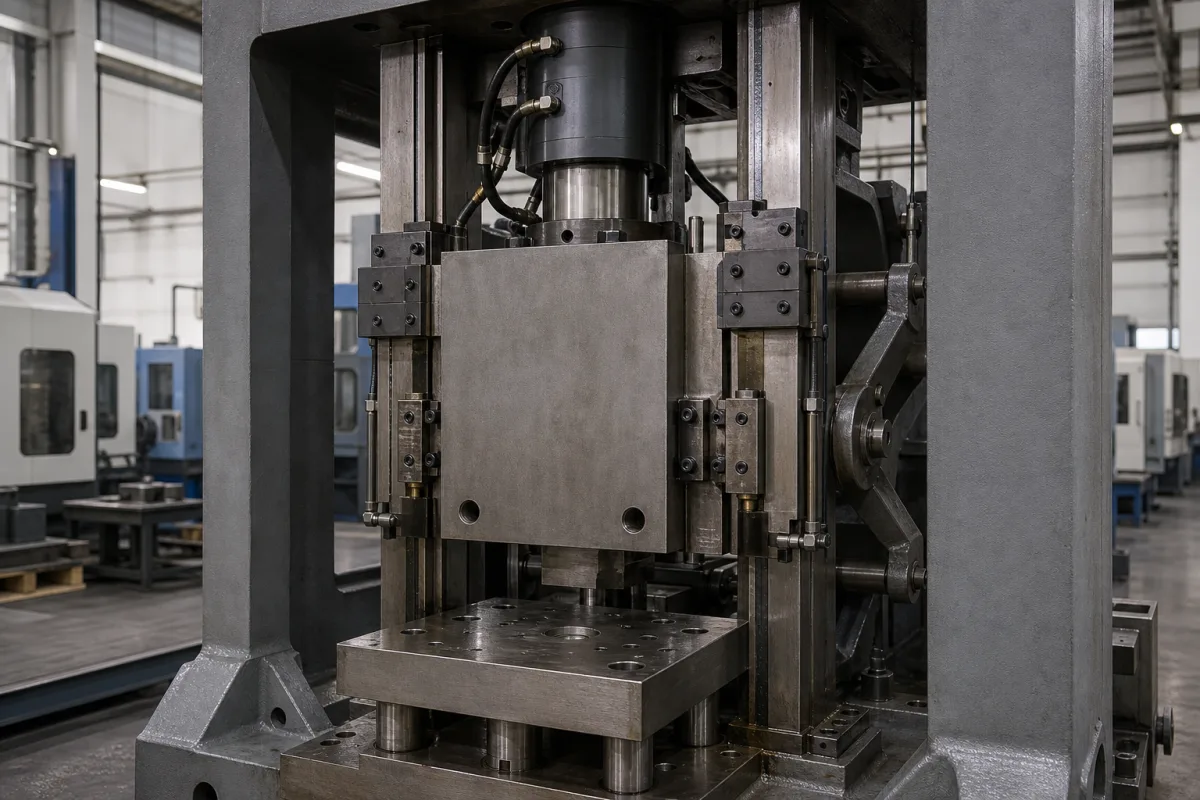
In a High-Speed Progressive Stamping Press, the Ram/Slide Assembly is the core moving element responsible for the precise vertical motion required for stamping operations. It translates the rotational force from the drive system into a linear, controlled stroke, carrying the upper die to perform cutting, forming, or drawing on the metal strip as it progresses through the press. The assembly is typically driven by a crankshaft or eccentric gear system. As the drive rotates, it converts this rotation into the linear up-and-down motion of the ram/slide via connecting rods or links. Precision guide systems (like gibs and guide posts) ensure the slide moves in a strictly vertical, non-rotating path, maintaining accurate alignment with the lower die (bolster) for consistent part quality. The assembly is manufactured from forged steel or ductile cast iron, with material grade QT500-7 specified for ductile iron. Key parameters include rated capacity (160–630 kN, ISO 9188), stroke length (25–150 mm, ISO 9188), slide adjustment (30–80 mm), slide speed (0.1–0.5 m/s), parallelism (0.02–0.05 mm, ISO 1101), perpendicularity (0.02–0.05 mm, ISO 1101), operating pressure (1.0–1.6 MPa), operating temperature (-10–60 °C), ingress protection (IP54–IP65, IEC 60529), and weight (500–2000 kg). These values are reference ranges; verify model-specific values with the manufacturer. The assembly's performance directly affects stamping force, part accuracy, and productivity. Proper maintenance includes monitoring slide adjustment, guide wear, and lubrication. Failure modes include loss of parallelism, excessive clearance, and seal degradation. Always confirm standards and specifications with the legal manufacturer or supplier.
The ram/slide assembly converts rotational motion from the drive system into linear vertical motion. A crankshaft or eccentric gear drives connecting rods or links, causing the slide to move up and down. Precision guides, such as gibs and guide posts, constrain the slide to a vertical path, preventing rotation and maintaining alignment with the bolster. This ensures accurate stamping. The stroke length and speed are determined by the drive geometry and control system. The slide adjustment allows for die height compensation. The assembly's mass and rigidity influence press dynamics and part quality.