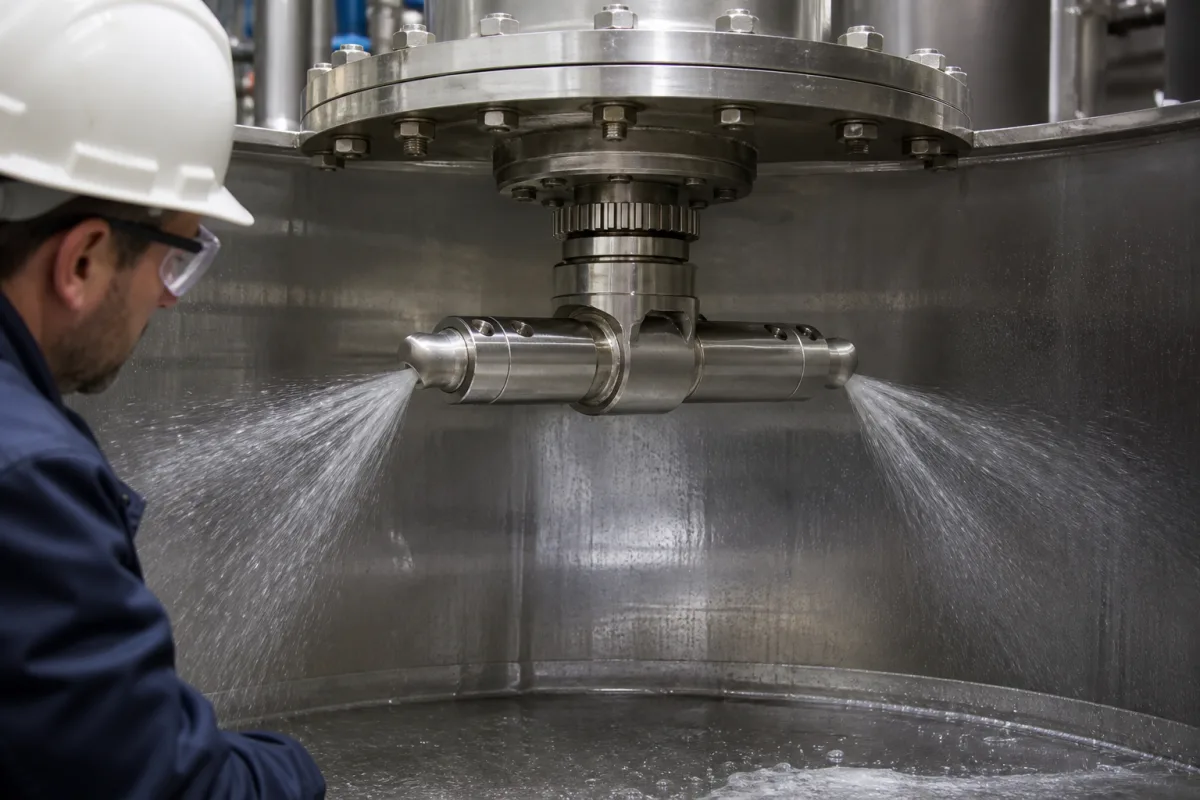
Rotating tank cleaning heads · Fluid-driven or motor-driven heads that spin nozzles inside tanks, drums and vessels, chosen by impact level, tank size, residue and opening, with pressure, temperature, material and hazardous-area limits
A rotating cleaning head is inserted into a tank, drum or vessel and spins its nozzles so that jets or sprays sweep the inside walls, removing residues with less water, chemical and manual work than hand cleaning. Ask three things first: how large the vessel and its opening are, what residue must be removed and so what impact is needed, and which drive, pressure, temperature, materials and area rating apply.
Fluid-driven and motor-driven rotating spray heads and jet heads for cleaning tanks, drums, totes and process vessels, fixed or portable. Static spray balls, complete clean-in-place skids, drum washing systems (see automated chemical drum cleaning and decontamination system) and pressure washer lances are outside this page.
CNFX editorial research · Sources checked October 12, 2026 · 7 sources
Spraying Systems offers tank cleaners with fluid-driven and motor-driven technologies and groups them by impact: lighter cleaning to remove loose residues in small to medium tanks, everyday cleaning with controlled rotation for routine residues, concentrated sprays for stubborn residues in larger tanks, and high-impact, high-efficiency cleaners for large vessels. It says its TankJet nozzles come in a range of spray coverages, impact ratings and chemical-resistant materials, including sanitary configurations, and that some compact models suit multiple-nozzle installations or beverage containers. [1]
Its AA190E is a motor-driven head with the drive mounted outside the tank, giving full coverage of internal surfaces by multi-axis rotation of solid-stream nozzles; the turret speed is independent of cleaning liquid pressure and flow. It can be permanently installed or used portably. [2]
Alfa Laval's TJ40G leaflet (ESE03366EN) shows the larger, fluid-driven end of the range: a rotary jet head for hygienic tanks of 150–2,250 m³ whose flow drives a geared rotation about the vertical and horizontal axes, laying a coarse pattern in the first cycle and densifying it on later cycles until the full pattern is reached, then repeating. It lists a working pressure of 3–12 bar (5–7 bar recommended), a maximum throw length of 21.5 m and an impact throw length of 10.5 m at 5 bar, nozzle sets of four nozzles from Ø6 to Ø11 mm or two of Ø10 or Ø11 mm, and a weight of 6.3 kg. [3]
Give the supplier the vessel size and shape, opening size and location, internal obstructions, residue type, cleaning liquid and temperature, available pump pressure and flow, drive preference (fluid or motor), fixed or portable use, sanitary or chemical-resistant needs, and hazardous-area classification.
02
Check opening, pressure, temperature and materials
Spraying Systems' AA190E fits a 3 in (76 mm) opening and is described for drums, totes, tanks, reactors and other process vessels. Its manual lists 500 psi (35 bar) maximum liquid pressure and 200 °F (93 °C) maximum liquid and ambient temperature, with plain water or chemicals compatible with 316 stainless steel. [2]
The manual recommends a liquid line strainer ahead of the head to remove particles that could damage it and flushing with clean water at the end of the day when chemicals are used. The AA190E-EP version carries a NEMA 7 explosion-proof motor for areas where electrical sparks may be hazardous. [2]
The TJ40G leaflet gives wetted materials of AISI 316, SAF 2205, PFA, PEEK and EPDM (the polymers FDA 21 CFR 177 compliant), exterior and interior finishes of Ra 0.5 µm and 0.8 µm, a maximum working temperature of 95 °C, and ATEX approval. It warns against hydraulic shock and hard or abrasive particles, recommending a 3 mm strainer for low particle loads and 0.1 mm (1 mm for the heavy-duty version) for high loads. [3]
Editorial calculation: an impact throw length of 10.5 m at 5 bar means a single centrally mounted head reaches the wall of a vertical tank up to about 21 m across with impact cleaning; taller or wider tanks need more heads or higher pressure. [3]
03
Use a published cleaning-efficiency scale to size the head
Lechler groups its rotating tank cleaning nozzles into numbered cleaning efficiency classes and publishes, for each class, the operating principle, the maximum tank diameter, the flow range at 2 bar and the recommended operating pressure. Free-spinning heads in classes 2 and 3 are aimed at rinsing and light to medium soiling; controlled-rotation heads in class 4 at heavy soiling; and gear-controlled solid-jet heads in class 5 at persistent soiling in medium to very large tanks. [4][5][6][7]
Lechler states that class 2 heads are made from stainless steel, PVDF, PEEK and Teflon, that its class 3 Whirly series is also available in an ATEX version, and that heads in classes 4 and 5 can be combined with its rotation monitoring sensor. Its class 5 PressureClean is turned by a 24 V motor in an IP 65 housing mounted, with the water connection, outside the tank, the same arrangement as the motor-driven AA190E above. [4][5][6][7][2]
Editorial calculation: the class 5 maximum of 24.0 m is close to the 21 m reach worked out above for the TJ40G's 10.5 m impact throw at 5 bar, while the free-spinning class 3 stops at 5.5 m. If the vessel is wider than about 5.5 m and the residue is heavy, the published figures point to a gear-driven jet head rather than a free-spinning spray head. [5][7][3]
What to ask a cleaning-head maker: radius, cycle time, flow and insertion size
Ask any supplier for coverage pattern and cleaning cycle time, effective cleaning radius, flow at your pressure, insertion diameter, maximum pressure and temperature, drive type, wetted and seal materials, sanitary certification if needed, hazardous-area rating, and maintenance kits.
05
Nozzle turret, drive, mount, strainer and wetted metal of a cleaning head
Pressure, throw length, opening size, temperature and nozzle set for a cleaning-head order
Each published value here belongs to one named head, the motor-driven AA190E or the fluid-driven TJ40G, so ask for the same row for the head offered at your pump pressure.
Field
What it means and published values
Ask the supplier for
Rotation Speed (RPM)
Independent of pressure on motor-driven heads. [2]
Speed.
Operating Pressure (bar)
e.g. up to 35 bar (motor-driven); 3–12 bar (fluid-driven jet head). [2][3]
2 companies list this product among what they make. Company figures are quoted from each
company's own website; every card states where the relationship came from.
Explore company information and manufacturing capabilities, then discuss the scope of your project with a relevant supplier.
Share this page
Compiled and source-reviewed by the CNFX editorial team.
Each manufacturer above links to the page on that company's own website where the product is listed, with the date we checked it. How we source and review
· Page last updated 13 October 2026
Buyer questions
Fluid-driven or motor-driven cleaning head?
Spraying Systems offers both; its motor-driven AA190E keeps turret speed independent of liquid pressure and flow. [1][2]
Can a cleaning head go through a drum bung?
Spraying Systems says its AA190E fits a 3 in (76 mm) opening and suits drums and totes. [2]
How hot and how high a pressure can it run?
The AA190E manual lists 500 psi (35 bar) and 200 °F (93 °C) maximum. [2]
How far does a rotary jet head clean?
Alfa Laval's TJ40G leaflet gives an impact throw length of 10.5 m and a maximum throw of 21.5 m at 5 bar, for tanks of 150–2,250 m³. [3]
What tank diameter can a rotating cleaning nozzle clean?
Lechler lists maximum tank diameters of 0.5–3.25 m and 0.25–5.5 m for its free-spinning classes, 0.25–8.0 m for controlled rotation and 0.25–24.0 m for gear-controlled heads. [4][5][6][7]
Sources and what still needs a direct check
Sources checked 2026-10-12. Spraying Systems Co. makes tank cleaning nozzles and motor-driven tank washers; Alfa Laval's TJ40G leaflet and Lechler's cleaning efficiency class pages add published pressure, flow and tank-diameter ranges from two more makers. They are cited as examples, not endorsements.