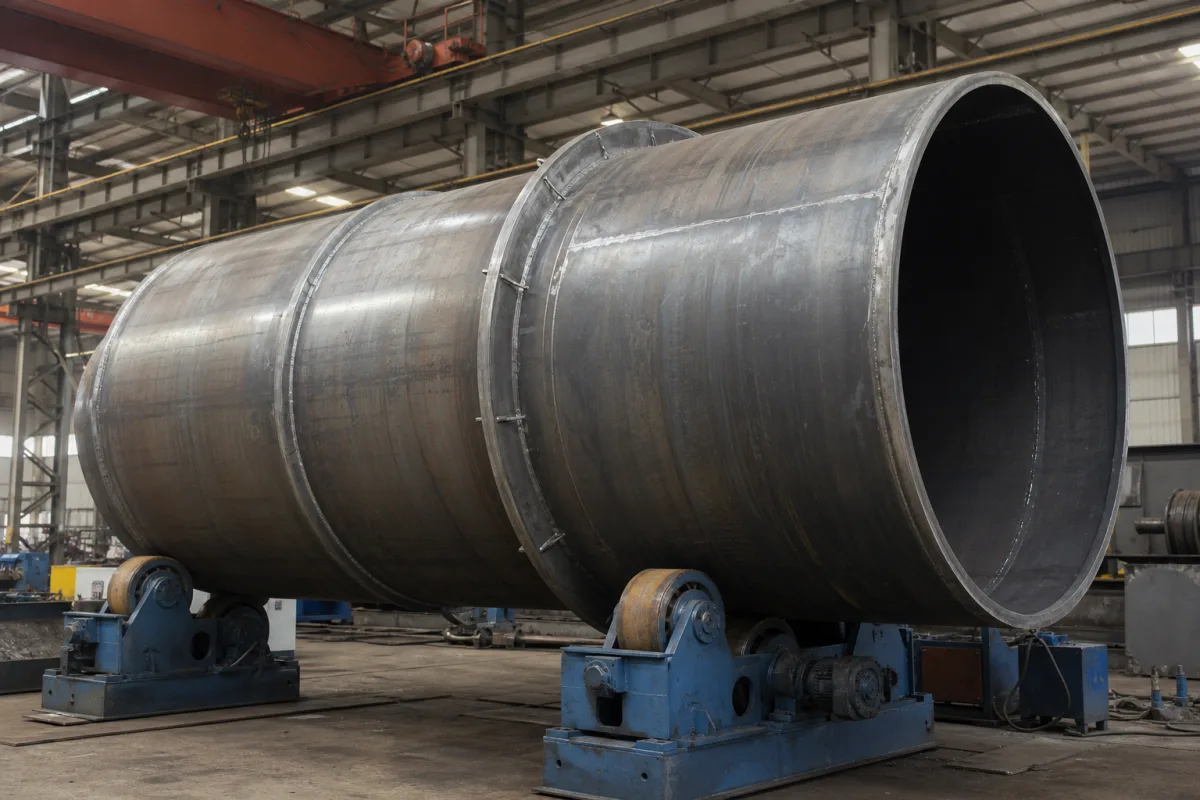
Rotating drum shell: the welded steel cylinder of a rotary drum, its roundness, ovality on the tyres and straightness of axis
The rolled and welded steel cylinder of a rotary drum, judged as a structure · roundness after welding, ovality while it turns on its tyres (about 0.3% to 0.5% of diameter), and straightness of the axis (3 to 10 mm tolerated on long kilns)
Whatever a rotary drum does — granulate fertilizer, dry sand, cool clinker, burn cement — it does it inside a steel cylinder made from rolled plate and welded together, carried on two or more tyres and turned by a girth gear. This page treats that cylinder on its own: how a welded shell is made round, how much it may flex into an oval as it rolls over its support rollers, how far its axis may wander from a straight line, and what those limits mean in millimetres.
Shells of rotary drums and kilns as fabricated steel structures: rolled and welded plate courses, roundness after fabrication, ovality (shell flexing) under the tyres in service and its measurement, and straightness of the shell axis across the supports. The complete fertilizer granulator, with bed, slurry and ammonia feeds and its recycle loop, is covered on the Rotary drum granulator for compound fertilizers page; complete rotary dryers on the Drying drum (rotary drum dryer) page. Tyres, support rollers, girth gears and refractory linings are referred to only where they set limits on the shell.
CNFX editorial research · Sources checked October 12, 2026 · 3 sources
How much a shell may go oval on its tyres: about 0.3% of diameter up to 3.5 m, 0.5% at 6 m
A shell turning on tyres and support rollers flexes into an oval as it rotates, and the readings that matter are taken next to the tyres. Hartco Engineering's patent on measuring this flexing expresses it as relative ovality, the ovality as a percentage of the shell's internal diameter, and gives upper limits that rise with diameter. [1]
The patent reads values above the acceptable band as too much clearance between tyre and shell and undue flexing, with a higher chance of refractory failure; values below it as too little clearance, also with undue lining wear. [1] Its subject is the refractory-lined kiln, where the lining is what fails first. [1]
Editorial calculation: 0.3% of 3.5 m is 10.5 mm, and 0.5% of 6 m is 30 mm, of difference between the oval's major and minor dimensions; for the example kiln, 0.3% of its 3.353 m inside diameter is about 10 mm. Unlined granulators and coolers do not carry the brittle lining these limits protect; ask the drum supplier what ovality the shell is designed for and how it will be checked.
Statement in the Hartco patent
Value
Upper limit of relative ovality, shells up to 3.5 m diameter
Chordal beam 1 m long fixed to the shell, sensor at its centre [1]
Example survey
72 readings per revolution at 6 locations by one tyre: uphill and downhill sides, 3 positions 120° apart [1]
Example kiln
3.607 m outside diameter, 3.353 m inside diameter [1]
Ask the shell supplier for the plate thickness in the body and under each tyre, the design ovality at the tyres, the tyre-to-shell clearance cold and hot, and how ovality will be measured at commissioning.
02
Straightness of the shell axis across its supports: 3 to 10 mm tolerated on long kilns
Holcim's patent on laser measurement of rotary kilns starts from their size — lengths of 75 to 80 m in cement plants, occasionally up to 150 m, with diameters up to 6.5 m — and states that in practice maximum deviations of 3 to 10 mm from the ideal axis are tolerated, vertically and laterally. [2]
The patent explains why: straightness deviations of the axis, caused by installation tolerances or by wear of tyres, rollers and roller bearings, put a dynamic bending stress on the drum shell, with a risk of cracking and greater abrasion, and larger deviations raise that stress significantly. [2] Rollers whose axes are not parallel to the kiln axis increase friction and give uneven contact between tyre and roller. [2]
Holcim's method scans the shell surface, tyres and rollers with a 3D laser scanner, linking the shell surface points to the rotation angle so that the shell's deviation from a cylinder can be found as well as the axis; reference spheres on the roller shaft ends give the roller axes. [2]
Editorial calculation: 10 mm over 75 m is a deviation of about 0.13 mm per metre of length, and 3 mm over 150 m about 0.02 mm/m; the same millimetre limit is much tighter, relative to length, on a long kiln than on a short drum. The patent gives the 3–10 mm range for kilns in practical use, not a fabrication tolerance for a new shell.
For a new drum, ask for the straightness and run-out tolerance of the shell at the tyre seats and gear seat as fabricated, and for the alignment tolerance the erector will work to.
03
Making a welded shell round: expanding the weldment by 1 to 1.5% of its diameter
How a rolled and welded cylinder is brought to roundness is shown in a United States Steel patent for a Yankee dryer — a paper-machine drying cylinder, not a process drum — whose outer shell is a weldment of steel plates of uniform thickness of about 1 to 2 inches, with all primary welds X-rayed. [3]
Editorial calculation: on a 3 m diameter shell, a total expansion of 1 to 1.5% adds 30 to 45 mm to the diameter. Editorial note: rotary process drums are not finish-machined like a Yankee cylinder, but the same points apply — weld seams and rolling leave the shell out of round unless something corrects it, and roundness at the tyre and gear seats is what the running gear sees. Ask the fabricator how roundness is achieved and measured at those seats.
1 to 1.5% of diameter, also cold-working the weldment [3]
Machining
Little and nearly even metal removal around the circumference, because the shell is already round [3]
04
What to send for a rotating drum shell
Paste it into your enquiry below or into an email to a maker, then replace every bracket.
Drum: [duty; inside diameter; length; slope]
Shell: [plate grade; thickness in body and under tyres; lining or none]
Supports: [number of tyres; spacing; tyre fixing and clearance]
Tolerances: [roundness at tyre and gear seats; straightness; run-out]
Welds: [procedure; inspection, radiography extent]
In service: [design ovality; measurement at commissioning]
Explore company information and manufacturing capabilities, then discuss the scope of your project with a relevant supplier.
Share this page
Compiled and source-reviewed by the CNFX editorial team.
Each manufacturer above links to the page on that company's own website where the product is listed, with the date we checked it. How we source and review
· Page last updated 13 October 2026
Buyer questions
What is an acceptable ovality for a rotary kiln or drum shell?
Hartco Engineering's patent gives an upper limit of about 0.3% of internal diameter for shells up to 3.5 m and about 0.5% for 6 m shells, measured with a 1 m chordal beam next to the tyres. [1]
How straight must a rotary kiln shell axis be?
Holcim's patent says maximum deviations of 3 to 10 mm from the ideal axis, vertically and laterally, are tolerated in practice on kilns 75 to 150 m long. [2]
Why does shell ovality matter?
In refractory-lined kilns, too much ovality points to excessive tyre clearance and flexing, with a higher chance of lining failure; too little points to inadequate clearance, per the Hartco patent. [1]
How can a welded drum shell be made round?
One US Steel patent expands a welded steel shell by 0.5–1.0% of diameter, stress relieves it, then expands it to a total of 1–1.5%. [3]
Sources and what still needs a direct check
Sources checked 2026-10-12. Ovality limits and their measurement come from a Hartco Engineering patent; axis straightness and its effect on the shell from a Holcim Technology patent; rounding a welded shell by expansion from a United States Steel patent for a Yankee dryer cylinder.