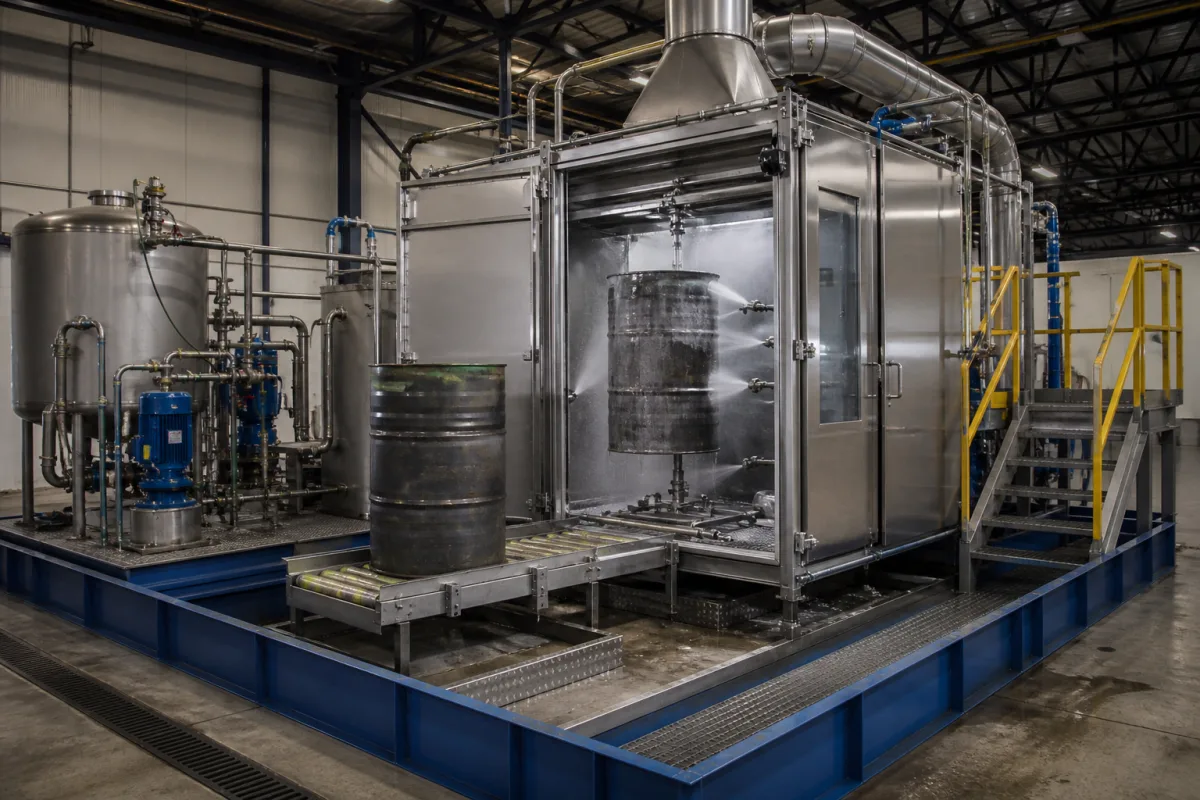
Automated chemical drum cleaning and decontamination system
Automated drum washing · Enclosed spray-wash cabinets and rotating tank-wash heads that fit a 3 in (76 mm) drum opening, wash pressure and temperature limits, explosion-proof drives, and the US empty-container residue limits a cleaned drum is measured against
An automated drum cleaning system washes the inside of used chemical drums with spray heads inserted through the bung or open top, then rinses and drains them so they can be reused, reconditioned or disposed of. Ask three things first: which drums and residues it must clean, which wash head, pressure, temperature and chemistry it will run, and what cleanliness end point and hazardous-area rating apply.
Spray-wash cabinets and lines for steel and plastic drums, and the rotating tank-wash heads they use, with their rinse and drain stages. IBC-only washers, drum tumblers and mixers (see automated chemical drum agitation and homogenization system) and solvent recovery stills are outside this page.
CNFX editorial research · Sources checked October 12, 2026 · 5 sources
Spraying Systems describes its AA190E electrically motorized tank washer as fitting into a 3 in (76 mm) diameter opening and ideal for cleaning drums, totes, tanks and reactors; multi-axis rotation of its solid-stream nozzles covers the internal surfaces, and the nozzle turret's rotational speed is independent of cleaning-liquid pressure and flow. [1]
The manual lists 500 psi (35 bar) maximum liquid pressure and 200 °F (93 °C) maximum liquid temperature, and says the unit may run on plain water or chemicals compatible with 316 stainless steel; when chemicals are used it should be flushed with clean water at the end of the day, and a liquid line strainer ahead of the unit is recommended. [1]
Its AA190E-EP version carries a NEMA 7 explosion-proof motor for process areas where electrical sparks may be hazardous, with the motorized drive mounted outside the tank. [1]
Give the supplier the drum types (steel, plastic, tight-head or open-head), opening sizes, residues and their hazard class, wash and rinse chemistry, pressure, temperature, throughput, drain and drying needs, effluent handling, hazardous-area classification, power and air supply, and floor space.
02
Set the cleanliness end point before buying
Under US rule 40 CFR 261.7, a container that held non-acute hazardous waste is empty when everything that can be removed by pouring, pumping, aspirating or similar practices has been removed and no more than 2.5 centimetres (one inch) of residue remains, or no more than 3 percent by weight of total capacity remains for containers of 119 gallons or less (0.3 percent above 119 gallons). [2]
For acute hazardous waste the container is empty only if triple rinsed with a solvent capable of removing the product, cleaned by another method shown in the scientific literature or by the generator's tests to achieve equivalent removal, or, for a lined container, the inner liner that prevented contact has been removed. [2] State which rule or customer specification the cleaned drums must meet so the supplier can size the rinse stages and verification.
03
Compare the machine cycle with the label rinse procedure
US rule 40 CFR 156.146 sets the container-cleaning instructions that labels of dilutable pesticides in rigid nonrefillable containers must carry. Triple rinse: empty the contents, fill the container 1/4 full with water and close it; for containers too large to shake, roll it on its side for 30 seconds with at least one complete revolution, then tip it on each end; empty the rinsate and repeat two more times. For containers small enough to shake, the instruction is to shake for 10 seconds and drain for 10 seconds after the flow begins to drip. [3]
The pressure rinse instruction has the container held upside down over the application equipment or mix tank while the rinsing nozzle is inserted through the side. Rinsate goes to the application equipment or mix tank, or is stored for later use or disposal. [3]
Editorial calculation: for a 208 L (55 US gal) drum, 1/4 full is about 52 L per rinse, about 156 L for a triple rinse; 40 psi is about 2.8 bar. A machine cycle can be checked against these figures for water use, pressure and contact time.
Method in 40 CFR 156.146
Water or pressure
Time
Repeats
Triple rinse, small containers
Fill 1/4 full
Shake 10 s; drain 10 s after drip starts
3 rinses in total
Triple rinse, large containers
Fill 1/4 full
Roll 30 s (at least one revolution), tip on both ends
3 rinses in total
Pressure rinse
Nozzle inserted in container side, about 40 psi
At least 30 s; drain 10 s after drip starts
Once
Ask the supplier whether the machine's rinse programme meets the label rinse method for your products, and for water use per drum, nozzle pressure and rinse time.
04
Match washing to the transport rules for reusing and reconditioning drums
US DOT hazardous materials rule 49 CFR 173.28 says a packaging used more than once must be inspected before reuse and may not be reused unless free from incompatible residue, rupture or other damage that reduces its structural integrity. For metal drums, reconditioning means cleaning to the base material of construction with all former contents and internal and external corrosion removed, restoring shape and chimes, replacing non-integral gaskets, and inspecting after cleaning but before painting, rejecting drums with visible pitting, significant thickness loss, metal fatigue or damaged threads or closures. [4]
Editorial note: a wash line that ends at the 40 CFR 261.7 empty-container point does not by itself make a drum ready for refilling with hazardous materials; under 49 CFR 173.28 the drum also needs inspection and, where it is subject to the air leakproofness test, a passed retest and “L” marking. Ask the supplier whether the line includes post-wash drying and visual inspection, and whether a leak-test station at 20 kPa or 48 kPa can follow the wash. [4][2]
Editorial calculation: 48 kPa is 2.4 times the 20 kPa retest pressure, so a leak-test station serving Packing Group I drums needs a regulator and gauge range that covers both settings. [4]
49 CFR 173.28 / 178.604 requirement
Value
Leakproofness retest before reuse, Packing Group I
At least 48 kPa (7.0 psig) internal air pressure [4]
Leakproofness retest before reuse, Packing Groups II and III
Packaging restrained under water with internal air pressure; no air leakage to pass; 5 min minimum for other than production testing [5]
05
What to ask any drum-washer bidder: head, pressure, cycle time, effluent and area rating
Ask any supplier for drum sizes handled, wash head type and opening size, pump pressure and flow, wash temperature, wetted materials, cycle time, water and chemical consumption per drum, effluent volume, hazardous-area rating, installed power, footprint and weight.
06
Wash head, NEMA 7 drive, pump and strainer, wash liquid and rinse stages
All rows but the last come from the AA190E manual; the drain and rinse stages are sized by the end point the drum must reach under 40 CFR 261.7, not by the wash head. [1][2]
Part
Role
Fix in the order
Rotating wash head
Sprays the internal surfaces through the opening. [1]
Cycle time, drum size, wash pressure, temperature and rinse method for a drum washer
Nine of the fifteen rows have no published value. Pressure, temperature, drive rating and wetted material describe one wash head, the AA190E, rather than a complete washing line. [1]
Field
What it means and published values
Ask the supplier for
Cleaning Cycle Time (minutes)
Not stated in the reviewed sources.
Time per drum.
Drum Capacity (L)
40 CFR 261.7 sets different residue limits at or below and above 119 gal. [2]
Drum sizes.
Water Consumption (L/cycle)
Not stated in the reviewed sources.
Per drum.
Waste Collection Volume (L)
Not stated in the reviewed sources.
Effluent volume.
Operating Pressure (MPa)
e.g. 500 psi (35 bar) maximum for one wash head. [1]
Pump pressure.
Maximum Temperature (°C)
e.g. 93 °C maximum liquid temperature for one wash head. [1]
Explore company information and manufacturing capabilities, then discuss the scope of your project with a relevant supplier.
Share this page
Compiled and source-reviewed by the CNFX editorial team.
Each manufacturer above links to the page on that company's own website where the product is listed, with the date we checked it. How we source and review
· Page last updated 13 October 2026
Buyer questions
Can a wash head clean a closed drum through its bung?
Spraying Systems says its AA190E fits a 3 in (76 mm) opening and is ideal for drums and totes. [1]
When is a drum legally empty in the US?
Under 40 CFR 261.7, for non-acute hazardous waste: removable waste removed and no more than 2.5 cm of residue, or 3% by weight of capacity up to 119 gal. [2]
Do acute hazardous waste drums need rinsing?
Yes; 40 CFR 261.7 requires triple rinsing with a capable solvent, an equivalent proven method, or liner removal. [2]
What does a pressure rinse of a pesticide container involve?
40 CFR 156.146 describes inserting a pressure rinsing nozzle in the side of the inverted container and rinsing at about 40 psi for at least 30 seconds, then draining for 10 seconds. [3]
What must happen to a washed drum before it is reused for hazardous materials?
Under 49 CFR 173.28 it must be inspected free of incompatible residue and damage, and drums subject to the air leakproofness test must be retested at 48 kPa (7.0 psig) for Packing Group I or 20 kPa (3.0 psig) for Groups II and III and marked “L”. [4]
Sources and what still needs a direct check
Sources checked 2026-10-12. Spraying Systems Co. makes tank-wash heads; the US eCFR publishes EPA's empty-container and pesticide rinse rules and DOT PHMSA's packaging reuse and leakproofness rules.