Industry-Verified Manufacturing Data (2026)

Rotating Worktable

Based on aggregated insights from multiple verified factory profiles within the CNFX directory, the standard Rotating Worktable used in the Machinery and Equipment Manufacturing sector typically supports operational capacities ranging from standard industrial configurations to heavy-duty production requirements.

Technical Definition & Core Assembly

A canonical Rotating Worktable is characterized by the integration of Table Surface and Rotary Bearing. In industrial production environments, manufacturers listed on CNFX commonly emphasize Cast iron construction to support stable, high-cycle operation across diverse manufacturing scenarios.

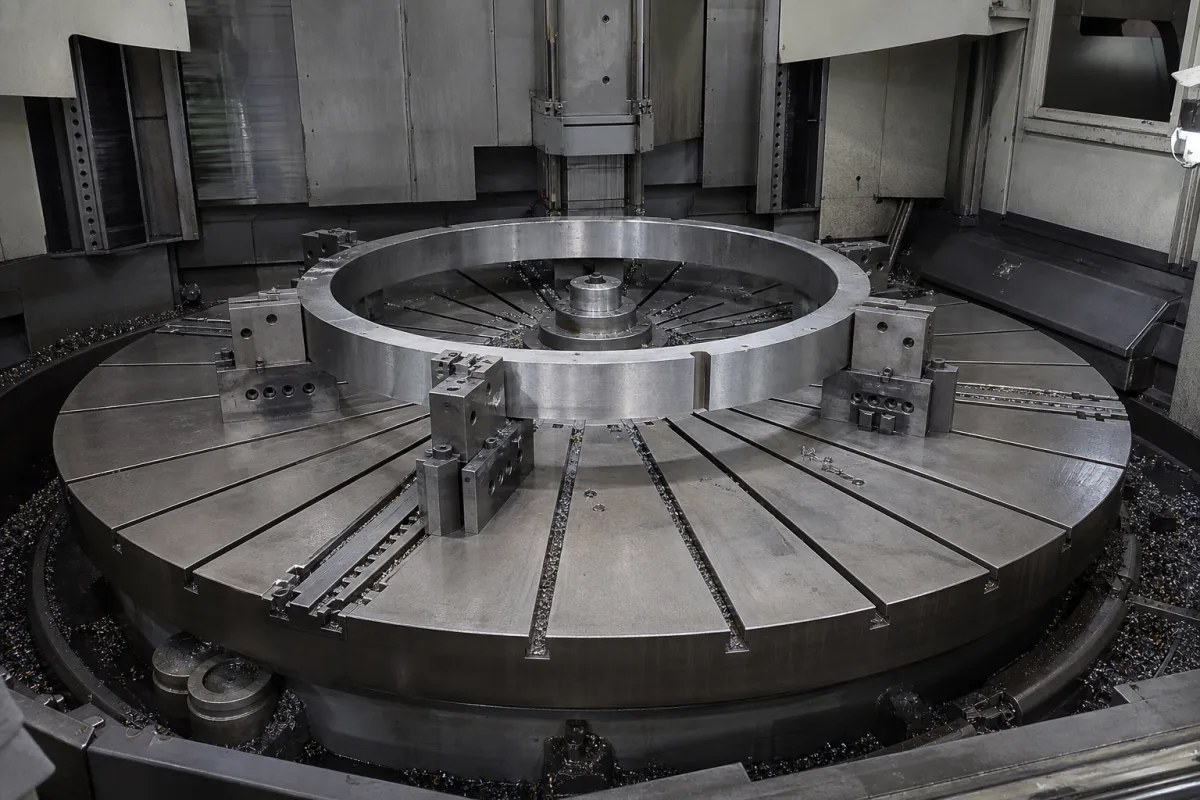
A precision rotating platform that holds and positions workpieces during machining operations on a CNC vertical lathe.

Product Specifications

Technical details and manufacturing context for Rotating Worktable

Definition
The rotating worktable is a critical component of a CNC vertical lathe that provides controlled rotational motion to workpieces during machining processes. It serves as the mounting surface for fixtures, chucks, or direct workpiece clamping, enabling precise angular positioning and continuous rotation for operations like turning, facing, boring, and threading on vertical-axis machines.
Working Principle
The worktable rotates via a direct drive or gear-driven spindle mechanism powered by an electric motor. It receives positioning commands from the CNC controller, which coordinates rotation speed, direction, and angular position with other machine axes. Precision bearings support the table to maintain rigidity and minimize runout during high-speed rotation under cutting loads.
Common Materials
Cast iron, Steel alloy
Technical Parameters
  • Table diameter determines maximum workpiece size capacity (mm) Per Request
Components / BOM
  • Table Surface
    Provides mounting interface for workpieces and fixtures with T-slots or mounting holes
    Material: Cast iron
  • Rotary Bearing
    Supports the table and enables smooth, precise rotation with minimal friction
    Material: Bearing steel
  • Drive Motor
    Provides rotational power to the table through direct drive or gear reduction
    Material: Electrical components with steel housing
  • Position Encoder
    Measures angular position and provides feedback to the CNC controller for closed-loop control
    Material: Electronic components with aluminum housing
Engineering Reasoning
0-3000 rpm with ±0.001° angular positioning accuracy
Exceeding 3500 rpm causes bearing raceway spalling due to centrifugal forces exceeding 1.5 GPa yield strength of AISI 52100 steel
Design Rationale: Hertzian contact stress exceeding material fatigue limit at 1.2 GPa, leading to subsurface crack initiation and propagation through rolling contact fatigue mechanism
Risk Mitigation (FMEA)
Trigger Thermal expansion mismatch between AISI 4140 steel table (α=11.5 μm/m·K) and ceramic bearing balls (α=5.5 μm/m·K)
Mode: Bearing preload loss exceeding 15 μm axial clearance, causing 0.005 mm radial runout
Strategy: Implementing Invar 36 alloy (α=1.2 μm/m·K) thermal compensation rings between components
Trigger Electromagnetic interference from 400 Hz spindle drive inducing 50 mV RMS noise in resolver feedback signals
Mode: Positional error accumulation exceeding ±0.002° over 10 revolutions due to phase-locked loop desynchronization
Strategy: Installing Mu-metal shielding with 60 dB attenuation and implementing Kalman filtering with 0.0005° resolution digital encoders

Industry Taxonomies & Aliases

Commonly used trade names and technical identifiers for Rotating Worktable.

Applied To / Applications

This component is essential for the following industrial systems and equipment:

Industrial Ecosystem & Supply Chain DNA

Complementary Systems
Downstream Applications
Specialized Tooling

Application Fit & Sizing Matrix

Operational Limits
pressure: Atmospheric (sealed bearing environment)
other spec: Max workpiece weight: 500-5000 kg (model dependent), Rotation accuracy: ±0.001°, Max rotational speed: 0-30 RPM
temperature: -10°C to 80°C (operating), -20°C to 100°C (storage)
Media Compatibility
✓ Steel alloys ✓ Aluminum alloys ✓ Titanium alloys
Unsuitable: High-corrosion environments (e.g., saltwater exposure without protective sealing)
Sizing Data Required
  • Maximum workpiece weight and dimensions
  • Required rotational accuracy and speed
  • CNC lathe model and mounting interface specifications

Reliability & Engineering Risk Analysis

Failure Mode & Root Cause
Bearing fatigue failure
Cause: Cyclic loading from rotational motion combined with inadequate lubrication leads to subsurface cracking and spalling in bearing races and rolling elements.
Gear tooth pitting and wear
Cause: High contact stress at gear mesh points, exacerbated by misalignment, insufficient lubrication, or contamination, causing surface fatigue and material removal.
Maintenance Indicators
  • Abnormal audible grinding or clicking noises during rotation, indicating bearing or gear damage
  • Excessive vibration or wobble during operation, suggesting imbalance, misalignment, or component wear
Engineering Tips
  • Implement precision laser alignment during installation and periodic checks to minimize misalignment-induced stresses on bearings and gears
  • Establish a proactive lubrication management program with scheduled oil analysis to monitor contamination, viscosity, and wear particle levels

Compliance & Manufacturing Standards

Reference Standards
ISO 230-1:2012 (Test code for machine tools - Geometric accuracy of machines operating under no-load or quasi-static conditions) ANSI B5.54-2005 (Methods for Performance Evaluation of Computer Numerically Controlled Machining Centers) DIN 55189-1 (Rotary tables for machine tools - Acceptance conditions and testing of accuracy)
Manufacturing Precision
  • Radial runout: ≤0.01 mm
  • Axial runout: ≤0.005 mm
Quality Inspection
  • Runout measurement test (using dial indicators or laser interferometer)
  • Hardness test (Rockwell or Brinell scale for bearing surfaces)

Factories Producing Rotating Worktable

Verified manufacturers with capability to produce this product in China

✓ 98% Supplier Capability Match Found

P Project Engineer from Singapore Jan 13, 2026
★★★★★
"Standard OEM quality for Machinery and Equipment Manufacturing applications. The Rotating Worktable arrived with full certification."
Technical Specifications Verified
S Sourcing Manager from Germany Jan 10, 2026
★★★★★
"Great transparency on the Rotating Worktable components. Essential for our Machinery and Equipment Manufacturing supply chain."
Technical Specifications Verified
P Procurement Specialist from Brazil Jan 07, 2026
★★★★★
"The Rotating Worktable we sourced perfectly fits our Machinery and Equipment Manufacturing production line requirements."
Technical Specifications Verified
Verification Protocol

“Feedback is collected from verified sourcing managers during RFQ (Request for Quote) and factory evaluation processes on CNFX. These reports represent historical performance data and technical audit summaries from our B2B manufacturing network.”

11 sourcing managers are analyzing this specification now. Last inquiry for Rotating Worktable from Turkey (52m ago).

Supply Chain Compatible Machinery & Devices

Automated Assembly Line System

Integrated production system for sequential component assembly operations

Explore Specs →
Automated Powder Coating System

Integrated industrial system for applying dry powder coatings to metal substrates.

Explore Specs →
Centrifugal Pump Impeller

Rotating component that transfers energy to fluid in centrifugal pumps.

Explore Specs →
High-Precision CNC Laser Cutting Machine

Computer-controlled industrial machine using focused laser beams to cut sheet metal with micron-level accuracy.

Explore Specs →

Frequently Asked Questions

What materials are used in the rotating worktable construction?

The rotating worktable is constructed from high-grade cast iron for stability and steel alloy components for durability, ensuring precision and longevity in machining applications.

How does the position encoder improve machining accuracy?

The integrated position encoder provides real-time feedback on table rotation, enabling precise angular positioning and repeatability for complex machining operations on CNC vertical lathes.

What types of workpieces can this rotating worktable handle?

This rotating worktable is designed to securely hold and position various workpieces including cylindrical, prismatic, and irregular shapes during turning, milling, and drilling operations on CNC vertical lathes.

Can I contact factories directly on CNFX?

CNFX is an open directory, not a transaction platform. Each factory profile provides direct contact information and production details to help you initiate direct inquiries with Chinese suppliers.

Get Quote for Rotating Worktable

Request technical pricing, lead times, or customized specifications for Rotating Worktable directly from verified manufacturing units.

Your business information is encrypted and only shared with verified Rotating Worktable suppliers.

Thank you! Your message has been sent. We'll respond within 1–3 business days.

Need to Manufacture Rotating Worktable?

Connect with verified factories specializing in this product category

Add Your Factory Contact Us
Previous Product
Rotating Turret
Next Product
Rotation Bearing