Metal cutting · Workpiece size and mass, table torque and speed, cutting force and power
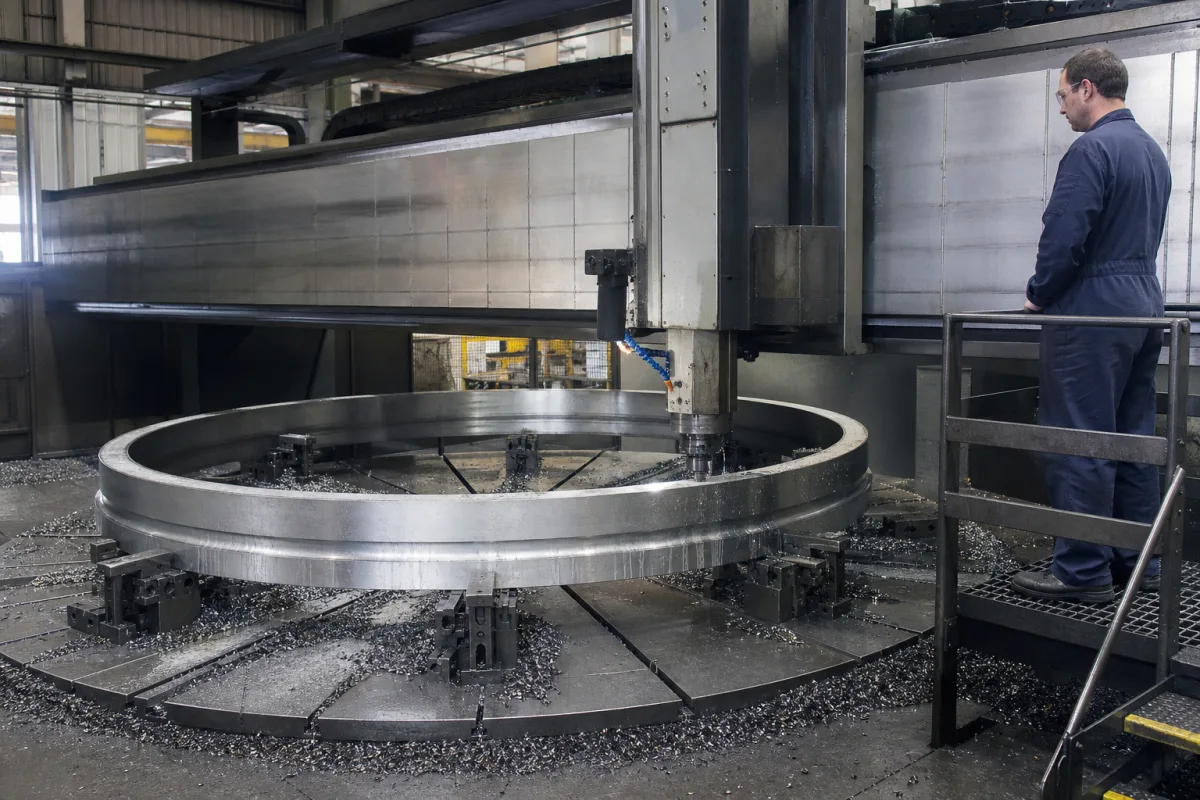
A CNC vertical lathe turns parts on a horizontal rotating table with the spindle axis vertical, so heavy discs and rings sit on the table under their own weight. Ask three things first: the largest diameter, height and weight of the clamped part, the material and cuts, and how parts will be loaded.
CNC vertical lathes and vertical turning centres, single- and double-column, from compact chuck machines to heavy table machines. Horizontal lathes, vertical machining centres and used-machine brokerage are outside this page.
CNFX editorial research · Sources checked October 12, 2026 · 6 sources
Absolute Machine Tools, a VTL distributor, explains that the vertical layout lets gravity hold the workpiece, directing its weight down into the foundation without off-axis load on the spindle and allowing lighter clamping; it lists heavy crane-loaded parts, odd shapes, delicate parts, interrupted cuts and unbalanced parts among the “applications that benefit from using a VTL”. [1]
SHS advises selecting around the complete clamped assembly: maximum turning diameter and height are separate limits, and chuck size, jaw height and tool approach also decide whether a part fits; loading method and component mass should be described before choosing the chuck and fixture. [2]
Capacities range from SHS's V-series, which runs from 650 to 1,000 mm swing, while Kingston's C5240 double-column machine turns up to 4,000 mm diameter on a 3,200 or 3,600 mm table, with parts up to 2,500 mm high and 32 t. [2][3]
Give the supplier the drawing, material, largest diameter, height and weight with fixtures, operations and tolerances, batch size, loading method, required controller and tooling, and floor space and foundation limits.
02
Check table torque, speed range and power
SHS cautions that a larger nominal capacity does not establish cutting torque or cycle time, and that the spindle speed range must suit the material and cutting diameter. [2] Kingston's C5240 lists 80 kN·m maximum table torque, 2–63 r/min table speed in 16 steps, 40 kN maximum cutting force on the vertical tool holder, a 75 kW main motor and a 52 t machine. [3]
Editorial calculation: at the full 4,000 mm diameter the radius is 2 m, so 80 kN·m ÷ 2 m = 40 kN of tangential force, matching the listed 40 kN cutting force. Power is force × surface speed, so 75 kW ÷ 40 kN ≈ 1.9 m/s, about 112 m/min, is the highest surface speed the motor can supply at that force, ignoring drive losses. [3]
Editorial calculation: surface speed is π × diameter × table speed. At 4,000 mm and the lowest 2 r/min that is π × 4 × 2 ≈ 25 m/min; at the top 63 r/min it is about 790 m/min, far above what the force and power allow, so check the speed you need against torque and power together. [3]
03
See how column layout and bearings change with turning diameter
Fives Pietro Carnaghi's vertical lathe pages show how one builder steps its machine families by turning diameter. The compact ATF series covers 1,000–1,400 mm with a single column and an optional double rotating pallet (0–180°) so one part can be centred while another is machined; the ATT series covers 1,600–2,400 mm; the AC single-column series 1,600–3,200 mm; and the AC double-column series 3,600–6,500 mm, a thermo-symmetrical frame with two columns fixed to the base and a fixed crossrail, with all linear axes on hydrostatic bearings. For large parts the AS single-column series runs from 6,500 to 18,000 mm and the AP double-column series from 7,000 to 14,000 mm; the AP frame is designed by finite element analysis and thermally stress-relieved, its linear axes run on hydrostatic pockets, and for loads over 200 t the table bearing can also be hydrostatic, carrying up to 750 t. [4][5][6]
Editorial calculation: the 750 t table load is about 23 times the 32 t Kingston lists for its 4,000 mm C5240, and the AP series' 14,000 mm diameter is 3.5 times the C5240's. When a part weighs more than about 200 t, ask whether the table bearing is hydrostatic, and for any size ask the builder to state turning diameter and height with your fixture, table load, and whether the crossrail is fixed or movable. [4][3]
Compact chuck machines to heavy double-column VTLs from listed suppliers
Kingston lists heavy-duty double-column vertical lathes built to its specifications under its own label; SHS lists V-series vertical lathes; Guosheng lists GVL and iVT vertical lathes; Luzhong and Yangsen list CNC vertical lathes among other machine tools; BiGa lists a VTL2500 vertical lathe with tool changer; Oturn lists vertical turning and milling centres; MOK lists Shenyang SMTCL and SYMG vertical lathes. [2][3]
05
Table, columns and crossrail, ram and tool head, turret, CNC control and chuck
The table row carries the cutting limit: on Kingston's C5240, 80 kN·m of table torque at a 2 m radius gives the same 40 kN the catalogue lists as cutting force (editorial calculation). [3]
Part
Role
Fix in the order
Table (faceplate)
Carries and turns the workpiece; sets torque and speed. [3]
Diameter, torque, speed range.
Column(s) and crossrail
Carry the tool heads; single or double column. [3]
Column type and rail travel.
Ram and tool head
Moves the tool vertically; ram section sets stiffness. [3]
Turning diameter and height, workpiece weight, table speed, motor power and table size for a VTL quotation
Diameter, height and weight are three separate limits, and SHS warns that a larger nominal capacity says nothing about cutting torque or cycle time, so ask for the torque curve with the envelope. [2]
Field
What it means and published values
Ask the supplier for
Maximum turning diameter (mm)
E.g. 4,000 mm on C5240; series from 1,000 to 18,000 mm. [3][4][6]
12 companies list this product among what they make. Company figures are quoted from each
company's own website; every card states where the relationship came from.
Jiangsu Kingston Machine Tools Group Co.,Ltd
Manufacturing site to be confirmed for the order
Lists heavy-duty vertical lathes built to its specifications under its own label.
Explore company information and manufacturing capabilities, then discuss the scope of your project with a relevant supplier.
Share this page
Compiled and source-reviewed by the CNFX editorial team.
Each manufacturer above links to the page on that company's own website where the product is listed, with the date we checked it. How we source and review
· Page last updated 13 October 2026
Buyer questions
Why use a vertical lathe instead of a horizontal lathe?
Gravity holds heavy or delicate parts on the table, putting weight into the foundation rather than the spindle and allowing lighter clamping. [1]
Is the maximum turning diameter enough to choose a VTL?
No; height, weight, fixtures and tool approach are separate limits, and table torque and speed decide how hard large diameters can be cut. [2][3]
How fast can a large VTL cut?
Surface speed is π × diameter × table speed, but force and motor power limit it; one 75 kW, 40 kN machine supports about 112 m/min at full force. [3]
When does a vertical lathe table need a hydrostatic bearing?
One large-lathe builder offers a hydrostatic table bearing for loads over 200 t, carrying up to 750 t, on double-column machines turning 7,000–14,000 mm diameter. [4]
Sources and what still needs a direct check
Sources checked 2026-10-12. Absolute Machine Tools is a VTL distributor; its claims are its own. SHS and Kingston are suppliers listed on this page, and Fives Pietro Carnaghi publishes its own series ranges; their values are catalogue figures.