Industry-Verified Manufacturing Data (2026)

Sensing Array

Based on aggregated insights from multiple verified factory profiles within the CNFX directory, the standard Sensing Array used in the Machinery and Equipment Manufacturing sector typically supports operational capacities ranging from standard industrial configurations to heavy-duty production requirements.

Technical Definition & Core Assembly

A canonical Sensing Array is characterized by the integration of Sensor Housing and Sensor Element(s). In industrial production environments, manufacturers listed on CNFX commonly emphasize Stainless Steel (Housing) construction to support stable, high-cycle operation across diverse manufacturing scenarios.

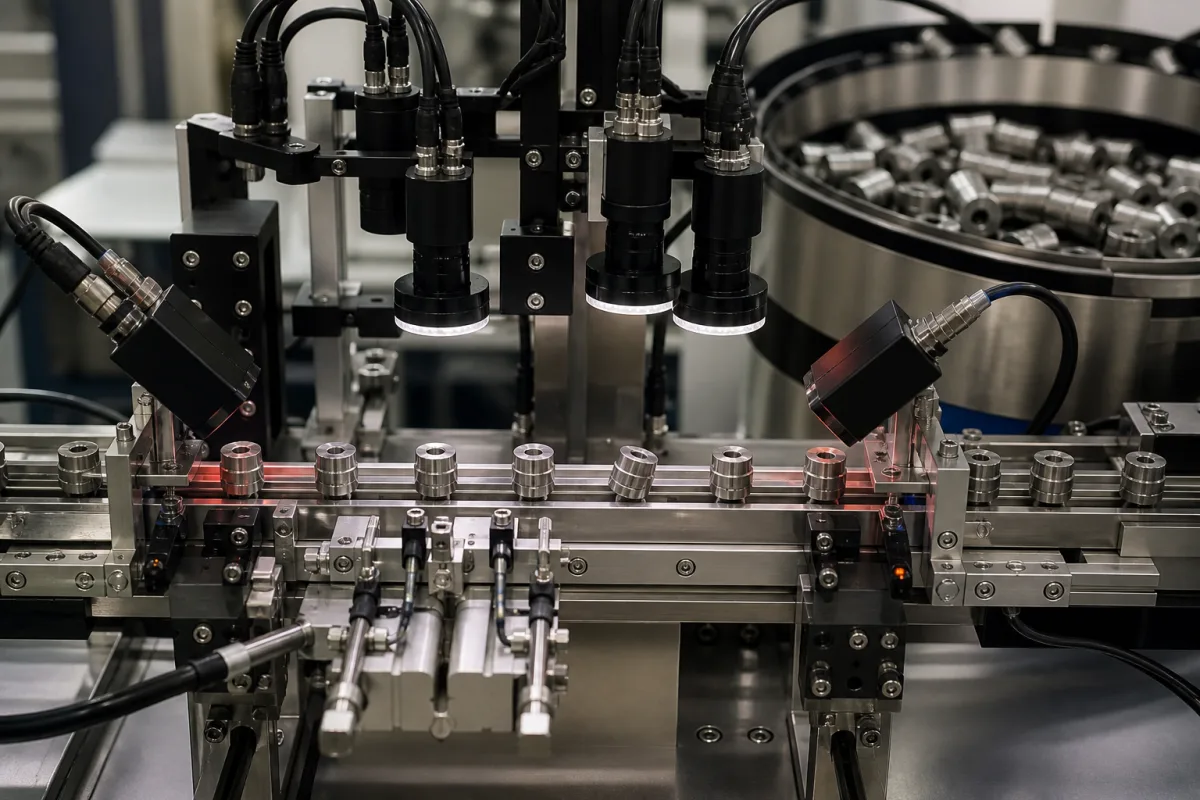
A multi-sensor configuration within a component feeding system that detects, identifies, and monitors the position, orientation, and presence of components.
Product Specifications

Technical details and manufacturing context for Sensing Array

Definition
A sensing array is a critical sub-assembly within a component feeding system, typically consisting of multiple sensors (e.g., photoelectric, proximity, vision) arranged in a specific pattern or sequence. Its primary role is to provide real-time feedback on the feeding process, ensuring components are correctly presented, oriented, and available for the subsequent pick-and-place or assembly operation. It acts as the system's 'eyes,' enabling precise control and error detection.
Working Principle
The array operates by deploying its individual sensors to monitor key points along the feeding path (e.g., bowl feeder track, linear vibrator, escapement). Sensors detect physical properties like light interruption, proximity, or visual features. Their combined signals are processed by a controller to determine component status (present/absent), verify correct orientation, and confirm proper positioning before release to the next stage, triggering corrective actions or halting the system if a fault is detected.
Common Materials
Stainless Steel (Housing), Polycarbonate (Lens/Window), Electronic Components (Sensor Elements, PCB)
Technical Parameters
  • Overall physical dimensions (LxWxH) and mounting hole pattern for integration into the feeding system frame. (mm) Standard Spec
Components / BOM
  • Sensor Housing
    Provides mechanical protection, mounting points, and environmental sealing for the internal electronics.
    Material: Stainless Steel or Engineering Plastic
  • Sensor Element(s)
    The core detection device (e.g., photoelectric emitter/receiver pair, inductive coil, capacitive plate) that generates the primary signal based on the presence or absence of a target.
    Material: Varied (Semiconductors, Ferrite Cores)
  • Signal Conditioning Circuit
    Amplifies, filters, and converts the raw sensor signal into a clean, standardized output signal for the system controller.
    Material: Electronic Components on PCB
  • Connector / Cable Gland
    Provides the electrical interface for power input and signal output to the main control system.
    Material: Plastic or Metal with Brass/Copper Contacts
Engineering Reasoning
0.1-100 kPa differential pressure, -40°C to 85°C ambient temperature, 0-100% relative humidity non-condensing
Differential pressure exceeding 120 kPa causes diaphragm rupture, temperatures beyond -50°C or 125°C cause sensor drift exceeding 5% FS, humidity above 95% RH causes capacitive coupling failure
Design Rationale: Diaphragm material (316L stainless steel) yields at 120 kPa due to Hooke's Law elastic limit violation, semiconductor junction thermal runaway occurs at 125°C per Arrhenius equation (Ea=0.7 eV), water adsorption on dielectric surfaces reduces permittivity by 30% at 95% RH
Risk Mitigation (FMEA)
Trigger Electrostatic discharge (ESD) event exceeding 8 kV HBM
Mode: CMOS sensor IC gate oxide breakdown with 10^6 Ω leakage path
Strategy: Integrated TVS diodes with 5 ns response time and 15 kV clamping voltage on all I/O lines
Trigger Mechanical vibration at 200 Hz resonance frequency with 5 g acceleration
Mode: Solder joint fatigue cracking per Coffin-Manson equation (Nf=1000 cycles at Δε=0.2%)
Strategy: Conformal coating (urethane, 50 μm thickness) and strain relief mounting with 60 Shore A durometer isolators

Industry Taxonomies & Aliases

Commonly used trade names and technical identifiers for Sensing Array.

Applied To / Applications

This component is essential for the following industrial systems and equipment:

Industrial Ecosystem & Supply Chain DNA

Complementary Systems
Downstream Applications
Specialized Tooling

Application Fit & Sizing Matrix

Operational Limits
pressure: 0 to 10 bar
flow rate: 0 to 5 m/s
temperature: -20°C to 85°C
slurry concentration: 0 to 30% solids by weight
Media Compatibility
✓ plastic pellets ✓ metal fasteners ✓ electronic components
Unsuitable: highly corrosive chemical environments
Sizing Data Required
  • component size range
  • required detection resolution
  • maximum feed rate

Reliability & Engineering Risk Analysis

Failure Mode & Root Cause
Sensor Drift
Cause: Thermal cycling and environmental exposure causing calibration shift in sensing elements
Signal Degradation
Cause: Moisture ingress and corrosion at electrical connections or within housing seals
Maintenance Indicators
  • Inconsistent or erratic readings compared to known process parameters
  • Physical damage to housing, exposed wiring, or visible corrosion on connectors
Engineering Tips
  • Implement regular calibration verification against master sensors or known references
  • Ensure proper IP-rated enclosures and use dielectric grease on connections to prevent moisture ingress

Compliance & Manufacturing Standards

Reference Standards
ISO 9001:2015 Quality Management Systems IEC 60529 Degrees of Protection Provided by Enclosures (IP Code) ASTM E1444/E1444M Standard Practice for Magnetic Particle Testing
Manufacturing Precision
  • Dimensional Accuracy: +/-0.05mm for sensor element positioning
  • Surface Flatness: 0.02mm across sensing face
Quality Inspection
  • Electrical Performance Verification (sensitivity, linearity, hysteresis)
  • Environmental Sealing Test (IP67/IP68 rating validation)

Factories Producing Sensing Array

Verified manufacturers with capability to produce this product in China

✓ 92% Supplier Capability Match Found

S Sourcing Manager from United States Jan 20, 2026
★★★★★
"Great transparency on the Sensing Array components. Essential for our Machinery and Equipment Manufacturing supply chain."
Technical Specifications Verified
P Procurement Specialist from United Arab Emirates Jan 17, 2026
★★★★☆
"The Sensing Array we sourced perfectly fits our Machinery and Equipment Manufacturing production line requirements. (Delivery took slightly longer than expected, but technical support was excellent.)"
Technical Specifications Verified
T Technical Director from Australia Jan 14, 2026
★★★★★
"Found 40+ suppliers for Sensing Array on CNFX, but this spec remains the most cost-effective."
Technical Specifications Verified
Verification Protocol

“Feedback is collected from verified sourcing managers during RFQ (Request for Quote) and factory evaluation processes on CNFX. These reports represent historical performance data and technical audit summaries from our B2B manufacturing network.”

18 sourcing managers are analyzing this specification now. Last inquiry for Sensing Array from Poland (1h ago).

Supply Chain Compatible Machinery & Devices

Heavy-Duty CNC Plasma Cutting Machine

Industrial machine for precision metal cutting using plasma arc technology

Explore Specs →
Automated Assembly Line System

Integrated production system for sequential component assembly operations

Explore Specs →
Automated Powder Coating System

Integrated industrial system for applying dry powder coatings to metal substrates.

Explore Specs →
Centrifugal Pump Impeller

Rotating component that transfers energy to fluid in centrifugal pumps.

Explore Specs →

Frequently Asked Questions

What materials are used in the Sensing Array construction?

The Sensing Array features a durable stainless steel housing for protection, polycarbonate lens/window for clear detection, and high-quality electronic components including sensor elements and PCB for reliable operation in industrial environments.

How does the Sensing Array improve component feeding system accuracy?

The multi-sensor configuration simultaneously detects position, orientation, and presence of components, providing comprehensive monitoring that reduces errors, minimizes jams, and ensures precise component placement in automated machinery systems.

What maintenance is required for the Sensing Array in manufacturing environments?

The stainless steel housing and polycarbonate lens require only periodic cleaning to maintain optical clarity. Electronic components are designed for long-term reliability with minimal maintenance, though regular system calibration is recommended for optimal performance.

Can I contact factories directly on CNFX?

CNFX is an open directory, not a transaction platform. Each factory profile provides direct contact information and production details to help you initiate direct inquiries with Chinese suppliers.

Get Quote for Sensing Array

Request technical pricing, lead times, or customized specifications for Sensing Array directly from verified manufacturing units.

Your business information is encrypted and only shared with verified Sensing Array suppliers.

Thank you! Your message has been sent. We'll respond within 1–3 business days.

Need to Manufacture Sensing Array?

Connect with verified factories specializing in this product category

Add Your Factory Contact Us
Previous Product
Semantic Validator
Next Product
Sensing Element/Probe