Industry-Verified Manufacturing Data (2026)

Separation Element/Cartridge

Based on aggregated insights from multiple verified factory profiles within the CNFX directory, the standard Separation Element/Cartridge used in the Machinery and Equipment Manufacturing sector typically supports operational capacities ranging from standard industrial configurations to heavy-duty production requirements.

Technical Definition & Core Assembly

A canonical Separation Element/Cartridge is characterized by the integration of Filter Media and End Caps. In industrial production environments, manufacturers listed on CNFX commonly emphasize Polypropylene construction to support stable, high-cycle operation across diverse manufacturing scenarios.

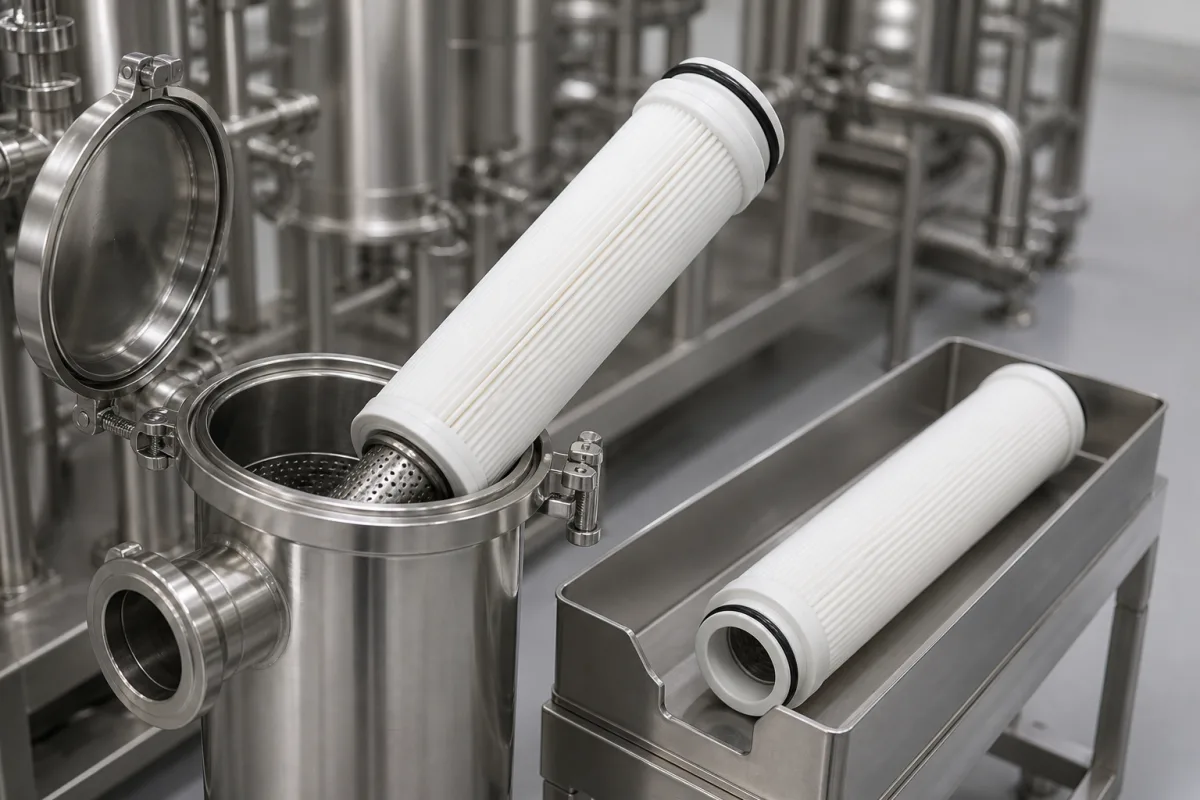
A replaceable filtration or separation component within an in-line separation unit that physically separates contaminants, particles, or specific substances from a fluid stream.
Product Specifications

Technical details and manufacturing context for Separation Element/Cartridge

Definition
The separation element or cartridge is the core consumable component of an in-line separation unit, such as a filter housing. It is designed to be inserted into and removed from the unit's body. Its primary function is to perform the actual separation task—whether filtration, coalescence, adsorption, or other separation mechanisms—by trapping target materials (like solids, water, oil, or specific chemicals) based on its media and construction, allowing the purified fluid to pass through. It is critical for maintaining process fluid quality and protecting downstream equipment.
Working Principle
Fluid flows through the porous or structured media of the cartridge. Target contaminants are removed via mechanisms such as surface filtration (particles trapped on the media surface), depth filtration (particles captured within the media matrix), adsorption (molecules adhering to media surfaces), or coalescence (small droplets merging into larger ones for separation). The clean fluid exits the cartridge, while contaminants are retained.
Common Materials
Polypropylene, Cellulose, Glass Fiber, Activated Carbon, Stainless Steel Mesh, PTFE Membrane
Technical Parameters
  • Outer diameter, inner diameter (if applicable), and length of the cartridge, critical for housing compatibility. (mm) Per Request
Components / BOM
  • Filter Media
    The active material (e.g., pleated membrane, depth media, adsorbent) that performs the separation by capturing contaminants.
    Material: Varies (e.g., Polypropylene, Cellulose, PTFE)
  • End Caps
    Seal the ends of the media pack, often providing gasket surfaces and connection points (e.g., O-ring grooves) to ensure a leak-proof seal within the housing.
    Material: Polypropylene, Metal
  • Support Core
    Internal cylindrical structure that provides mechanical strength to the media pack, preventing collapse under pressure differentials.
    Material: Polypropylene, Stainless Steel
  • Gasket/O-ring
    Elastomeric seal located on the end cap(s) to create a pressure-tight seal between the cartridge and the housing.
    Material: NBR, EPDM, Viton
Engineering Reasoning
0.5-25 bar differential pressure, -20°C to 120°C fluid temperature, 0.1-100 μm particle retention rating
35 bar differential pressure causes media rupture, 150°C causes polymer degradation, 0.01 μm particle breakthrough at 30 bar
Design Rationale: Hagen-Poiseuille law pressure differential exceeding media tensile strength (σ_max=15 MPa), Arrhenius equation thermal degradation at activation energy 80 kJ/mol, Darcy's law flow velocity exceeding 2 m/s causing media delamination
Risk Mitigation (FMEA)
Trigger Particulate loading exceeding 5 g/L concentration causing pore occlusion
Mode: Pressure differential increase to 30 bar within 15 minutes
Strategy: Upstream pre-filtration with 100 μm mesh screen and differential pressure monitoring with 20 bar cutoff
Trigger Chemical incompatibility with pH<2 or pH>12 fluid causing polymer hydrolysis
Mode: Media swelling by 15% volume leading to housing deformation
Strategy: Material selection of PTFE or PVDF for full pH 0-14 compatibility and chemical resistance testing per ASTM D543

Industry Taxonomies & Aliases

Commonly used trade names and technical identifiers for Separation Element/Cartridge.

Applied To / Applications

This component is essential for the following industrial systems and equipment:

Industrial Ecosystem & Supply Chain DNA

Complementary Systems
Downstream Applications
Specialized Tooling

Application Fit & Sizing Matrix

Operational Limits
pressure: Up to 10 bar (150 psi)
flow rate: 0.5 to 50 L/min
temperature: -20°C to 120°C
slurry concentration: Up to 15% solids by weight
Media Compatibility
✓ Polypropylene (PP) for general aqueous fluids ✓ Polysulfone (PSU) for high-temperature applications ✓ Stainless steel 316L for aggressive chemicals
Unsuitable: Concentrated strong acids (e.g., >50% sulfuric acid) at elevated temperatures
Sizing Data Required
  • Fluid viscosity (cP)
  • Required particle retention rating (microns)
  • System operating pressure drop (bar)

Reliability & Engineering Risk Analysis

Failure Mode & Root Cause
Media bypass/leakage
Cause: O-ring degradation due to chemical incompatibility, thermal cycling, or improper installation leading to seal failure and loss of separation efficiency
Filter media blinding/plugging
Cause: Excessive particulate loading beyond design capacity, improper pre-filtration, or agglomeration of particles causing rapid pressure drop increase and flow restriction
Maintenance Indicators
  • Sudden, sustained increase in differential pressure (ΔP) across the cartridge exceeding 25% of clean ΔP
  • Visible media migration or discoloration in downstream fluid samples indicating media breakdown or bypass
Engineering Tips
  • Implement condition-based monitoring with real-time ΔP trending and automated alerts at 80% of maximum rated pressure drop
  • Establish strict pre-filtration protocols using multi-stage filtration (e.g., bag → depth → final cartridge) matched to particle size distribution of incoming fluid

Compliance & Manufacturing Standards

Reference Standards
ISO 16889:2022 (Hydraulic fluid power - Filters - Multi-pass method for evaluating filtration performance) ASTM F838-23 (Standard Test Method for Determining Bacterial Retention of Membrane Filters) CE Marking (EU Directive 2006/42/EC for Machinery Safety)
Manufacturing Precision
  • Bore diameter: +/-0.025mm
  • End cap flatness: 0.05mm across sealing surface
Quality Inspection
  • Bubble Point Test (integrity testing of filter media)
  • Material Composition Verification (spectrographic analysis of housing materials)

Factories Producing Separation Element/Cartridge

Verified manufacturers with capability to produce this product in China

✓ 95% Supplier Capability Match Found

T Technical Director from Brazil Jan 22, 2026
★★★★★
"Found 38+ suppliers for Separation Element/Cartridge on CNFX, but this spec remains the most cost-effective."
Technical Specifications Verified
P Project Engineer from Canada Jan 19, 2026
★★★★☆
"The technical documentation for this Separation Element/Cartridge is very thorough, especially regarding technical reliability. (Delivery took slightly longer than expected, but technical support was excellent.)"
Technical Specifications Verified
S Sourcing Manager from United States Jan 16, 2026
★★★★★
"Reliable performance in harsh Machinery and Equipment Manufacturing environments. No issues with the Separation Element/Cartridge so far."
Technical Specifications Verified
Verification Protocol

“Feedback is collected from verified sourcing managers during RFQ (Request for Quote) and factory evaluation processes on CNFX. These reports represent historical performance data and technical audit summaries from our B2B manufacturing network.”

17 sourcing managers are analyzing this specification now. Last inquiry for Separation Element/Cartridge from Mexico (1h ago).

Supply Chain Compatible Machinery & Devices

Automated Assembly Line System

Integrated production system for sequential component assembly operations

Explore Specs →
Automated Powder Coating System

Integrated industrial system for applying dry powder coatings to metal substrates.

Explore Specs →
Centrifugal Pump Impeller

Rotating component that transfers energy to fluid in centrifugal pumps.

Explore Specs →
High-Precision CNC Laser Cutting Machine

Computer-controlled industrial machine using focused laser beams to cut sheet metal with micron-level accuracy.

Explore Specs →

Frequently Asked Questions

What materials are used in separation cartridges for machinery manufacturing?

Separation cartridges are typically constructed from polypropylene, cellulose, glass fiber, activated carbon, stainless steel mesh, or PTFE membrane, depending on the specific filtration requirements and fluid compatibility.

How often should separation elements be replaced in industrial equipment?

Replacement frequency depends on operating conditions, contaminant load, and fluid type. Monitor pressure differentials and follow manufacturer recommendations, typically ranging from weeks to several months of continuous operation.

What components make up a standard separation cartridge assembly?

A standard separation cartridge consists of filter media, end caps, a support core, and gasket/O-ring seals to ensure proper sealing and structural integrity within the separation unit.

Can I contact factories directly on CNFX?

CNFX is an open directory, not a transaction platform. Each factory profile provides direct contact information and production details to help you initiate direct inquiries with Chinese suppliers.

Get Quote for Separation Element/Cartridge

Request technical pricing, lead times, or customized specifications for Separation Element/Cartridge directly from verified manufacturing units.

Your business information is encrypted and only shared with verified Separation Element/Cartridge suppliers.

Thank you! Your message has been sent. We'll respond within 1–3 business days.

Need to Manufacture Separation Element/Cartridge?

Connect with verified factories specializing in this product category

Add Your Factory Contact Us
Previous Product
Separation Chamber / Tank
Next Product
Separation Mechanism