Industry-Verified Manufacturing Data (2026)

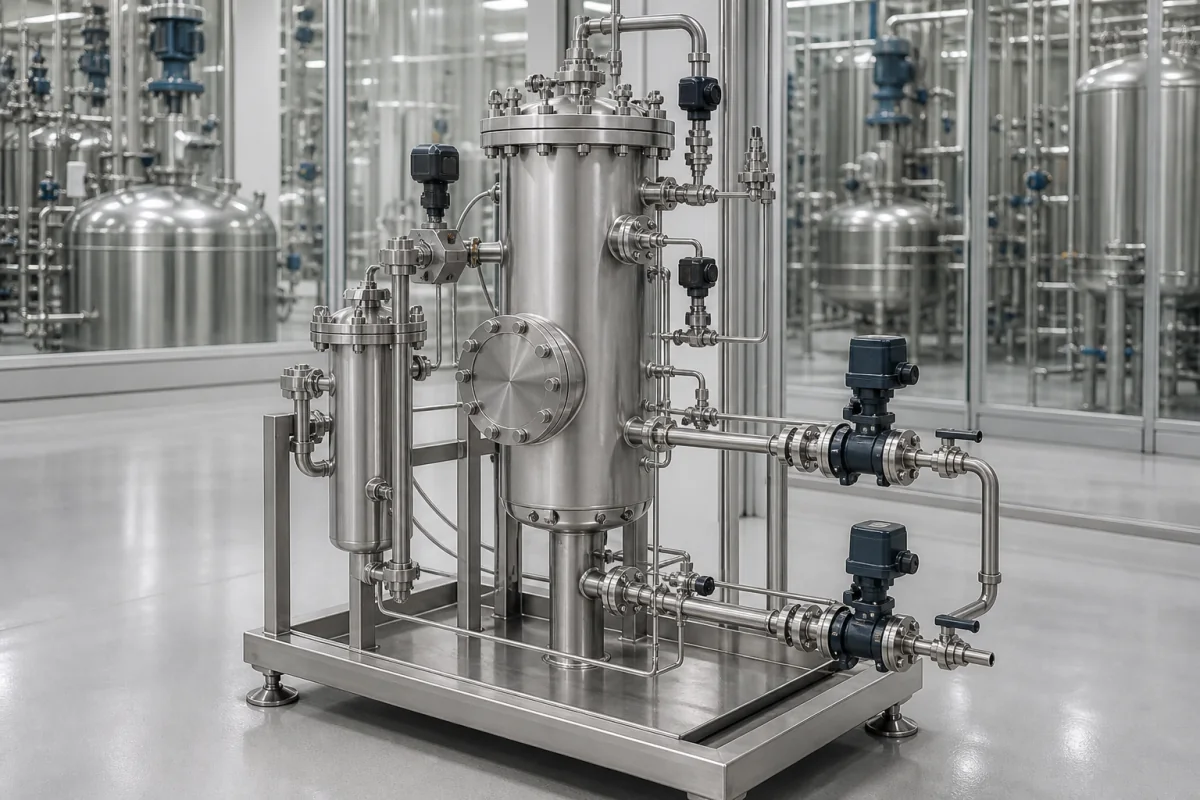
In-line Separation Unit

Based on aggregated insights from multiple verified factory profiles within the CNFX directory, the standard In-line Separation Unit used in the Chemical Manufacturing sector typically supports operational capacities ranging from standard industrial configurations to heavy-duty production requirements.

Technical Definition & Core Assembly

A canonical In-line Separation Unit is characterized by the integration of Separation Element/Cartridge and Flow Distribution Manifold. In industrial production environments, manufacturers listed on CNFX commonly emphasize Stainless Steel 316L construction to support stable, high-cycle operation across diverse manufacturing scenarios.

A component integrated within a continuous flow chemical synthesis system that performs real-time separation of reaction mixtures, products, or by-products without interrupting the continuous process.

Product Specifications

Technical details and manufacturing context for In-line Separation Unit

Definition
The In-line Separation Unit is a critical component of Continuous Flow Chemical Synthesis Systems designed to perform separation operations directly within the flow path. It enables the continuous removal, purification, or isolation of target compounds, intermediates, or by-products from the reaction stream in real-time, maintaining the system's uninterrupted operation. This unit typically follows reaction zones and precedes downstream processing or collection stages, ensuring efficient product recovery and process continuity.
Working Principle
The unit operates by exploiting physical or chemical property differences (such as phase, density, solubility, or molecular size) between components in the flowing mixture. Common mechanisms include membrane filtration, centrifugal separation, phase separation (liquid-liquid or gas-liquid), adsorption, or extraction. The separation occurs as the mixture flows through the unit, with separated streams exiting through different outlets while maintaining continuous flow conditions.
Common Materials
Stainless Steel 316L, PTFE (Polytetrafluoroethylene), Ceramic Membranes, Glass
Technical Parameters
  • Internal diameter of flow channels and separation elements (mm) Per Request
Components / BOM
  • Separation Element/Cartridge
    Core component where the actual separation occurs (membrane, filter, adsorbent, etc.)
    Material: Ceramic/PTFE/Stainless Steel Mesh
  • Flow Distribution Manifold
    Evenly distributes incoming mixture across the separation element
    Material: Stainless Steel 316L
  • Collection Chambers/Outlets
    Separate compartments or channels for collecting separated streams
    Material: Stainless Steel 316L/Glass
  • Pressure/Temperature Sensors
    Monitor operating conditions to ensure optimal separation performance
    Material: Stainless Steel with Electronic Components
Engineering Reasoning
0.1-15.0 MPa (1-150 bar) at 20-180°C
18.5 MPa (185 bar) internal pressure at 200°C
Design Rationale: Yield strength degradation of 316L stainless steel (205 MPa at 20°C reduced to 165 MPa at 200°C) combined with stress concentration at welded membrane joints exceeding material fatigue limit
Risk Mitigation (FMEA)
Trigger Particulate accumulation exceeding 50 μm diameter at 0.5 g/L concentration in feed stream
Mode: Membrane fouling reducing separation efficiency below 85% nominal
Strategy: Installation of 10 μm pre-filtration with automated backflush triggered at 5 kPa differential pressure increase
Trigger Thermal cycling exceeding 50°C/min rate during process transitions
Mode: Thermal stress cracking at ceramic membrane support interface
Strategy: Implementation of PID-controlled heating jackets with maximum 10°C/min ramp rate limitation

Industry Taxonomies & Aliases

Commonly used trade names and technical identifiers for In-line Separation Unit.

Industrial Ecosystem & Supply Chain DNA

Complementary Systems
Downstream Applications
Specialized Tooling

Application Fit & Sizing Matrix

Operational Limits
pressure: 0 to 50 bar
flow rate: 0.1 to 100 L/min
temperature: -20°C to 200°C
slurry concentration: Up to 40% solids by volume
Media Compatibility
✓ Organic solvents (e.g., DMF, THF, acetone) ✓ Aqueous solutions with pH 2-12 ✓ Ionic liquids and molten salts
Unsuitable: Highly corrosive media (e.g., concentrated HF, hot concentrated sulfuric acid)
Sizing Data Required
  • Required separation efficiency (e.g., 95% purity)
  • Maximum allowable pressure drop across the unit
  • Particle size distribution of solids in slurry (if applicable)

Reliability & Engineering Risk Analysis

Failure Mode & Root Cause
Corrosion-induced perforation
Cause: Exposure to corrosive process fluids (e.g., H2S, chlorides) combined with high temperatures and pressures, leading to wall thinning and eventual leaks.
Mechanical seal failure
Cause: Improper alignment, thermal expansion stresses, or particulate contamination in the sealing surfaces, resulting in loss of containment and reduced separation efficiency.
Maintenance Indicators
  • Unusual vibration or audible knocking from the vessel, indicating internal component detachment or flow-induced resonance.
  • Visible weeping or droplets at weld seams or flange connections, signaling incipient leaks or material degradation.
Engineering Tips
  • Implement real-time corrosion monitoring (e.g., ultrasonic thickness testing coupled with corrosion coupons) to track wall loss trends and schedule proactive replacements.
  • Establish a strict alignment and bolting procedure during reassembly, using laser alignment tools and calibrated torque wrenches to prevent seal distortion and ensure even gasket loading.

Compliance & Manufacturing Standards

Reference Standards
ISO 9001:2015 - Quality management systems ASME B31.3 - Process piping DIN EN 13445 - Unfired pressure vessels
Manufacturing Precision
  • Bore diameter: +/-0.025mm
  • Surface flatness: 0.08mm per 100mm
Quality Inspection
  • Hydrostatic pressure test
  • Dimensional verification with CMM

Factories Producing In-line Separation Unit

Verified manufacturers with capability to produce this product in China

✓ 98% Supplier Capability Match Found

T Technical Director from Singapore Feb 03, 2026
★★★★★
"Standard OEM quality for Chemical Manufacturing applications. The In-line Separation Unit arrived with full certification."
Technical Specifications Verified
P Project Engineer from Germany Jan 31, 2026
★★★★☆
"Great transparency on the In-line Separation Unit components. Essential for our Chemical Manufacturing supply chain. (Delivery took slightly longer than expected, but technical support was excellent.)"
Technical Specifications Verified
S Sourcing Manager from Brazil Jan 28, 2026
★★★★★
"The In-line Separation Unit we sourced perfectly fits our Chemical Manufacturing production line requirements."
Technical Specifications Verified
Verification Protocol

“Feedback is collected from verified sourcing managers during RFQ (Request for Quote) and factory evaluation processes on CNFX. These reports represent historical performance data and technical audit summaries from our B2B manufacturing network.”

19 sourcing managers are analyzing this specification now. Last inquiry for In-line Separation Unit from Vietnam (1h ago).

Supply Chain Compatible Machinery & Devices

Automated Batch Crystallization System

Automated system for controlled crystallization of chemical compounds in batch processes.

Explore Specs →
Automated pH Monitoring and Dosing System

Automated system for continuous pH monitoring and chemical dosing in process streams.

Explore Specs →
Automated Powder Dispensing and Blending System

Automated system for precise dispensing and homogeneous blending of powdered chemicals.

Explore Specs →
Automated Solvent Recovery and Purification System

Automated system for recovering and purifying industrial solvents.

Explore Specs →

Frequently Asked Questions

How does the in-line separation unit maintain continuous chemical processing?

The unit integrates directly into the flow system with collection chambers and manifolds that separate mixtures in real-time without stopping production, using pressure/temperature sensors to optimize performance.

What materials make this separation unit suitable for corrosive chemical environments?

Constructed with Stainless Steel 316L, PTFE components, ceramic membranes, and glass elements for maximum chemical resistance and durability in aggressive manufacturing conditions.

Can this unit separate multiple product streams simultaneously?

Yes, the flow distribution manifold and multiple collection chambers allow for simultaneous separation of products, by-products, and reaction mixtures within a single continuous system.

Can I contact factories directly on CNFX?

CNFX is an open directory, not a transaction platform. Each factory profile provides direct contact information and production details to help you initiate direct inquiries with Chinese suppliers.

Get Quote for In-line Separation Unit

Request technical pricing, lead times, or customized specifications for In-line Separation Unit directly from verified manufacturing units.

Your business information is encrypted and only shared with verified In-line Separation Unit suppliers.

Thank you! Your message has been sent. We'll respond within 1–3 business days.

Need to Manufacture In-line Separation Unit?

Connect with verified factories specializing in this product category

Add Your Factory Contact Us
Previous Product
ID Fan
Next Product
Industrial Chemical Crystallization Unit