Industry-Verified Manufacturing Data (2026)

Spring Return Mechanism

Based on aggregated insights from multiple verified factory profiles within the CNFX directory, the standard Spring Return Mechanism used in the Machinery and Equipment Manufacturing sector typically supports operational capacities ranging from standard industrial configurations to heavy-duty production requirements.

Technical Definition & Core Assembly

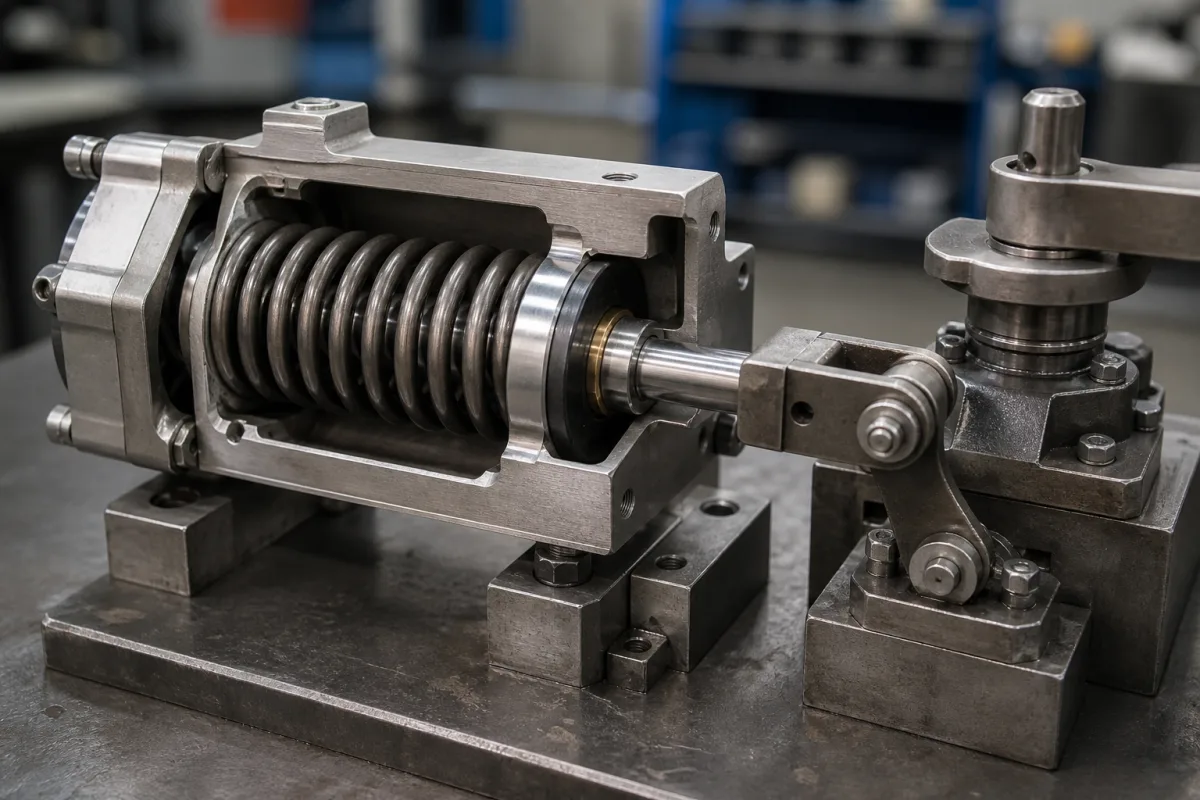
A canonical Spring Return Mechanism is characterized by the integration of Compression Spring and Guide Rod. In industrial production environments, manufacturers listed on CNFX commonly emphasize Spring steel construction to support stable, high-cycle operation across diverse manufacturing scenarios.

A mechanical component that uses spring force to return an actuator to its default position after actuation.
Product Specifications

Technical details and manufacturing context for Spring Return Mechanism

Definition
The Spring Return Mechanism is a critical sub-component within actuator systems that ensures automatic return to the neutral or default position when actuating force is removed. It typically consists of a spring element that stores energy during actuation and releases it to restore the actuator's original position, providing fail-safe operation and consistent performance in various industrial applications.
Working Principle
When an external force actuates the mechanism, the spring compresses or extends, storing potential energy. Upon release of the actuating force, the stored energy in the spring is converted back to kinetic energy, returning the actuator to its original position through spring force.
Common Materials
Spring steel, Stainless steel
Technical Parameters
  • Spring rate or stiffness coefficient (N/mm) Customizable
Components / BOM
  • Compression Spring
    Stores and releases energy to provide return force
    Material: Spring steel
  • Guide Rod
    Provides linear guidance and prevents spring buckling
    Material: Stainless steel
  • End Plates
    Secures spring ends and provides mounting points
    Material: Carbon steel
Engineering Reasoning
0.5-25 N·m torque, -40°C to 120°C temperature, 1×10⁶ to 5×10⁶ cycles
Spring fatigue fracture at 5.5×10⁶ cycles (S-N curve for ASTM A228 steel), permanent set at 35% of free length compression, torque drop below 0.3 N·m
Design Rationale: High-cycle fatigue from cyclic torsional stress exceeding 620 MPa endurance limit, stress relaxation due to dislocation movement at >85°C, fretting corrosion at pivot interfaces
Risk Mitigation (FMEA)
Trigger Corrosive fluid ingress (pH <4 or >10)
Mode: Spring corrosion pitting leading to stress concentration fracture
Strategy: 316L stainless steel spring with PTFE coating, IP67 sealed housing
Trigger Over-torque loading exceeding 30 N·m
Mode: Spring permanent deformation causing 40% torque loss
Strategy: Torque limiter coupling with shear pin rated at 28 N·m

Industry Taxonomies & Aliases

Commonly used trade names and technical identifiers for Spring Return Mechanism.

Applied To / Applications

This component is essential for the following industrial systems and equipment:

Industrial Ecosystem & Supply Chain DNA

Complementary Systems
Downstream Applications
Specialized Tooling

Application Fit & Sizing Matrix

Operational Limits
pressure: Up to 100 bar (standard), higher with reinforced housing
other spec: Max spring force: 5000 N, Cycle life: 1 million cycles minimum
temperature: -40°C to 120°C (standard), up to 200°C with high-temp springs
Media Compatibility
✓ Hydraulic oil ✓ Compressed air ✓ Water/glycol mixtures
Unsuitable: Corrosive chemicals (acids, strong bases)
Sizing Data Required
  • Required return force (N)
  • Stroke length (mm)
  • Operating frequency (cycles/min)

Reliability & Engineering Risk Analysis

Failure Mode & Root Cause
Spring Fatigue Failure
Cause: Cyclic loading beyond material endurance limit, often due to improper sizing, excessive operating cycles, or material defects, leading to crack initiation and propagation.
Corrosion-Induced Spring Degradation
Cause: Exposure to corrosive environments (moisture, chemicals, salts) without adequate protection, causing pitting, stress corrosion cracking, or loss of spring force over time.
Maintenance Indicators
  • Audible squeaking, grinding, or irregular clicking during operation indicating friction, misalignment, or spring binding.
  • Visible corrosion, discoloration, or pitting on spring surfaces, or noticeable deformation (set) or loss of return force compared to specifications.
Engineering Tips
  • Implement regular lubrication with compatible, corrosion-inhibiting lubricants to reduce friction and wear, and apply protective coatings (e.g., zinc plating, powder coating) tailored to the operating environment.
  • Conduct periodic force testing and visual inspections to monitor spring performance and wear, and ensure proper alignment and installation to avoid overloading or uneven stress distribution.

Compliance & Manufacturing Standards

Reference Standards
ISO 9001:2015 - Quality Management Systems ASTM A29/A29M - Standard Specification for Steel Bars, Carbon and Alloy, Hot-Wrought and Cold-Finished CE Marking - Directive 2006/42/EC (Machinery Directive)
Manufacturing Precision
  • Spring Force Tolerance: +/-5% of specified value
  • Return Stroke Length: +/-0.5mm
Quality Inspection
  • Spring Fatigue Test - Cyclic loading to verify durability
  • Dimensional Verification - Coordinate Measuring Machine (CMM) inspection

Factories Producing Spring Return Mechanism

Verified manufacturers with capability to produce this product in China

✓ 94% Supplier Capability Match Found

P Procurement Specialist from United Arab Emirates Jan 15, 2026
★★★★★
"Reliable performance in harsh Machinery and Equipment Manufacturing environments. No issues with the Spring Return Mechanism so far."
Technical Specifications Verified
T Technical Director from Australia Jan 12, 2026
★★★★★
"Testing the Spring Return Mechanism now; the technical reliability results are within 1% of the laboratory datasheet."
Technical Specifications Verified
P Project Engineer from Singapore Jan 09, 2026
★★★★★
"Impressive build quality. Especially the technical reliability is very stable during long-term operation."
Technical Specifications Verified
Verification Protocol

“Feedback is collected from verified sourcing managers during RFQ (Request for Quote) and factory evaluation processes on CNFX. These reports represent historical performance data and technical audit summaries from our B2B manufacturing network.”

10 sourcing managers are analyzing this specification now. Last inquiry for Spring Return Mechanism from Brazil (25m ago).

Supply Chain Compatible Machinery & Devices

Hydraulic Press

Industrial machine using hydraulic pressure to compress, form, or assemble materials

Explore Specs →
Heavy-Duty CNC Plasma Cutting Machine

Industrial machine for precision metal cutting using plasma arc technology

Explore Specs →
Automated Assembly Line System

Integrated production system for sequential component assembly operations

Explore Specs →
Automated Powder Coating System

Integrated industrial system for applying dry powder coatings to metal substrates.

Explore Specs →

Frequently Asked Questions

What is the primary function of a spring return mechanism in industrial equipment?

A spring return mechanism automatically returns an actuator, valve, or other mechanical component to its default neutral position after actuation, using stored spring energy to ensure reliable resetting without external power.

What materials are commonly used in spring return mechanisms and why?

Spring steel is most common for its excellent elasticity and fatigue resistance, while stainless steel is used in corrosive environments. Both provide the durability and consistent force needed for repeated cycling in industrial applications.

How do I select the right spring return mechanism for my machinery application?

Consider required return force, stroke length, operating environment (temperature, corrosion), cycle life, and mounting configuration. Consult specifications for spring rate, maximum deflection, and material compatibility with your equipment.

Can I contact factories directly on CNFX?

CNFX is an open directory, not a transaction platform. Each factory profile provides direct contact information and production details to help you initiate direct inquiries with Chinese suppliers.

Get Quote for Spring Return Mechanism

Request technical pricing, lead times, or customized specifications for Spring Return Mechanism directly from verified manufacturing units.

Your business information is encrypted and only shared with verified Spring Return Mechanism suppliers.

Thank you! Your message has been sent. We'll respond within 1–3 business days.

Need to Manufacture Spring Return Mechanism?

Connect with verified factories specializing in this product category

Add Your Factory Contact Us
Previous Product
Spring Dampers
Next Product
Spring Support System