Editorial Technical Reference

Stacking Mandrel/Press

This page explains how Stacking Mandrel/Press is classified within Machinery and Equipment Manufacturing. Technical values and manufacturer relationships are research references; confirm the current specification and supplier evidence for each order.

Technical Definition & Core Assembly

A mechanical component used to precisely align and compress laminated materials during the stacking process.
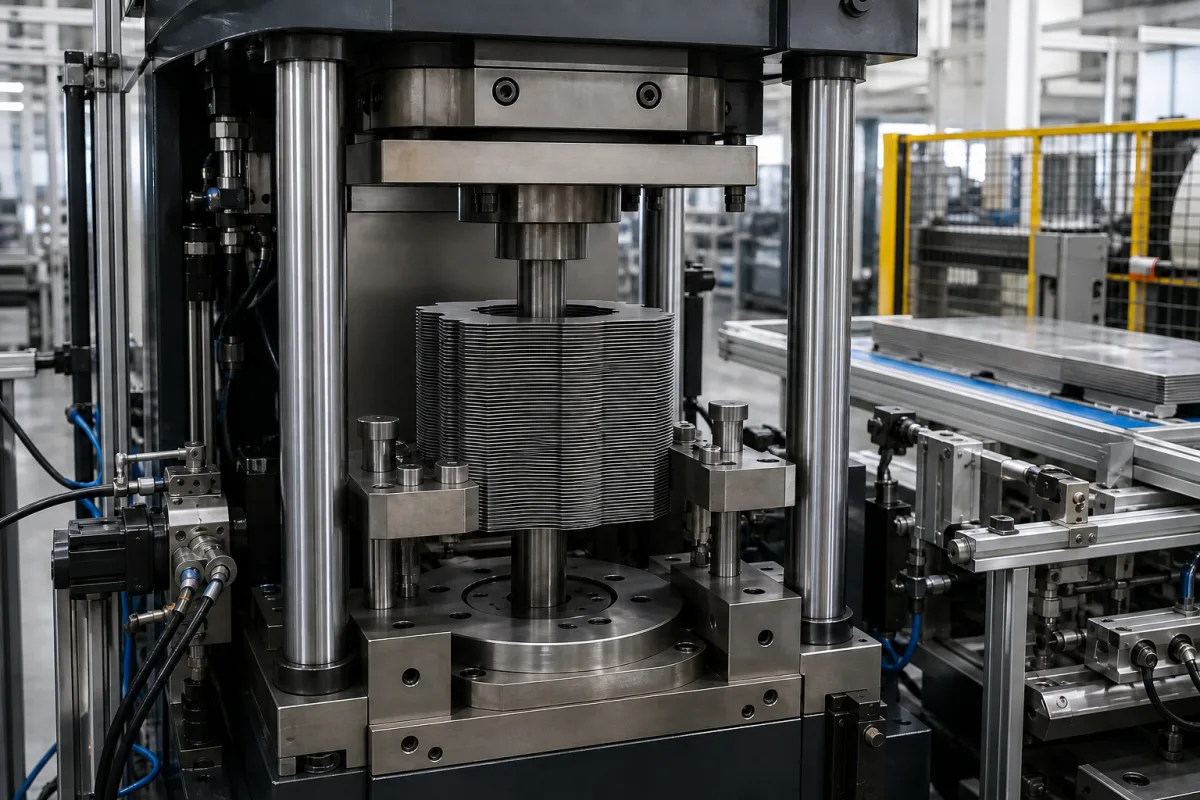
Representative product image. Confirm appearance and specifications with the manufacturer.

Product Specifications

Technical details and manufacturing context for Stacking Mandrel/Press

Definition
The Stacking Mandrel/Press is a critical component within the Lamination Feeding and Stacking Module, responsible for receiving individual laminations, ensuring their precise alignment, and applying controlled pressure to form a consolidated stack. It interfaces with feeding mechanisms and transfer systems to enable automated, high-precision stacking operations. The mandrel receives a lamination from the feeding system. A press mechanism (hydraulic, pneumatic, or mechanical) then actuates to apply controlled force, pressing the lamination onto the stack or a preceding layer. This ensures flatness, removes air gaps, and establishes the correct alignment for the entire stack before transfer to the next processing stage. The component is typically made from tool steel or hardened alloy steel for durability and wear resistance. Key parameters include operating pressure (1.0–1.6 MPa), maximum stacking diameter (200–600 mm), maximum stacking height (100–300 mm), parallelism (0.02–0.05 mm, ISO 1101), positioning accuracy (±0.05 mm), cycle time (10–30 s), motor power (2.2–7.5 kW, IEC 60034), supply voltage (380–480 V AC, IEC 60038), operating temperature (5–40 °C), ingress protection (IP54–IP65, IEC 60529), frame material (Q235–Q345, GB/T 700), platen hardness (HRC 40–50, ASTM E18), machine weight (1500–3500 kg), and footprint (1200×800×1800–2000×1200×2500 mm). These values are reference ranges and must be verified for the specific model and application. The component is designed for integration into automated lamination lines, and its performance depends on proper selection of pressure, alignment, and cycle time. Verification questions include: What is the required stacking diameter and height? What is the acceptable parallelism and positioning accuracy? What cycle time is needed for production throughput? What are the environmental conditions (temperature, humidity, dust)? What are the electrical supply specifications? Maintenance signals include unusual noise, vibration, or pressure drops, which may indicate wear or misalignment. Failure boundaries include exceeding the maximum stacking height or diameter, operating outside the specified temperature range, or using incorrect pressure settings, which can lead to misalignment, damage, or reduced product quality. Always confirm model-specific values and standards with the legal manufacturer or supplier.
Working Principle
The mandrel receives a lamination from the feeding system. A press mechanism (hydraulic, pneumatic, or mechanical) then actuates to apply controlled force, pressing the lamination onto the stack or a preceding layer. This ensures flatness, removes air gaps, and establishes the correct alignment for the entire stack before transfer to the next processing stage.
Common Materials
Tool Steel, Hardened Alloy Steel
Technical Parameters
ParameterTypical rangeNotes & selection driver
Operating Pressure1.0–1.6 MPa
Max. Stacking Diameter200–600 mmDetermines the maximum laminate size
Max. Stacking Height100–300 mmAffects the number of layers per cycle
Parallelism0.02–0.05 mmEnsures uniform compression across the stackISO 1101
Positioning Accuracy±0.05 mmCritical for alignment of laminated layers
Cycle Time10–30 sAffects production throughput
Motor Power2.2–7.5 kWSizing for the hydraulic or servo driveIEC 60034
Supply Voltage380–480 V ACThree-phase, 50/60 HzIEC 60038
Operating Temperature5–40 °COutside this range, hydraulic fluid viscosity changes
Ingress ProtectionIP54–IP65Protects against dust and water jetsIEC 60529
Frame MaterialQ235–Q345Carbon steel for structural rigidityGB/T 700
Platen HardnessHRC 40–50Wear resistance of the pressing surfaceASTM E18
Machine Weight1500–3500 kgImportant for floor loading and transport
Footprint (L×W×H)1200×800×1800–2000×1200×2500 mmSpace required for installation

Ranges are indicative industry figures for RFQ preparation, not a supplier commitment. Confirm every value and standard with the legal manufacturer before ordering.

Components / BOM
  • Mandrel Shaft Part
    Provides the central axis for aligning the inner diameter of laminations.
    Material: Hardened Alloy Steel
  • Press Platen Part
    The flat surface that applies uniform pressure across the face of the lamination stack.
    Material: Tool Steel
  • Actuation Cylinder
    Generates the linear force required for the pressing operation (hydraulic or pneumatic).
    Material: Steel

Industry Taxonomies & Aliases

Commonly used trade names and technical identifiers for Stacking Mandrel/Press.

Applied To / Applications

This component is essential for the following industrial systems and equipment:

Industrial Ecosystem & Supply Chain Structure

Complementary Systems
Downstream Applications
Specialized Tooling

Application Fit & Sizing Matrix

Operational Limits
pressure: Up to 50 MPa
other spec: Alignment tolerance: ±0.05 mm, Compression stroke: 100-500 mm
temperature: -20°C to 150°C
Media Compatibility
✓ Composite laminates (carbon fiber/epoxy) ✓ Printed circuit board (PCB) layers ✓ Battery cell stacking (Li-ion)
Unsuitable: High-viscosity slurries or abrasive particulate media
Sizing Data Required
  • Maximum stack thickness (mm)
  • Required compression force (kN)
  • Mandrel diameter/tooling interface dimensions (mm)

Reliability & Engineering Risk Analysis

Failure Mode & Root Cause
Mandrel surface scoring and galling
Cause: Insufficient lubrication during press operations, leading to metal-to-metal contact and adhesive wear between the mandrel and workpiece material.
Mandrel bending or buckling
Cause: Excessive axial load beyond design limits, often from misaligned press operations or using incorrect die settings that create uneven stress distribution.
Maintenance Indicators
  • Visible scoring marks or metal transfer on the mandrel surface after operation
  • Unusual popping or cracking sounds during press release, indicating binding or excessive friction
Engineering Tips
  • Implement a strict lubrication protocol using high-pressure, anti-galling lubricants specifically formulated for cold forming applications
  • Establish regular mandrel alignment checks using laser alignment tools and maintain detailed press force monitoring to prevent overload conditions

Indicative industry ranges for design and RFQ preparation. Confirm the exact figures and applicable standard with the manufacturer before specifying.

Compliance & Manufacturing Standards

Applicable Standards
ISO 286-2:2010 (Limits and fits) ANSI B4.1-1967 (Preferred Limits and Fits for Cylindrical Parts) DIN 7150-1:2011 (System of limits and fits)

Quoted from the published standard.

Manufacturing Precision
  • Bore diameter: +/-0.01mm
  • Parallelism of faces: 0.02mm
Quality Inspection
  • Dimensional verification with CMM (Coordinate Measuring Machine)
  • Surface roughness measurement per ISO 4287

Manufacturers of Stacking Mandrel/Press

Manufacturer profiles associated with Stacking Mandrel/Press.

Sourcing Stacking Mandrel/Press from China?
Tell us your specification and target quantity — we will match it against manufacturer records and come back with the factories that fit.
Request manufacturers We manufacture this

Manufacturer listings support early research and capability understanding. They are not certification, ranking, or transaction guarantees.

Technical documentation
Request current drawings, revision history, and a signed specification sheet.
Manufacturing capability
Verify equipment lists, process limits, capacity, and representative production evidence.
Inspection readiness
Confirm test methods, calibrated equipment, sampling plans, and traceable reports.
Supplier transparency
Check the legal entity, factory address, ownership, certifications, and direct contacts.

CNFX does not score or rank suppliers. Buyers must verify all claims and documents with the legal manufacturer before ordering.

Supply Chain Compatible Machinery & Devices

Automated Powder Coating System

Integrated industrial system for applying dry powder coatings to metal substrates.

Explore Specs →
Centrifugal Pump Impeller

The centrifugal pump impeller is a critical rotating component that converts mechanical energy from the motor into kinetic energy in fluid systems.

Explore Specs →
High-Precision CNC Laser Cutting Machine

Computer-controlled industrial machine using focused laser beams to cut sheet metal with micron-level accuracy.

Explore Specs →
Industrial-Grade Hydraulic Cylinder Piston Rod

This industrial-grade piston rod is a precision-ground cylindrical component designed for use in hydraulic cylinders.

Explore Specs →

Frequently Asked Questions

What is the operating pressure range for the Stacking Mandrel/Press?

The operating pressure range is 1.0–1.6 MPa. Verify the exact pressure for your application with the manufacturer.

What are the maximum stacking diameter and height?

The maximum stacking diameter is 200–600 mm, and the maximum stacking height is 100–300 mm. These values determine the laminate size and number of layers per cycle. Confirm the specific limits for your model.

What is the positioning accuracy and parallelism?

Positioning accuracy is ±0.05 mm, and parallelism is 0.02–0.05 mm (ISO 1101). These ensure uniform compression and alignment of laminated layers. Verify these tolerances with the supplier.

What are the electrical and environmental requirements?

The supply voltage is 380–480 V AC (IEC 60038), motor power is 2.2–7.5 kW (IEC 60034), and operating temperature is 5–40 °C. Ingress protection is IP54–IP65 (IEC 60529). Check these specifications against your facility's capabilities.

Data Basis

Editorial classification, named public sources where available, and source-reviewed manufacturer records.

Preliminary Technical Classification
This page supports structured research, RFQ preparation, and supplier evaluation. It does not replace buyer-led supplier qualification, standards review, or technical approval.
Buyer enquiry

Request manufacturing insight for Stacking Mandrel/Press

Ask for use case, specification boundaries, supplier type, and RFQ preparation information for this product.

Where it goes
Straight to the CNFX editorial desk, and to the manufacturer if this product is linked to a claimed profile. Nothing is broadcast to a supplier list.
Your details stay here
We do not sell or rent enquiry data, and we do not add you to a mailing list. Used only to answer this request.
No commission, no middleman
CNFX is a directory. We take no cut of any order and never negotiate on a supplier's behalf.
What we don't claim
A listing is not an endorsement. Qualify every supplier and verify every figure yourself before ordering.

Your business information is used only to process this request.

Thank you! Your message has been sent. We'll respond within 1–3 business days.
Sorry, we couldn't send your message. Please try again, or email us at contact@cnfx.com.

Need to Manufacture Stacking Mandrel/Press?

Compare manufacturer profiles with relevant product and process capability.

Previous Product
Z-axis Ram/Spindle
Last Product
Get QuotesChat