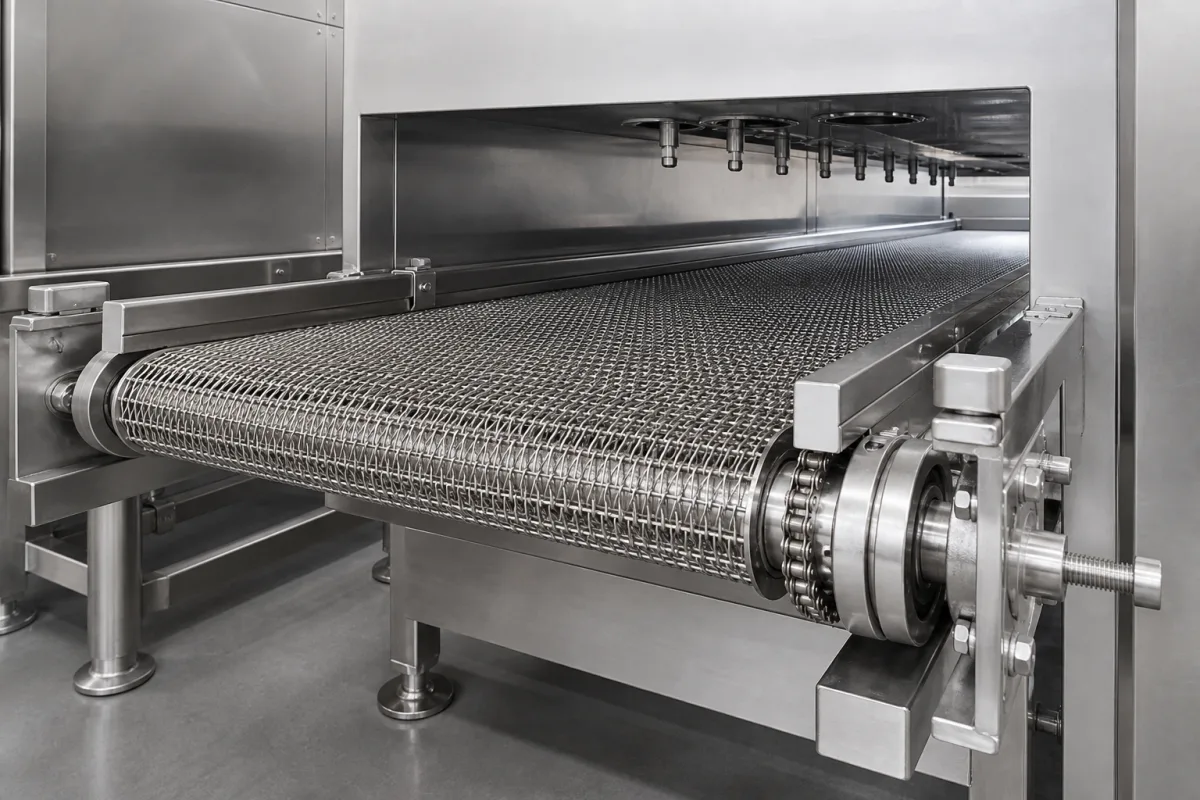
The belt in the illustration is a woven stainless mesh carried at both edges by roller chains on sprockets, running into a tunnel with air nozzles above and a screw take-up at the shaft end. It is the kind of belt that moves vials through a hot-air sterilising tunnel or product through a dryer. A wire belt is specified by a coded weave, a drive method and a tension calculation, and in a sterile tunnel by where its return run goes.
Covers woven stainless and alloy wire mesh conveyor belts for drying, baking and hot-air sterilising tunnels: balanced weave designations and pitches, opening size against product size, minimum drum diameter, friction drive versus positive-drive chain-edge construction, chains, cross supports and guard edges, belt tension and torque with bed friction at temperature, and belt routing in depyrogenation tunnels. Rubber, fabric, steel-cord, PVC, PU and modular plastic belts are on Industrial conveyor belt; belt and tray dryers for fruit and vegetables are on Industrial food dehydrator.
CNFX editorial research · Sources checked October 12, 2026 · 4 sources
Ashworth's technical bulletin defines balanced weave as alternating right- and left-hand spirals joined by crimped or straight connecting rods, with welded or brazed edges, in carbon, galvanised and stainless steels and high-temperature alloys, for straight runs only.
The designation B-first count-second count-gauge reads: B for balanced weave; first count = loops per foot of width, so lateral pitch = 12 / first count inches; second count = connectors per foot of length, so longitudinal pitch = 12 / second count inches; third count = wire gauge, or two gauges (connector, then spiral). Belts run up to 216 in (5,486 mm) wide.
Opening size follows from the counts, and Ashworth's maximum recommended opening is 0.75 times the smallest product size. A friction-driven balanced weave belt needs a drum of at least 180 / second count inches, and never under 6 in; a smaller drum makes the belt hinge on its spirals, bending them and lengthening the pitch unevenly across the width, which causes tracking problems and mesh distortion.
Example designation (assumed)
Lateral pitch
Longitudinal pitch
Minimum drum
B48-42-18
12/48 = 0.25 in (6.4 mm)
12/42 ≈ 0.29 in (7.3 mm)
180/42 ≈ 4.3 in, so the 6 in minimum applies
B36-24-16
12/36 ≈ 0.33 in (8.5 mm)
12/24 = 0.50 in (12.7 mm)
180/24 = 7.5 in (191 mm)
Product 16 mm across (assumed)
—
—
Opening no larger than 12 mm (0.75 × 16)
Editorial calculations from Ashworth's formulas; the designations are examples, not recommendations. Give the supplier the smallest product footprint and the drum diameter available.
02
Friction drive or chain-edge positive drive
Ashworth's bulletin on positive drive chain edge (PDCE) belts describes two or more chain strands joined by cross supports that carry the mesh, driven by sprockets on the chains, as in the illustration.
Ashworth lists the reasons to use it where a friction-driven belt is impracticable or undesirable: design limits, operational needs, where synchronised belt travel is essential, and where periodic inspection and service are hard to maintain. Its advantages are positive tracking, small terminals (sprockets) and synchronised travel. Belt strength becomes a function of the chain, so the chain maker's rating applies.
Chain choice sets the temperature limit as much as the mesh does. Ashworth notes malleable iron pintle chain works up to 600 °F (about 316 °C), cast stainless alloys are offered for severe corrosion or above 1,050 °F (about 566 °C), and stainless roller chain should be used in corrosive conditions. Cross supports are rods, pipe-and-rod, flat bar, channel or angle; round rods that engage the chain as pins have standard diameters per chain size, from 3.4 mm for RC35/RC41 to 7.8 mm for RC80.
Chain (ANSI)
Standard rod diameter as pin
RC35, RC41
0.135 in (3.4 mm)
RC40, C2040, C2042
0.152 in (3.9 mm)
RC50, C2050, C2052
0.196 in (5.0 mm)
RC60, C2060H, C2062H
0.230 in (5.8 mm)
RC80, C2080H, C2082H
0.307 in (7.8 mm)
Temperature conversions are Editorial calculations. Ask for the chain grade and its rated temperature, not only the mesh alloy, and for the chain-centre dimension, which Ashworth treats as the critical dimension.
03
Belt tension, bed friction and temperature
Ashworth gives belt tension as T = (W·L·fr + w·L·fr) × C, where W is belt plus product weight per unit area or length, w the belt weight, L the conveyor length, fr the friction coefficient between belt and support, and C = 9.8 for metric units (1.0 imperial); drive torque is tension times half the drum diameter. For chain-edge belts an incline term W·H is added.
The friction factor rises with temperature on mild steel supports, which is why a hot tunnel needs more drive than the same conveyor cold.
Belt support (Ashworth)
fr
Stainless steel
0.40
Free-turning rollers
0.10
Mild steel, up to 538 °C
0.35
Mild steel, 538–649 °C
0.37
Mild steel, 649–760 °C
0.40
Mild steel, 761–871 °C
0.44
Editorial example with assumed values: belt 5 kg/m², product 10 kg/m², 6 m long, mild steel bed below 538 °C (fr 0.35): T = (15 × 6 × 0.35 + 5 × 6 × 0.35) × 9.8 ≈ 412 N per metre of width; on a 150 mm drum that is about 31 N·m per metre of width. Ask the supplier for its tension and torque calculation at operating temperature.
04
Where the belt goes in a depyrogenation tunnel
PROT's patent US 4,597,192 describes the tunnel as a preheating station, a hot sterilising station and a cooling station traversed by a conveyor belt, with sterilisation by air at 300–350 °C in laminar flow through filters and a perforated plate onto the objects on the belt. Romaco's Macofar tunnels use sterile air up to 340 °C and a stainless wire mesh belt with lateral guides that keep vials off the tunnel walls.
Romaco also states how the belt is kept clean: it stays within the outer limits of the infeed and discharge areas, always under the vertical laminar flow, and on its return run passes outside the heated area in a closed, sealed-off environment. The patent's concern in the same setting is air seeping past filter gaskets into the sterile space, a reminder that the belt's openings and return path are part of the air design, not only the conveying design.
Tunnel zone (PROT patent; Romaco)
What the belt meets
Infeed / preheating
Belt enters under vertical laminar flow
Sterilising
Filtered air at 300–350 °C (patent), up to 340 °C (Romaco), through a perforated plate onto the containers
Cooling
Cooled filtered air before discharge
Return run
Outside the heated area in a closed, sealed-off environment (Romaco)
Ask where the belt returns, whether it passes through any non-sterile zone, how it is cleaned, and which alloy and chain are rated for the tunnel's maximum temperature.
05
What to give a mesh belt supplier
Paste it into your enquiry below or into an email to a maker, then replace every bracket.
State the product and its smallest footprint, load per square metre, conveyor length and width, drum or sprocket size, maximum temperature and atmosphere, corrosive cleaning agents, and whether synchronised travel is required. Ask for the weave designation and opening, wire alloy and gauges, edge and guard-edge type, friction or chain-edge drive with chain grade and rated temperature, cross-support type, tension and torque at temperature, and tracking method.
Listed suppliers for stainless steel conveyor belts
1 company lists this product among what they make. Company figures are quoted from each
company's own website; every card states where the relationship came from.
Shanghai Metal Corporation
TBC
Shanghai Metal Corporation's stainless steel products page lists stainless steel conveyor belt among its products; ask for the weave designation, alloy and edge construction offered.
Explore company information and manufacturing capabilities, then discuss the scope of your project with a relevant supplier.
Share this page
Compiled and source-reviewed by the CNFX editorial team.
Each manufacturer above links to the page on that company's own website where the product is listed, with the date we checked it. How we source and review
· Page last updated 13 October 2026
Buyer questions
What does B48-42-18 mean?
In Ashworth's system: balanced weave, 48 loops per foot of width, 42 connectors per foot of length, 18-gauge wire; lateral pitch 12/48 in and longitudinal pitch 12/42 in. [1]
When should a chain-edge belt be used?
Ashworth names cases where friction drive is impracticable: design limits, operating needs, synchronised travel, and where inspection and service are hard to maintain. [2]
How small can the drive drum be?
For balanced weave, at least 180 divided by the second count in inches and not under 6 in; smaller drums bend the spirals and lengthen the pitch. [1]
How hot are depyrogenation tunnels?
PROT's patent gives 300–350 °C sterilising air; Romaco states a maximum of 340 °C. [4][3]
Sources and what still needs a direct check
Sources checked 2026-10-12. A belt maker's two technical bulletins, a tunnel maker's datasheet and a tunnel patent.