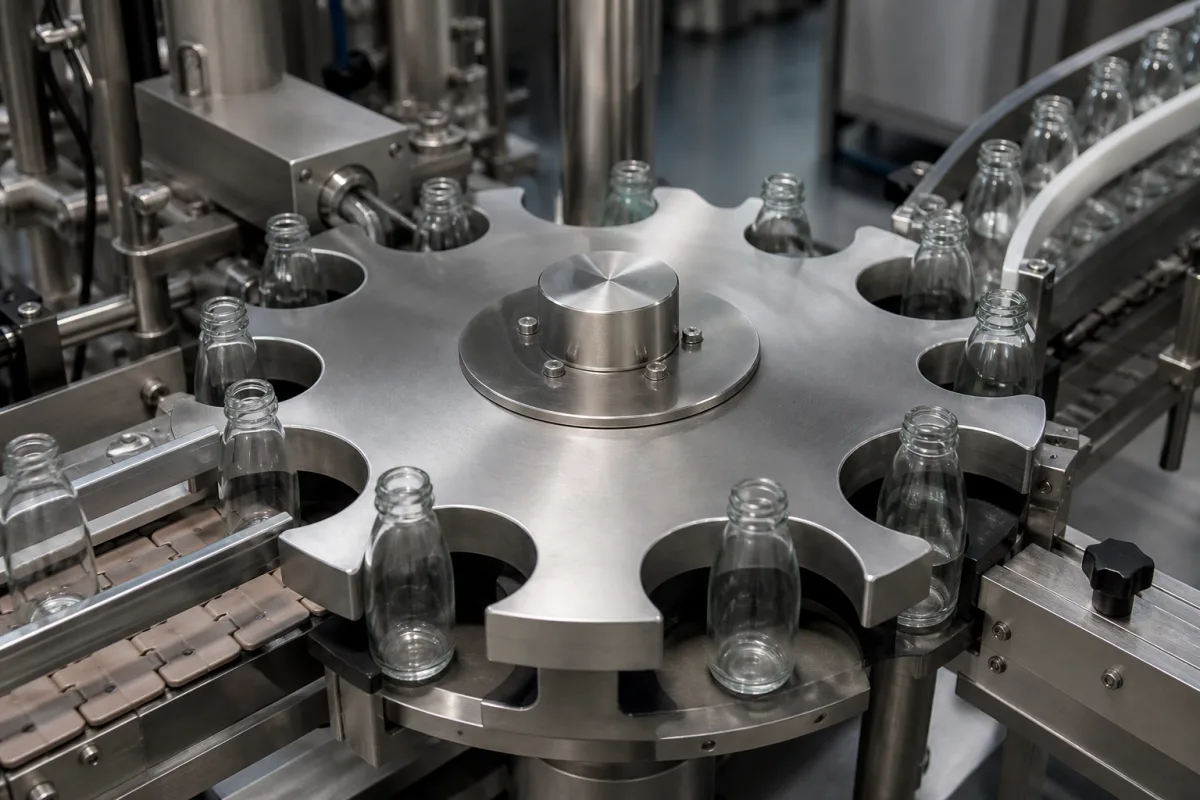
Star wheel in UHMW-PE for bottle transfer: friction, food-contact listing and thermal growth of the pockets
Star wheel material for bottle handling · UHMW-PE friction and wear data, FDA olefin-polymer limits, thermal growth of the pitch circle and the 80 °C service ceiling
A star wheel is the notched disc that takes bottles one by one from a conveyor or screw and carries them on a fixed pitch into the next machine. When the wheel or its pocket rim is machined from ultra-high-molecular-weight polyethylene (UHMW-PE), three material properties decide whether bottles slide in cleanly and stay in step: how much friction and wear the plastic shows against glass and PET, whether the grade is listed for food contact, and how far the wheel grows with temperature, because every millimetre of diameter changes the pocket pitch that has to match the neighbouring wheel.
Bottle and container star wheels, and their pocket rims, machined from UHMW-PE plate, with the material checks a buyer needs: friction and wear, food-contact listing, thermal expansion and service temperature. Complete rotary rinse-fill-cap monoblocks are covered on the High-speed rotary bottle filling machine page; stainless-steel wheels are mentioned only as the alternative where temperature rules out the plastic; infeed timing, changeover systems and turntables are outside this page. Star wheels in harvesters and book-binding machines are different products.
CNFX editorial research · Sources checked October 12, 2026 · 3 sources
Two UHMW-PE grades sold for bottling: friction, wear index and hardness
Röchling lists its Polystone M AST FDA, a PE-UHMW (PE 1000) grade for the beverage industry and conveyor technology, with a dynamic coefficient of friction of 0.10–0.22, a static coefficient of 0.15–0.20, a sand-slurry wear value of 100 and a surface resistivity of 10⁶–10¹¹ Ω/sq, which it describes as reducing the build-up of static charge. [1] Angst+Pfister names the bottling and food industry as the first application of its APSOplast PE-UHMW natural. [2]
Neither sheet states that its sand-slurry value was measured against the same reference as the other, so a wear value of 100 against 80 is not by itself a ranking; Angst+Pfister states that its values are measured on standard test specimens and do not represent guaranteed property values. [2][1]
Röchling gives a surface resistivity of 10⁶–10¹¹ Ω/sq and Angst+Pfister more than 10¹⁴ Ω, at least three orders of magnitude apart. [1][2] Editorial note: where PET bottles cling to the wheel or guides through static, ask which grade the star wheel is cut from and request its resistivity value.
Ask the supplier for the plate grade and maker, its data sheet, and whether pocket faces are machined, polished or fitted with separate inserts.
02
Thermal growth of the pitch circle and the 80 °C service limit
Angst+Pfister lists a coefficient of linear thermal expansion of 150–230 × 10⁻⁶ K⁻¹ for its PE-UHMW, a long-term maximum operating temperature of 80 °C, 130 °C short-term, and a crystalline melting point of 135 °C. Röchling lists 1.1 × 10⁻⁴ in/in/°F and a maximum service temperature in air of 180 °F, with a heat deflection temperature of 108 °F at 264 psi. [2][1]
Editorial calculation: 1.1 × 10⁻⁴ per °F is about 2.0 × 10⁻⁴ per K, inside Angst+Pfister's range, and 180 °F is about 82 °C. For a star wheel with a 500 mm pitch-circle diameter warmed by 60 K, the diameter grows by 500 × (150 to 230) × 10⁻⁶ × 60 = 4.5 to 6.9 mm. With 12 pockets, the pocket pitch (π × D / 12) grows by about 1.2 to 1.8 mm, an offset that adds up across the pockets handing bottles to the next wheel.
The same arithmetic applies in reverse when a wheel machined in a warm workshop runs in a chilled filling room. Editorial note: give the supplier the temperature at which the wheel runs and is cleaned, and ask at what temperature the drawing dimensions apply; if the line runs or is cleaned above the plastic's long-term limit, ask whether the wheel can be supplied in stainless steel instead.
State bottle diameter, pitch-circle diameter, number of pockets, running temperature, cleaning temperature and chemicals, and the reference temperature for drawing dimensions.
03
Food-contact listing: what 21 CFR 177.1520 sets for polyethylene
US FDA regulation 21 CFR 177.1520 covers olefin polymers in food-contact articles. Item 2.1, polyethylene for articles that contact food except articles used for packing or holding food during cooking, sets a density of 0.85–1.00 g/cm³, a maximum n-hexane extractable fraction of 5.5 % at 50 °C and a maximum xylene-soluble fraction of 11.3 % at 25 °C. [3]
Both bottling grades above report densities of 0.93–0.94 g/cm³, inside that range. Angst+Pfister lists FDA 21 CFR 177.1520, EU Regulation 10/2011, Regulation 1935/2004 and GMP Regulation 2023/2006 for its grade; Röchling's sheet marks FDA compliance yes, NSF no and USDA no. [2][1][3]
Editorial note: these listings apply to the plate as supplied. Ask the star wheel maker for a declaration covering the finished part, including any coloured grade, inserts, adhesives or fasteners in the product zone.
04
Send the bottle, the wheel geometry and the line temperatures
Paste it into your enquiry below or into an email to a maker, then replace every bracket.
Bottle: [material; diameter; height; neck finish]
Wheel: [pitch-circle diameter; number of pockets; thickness; bore and keyway]
Material: [UHMW-PE grade and maker; colour; resistivity if static matters]
Temperatures: [running; cleaning; reference for drawing dimensions]
Food contact: [FDA 21 CFR 177.1520; EU 10/2011; declaration for finished part]
Machine: [make and model the wheel fits; neighbouring wheel pitch]
1 company lists this product among what they make. Company figures are quoted from each
company's own website; every card states where the relationship came from.
AnsixTech
Manufacturing site to be confirmed for the order
Lists CNC-machined plastic star wheels, including PA66 nylon star wheels for automation equipment, conveyors and packaging machines, within its plastic machining division.
Explore company information and manufacturing capabilities, then discuss the scope of your project with a relevant supplier.
Share this page
Compiled and source-reviewed by the CNFX editorial team.
Each manufacturer above links to the page on that company's own website where the product is listed, with the date we checked it. How we source and review
· Page last updated 13 October 2026
Buyer questions
What friction does a UHMW-PE star wheel have?
Röchling lists 0.10–0.22 dynamic and 0.15–0.20 static for its beverage-industry PE-UHMW grade. [1]
How hot can a UHMW-PE star wheel run?
Angst+Pfister lists 80 °C long-term and 130 °C short-term for its PE-UHMW; Röchling lists 180 °F (about 82 °C) in air. [2][1]
How much does a plastic star wheel grow when it warms up?
With Angst+Pfister's expansion of 150–230 × 10⁻⁶/K, a 500 mm wheel warmed by 60 K grows 4.5–6.9 mm in diameter (editorial calculation). [2]
Which FDA rule covers UHMW-PE star wheels?
21 CFR 177.1520 for olefin polymers; item 2.1 polyethylene must have a density of 0.85–1.00 g/cm³ and at most 5.5 % n-hexane extractables at 50 °C. [3]
Sources and what still needs a direct check
Sources checked 2026-10-12. Röchling and Angst+Pfister data sheets give properties of two PE-UHMW plate grades marketed for bottling and beverage use; 21 CFR 177.1520 is the US FDA regulation for olefin polymers in food contact. Data-sheet values are guideline values, not guaranteed properties.