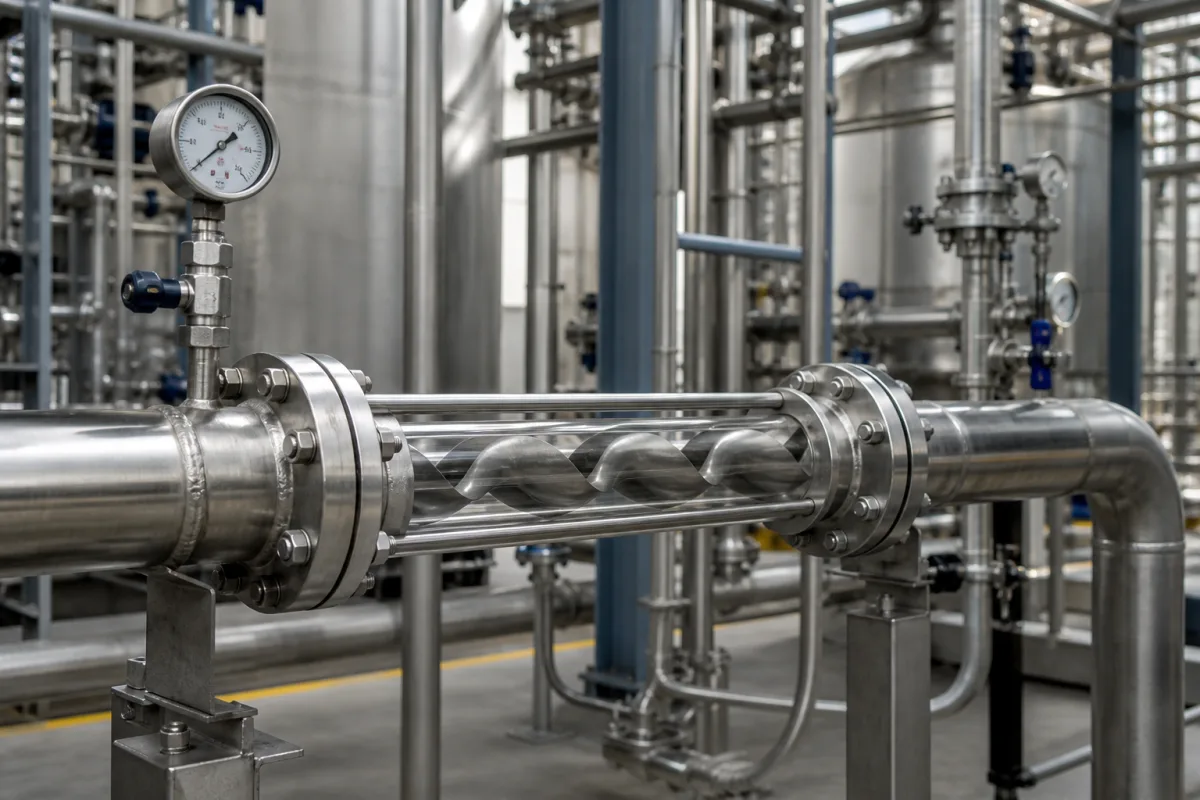
Inline static mixers · Helical, vortex-tab and cross-blade elements, selection by flow and viscosity, pressure drop, construction
A static mixer is a pipe section with fixed internal elements that blend or disperse flowing fluids using the energy of the flow itself, with no moving parts. Ask three things first: which element type suits your flow regime and viscosity, how many elements or what length is needed for the uniformity you require, and what pressure drop that costs at your flow rate.
Inline static mixers for pipes and ducts: helical-element, vortex-tab and cross-blade types for blending, dispersion and heat transfer, in metals and plastics. Disposable mixing nozzles for adhesive cartridges, high-shear rotor–stator inline mixers and agitated tanks are outside this page.
CNFX editorial research · Sources checked October 12, 2026 · 4 sources
NOV's Kenics brochure explains that in its KM mixer a helical element directs flow radially to the pipe wall and back to the centre, with alternating right- and left-hand elements adding flow division and velocity reversal so radial gradients in temperature, velocity and composition are removed. KM mixers are used for laminar, transitional and turbulent flow, liquid–liquid and gas–liquid dispersion, heat transfer and promoting plug flow in place of laminar flow's parabolic profile. [1]
For turbulent flow NOV describes its HEV mixer, whose tabs generate counter-rotating vortices, limiting mixer length to less than 1.5 pipe diameters with, by NOV's account, 75% lower pressure loss than conventional static mixers; and the UltraTab with an upstream injector, which it says produces a 0.05 coefficient of variation in as little as two pipe diameters downstream. For laminar mixing with extreme viscosity or volume ratios it describes the KMX-V, with intersecting blades and elements about one pipe diameter long. [1]
Editorial note: coefficient of variation (CoV) is the standard deviation of concentration divided by the mean across the pipe; ask suppliers to state the CoV their design achieves at your flow, viscosity ratio and additive ratio, and how it was determined.
Give the supplier the fluids and their viscosities, flow rates (minimum and maximum), additive ratio, required uniformity (CoV) and distance, allowable pressure drop, line size and connections, temperature, pressure and materials, and whether elements must be removable for cleaning.
02
Size the mixer for viscosity and pressure drop
NOV's Kenics KM quick-selection guide (Bulletin 825) lists models by flow range (0.5 to 40 gpm), line size (0.5 to 3 in) and viscosity (1, 10, 100 and 500 cP). For a 1 in line at 0.5–2 gpm, the model moves from 1-KMS-4 at 1 cP to 1-KMS-6 at 10 cP, 1-KMS-12 at 100 cP and 1-KMS-18 at 500 cP; combinations where pressure drop would exceed 10 psi are marked instead of a model, and these marks cluster at higher viscosity and flow in small lines. [2]
The brochure offers fixed (KMS), removable (KMR), element-assembly (KMA) and edge-sealed (KME) designs, in carbon and stainless steels, high alloys, titanium, zirconium and plastics such as PVC, PTFE and PVDF, with options including ASME B31.3 certification, design pressures above 10,000 psi, polished finishes down to 8 microinches and jackets. [1]
An independent 2025 review in ACS Omega (10(45):53746–53759, Luo and co-authors) compares element families for viscous duties. It reports that helical elements have a laminar friction factor about 5–6 times that of an empty tube, while intensive cross-blade (SMX-type) elements can reach pressure drops tens of times the empty pipe. Its comparison table gives about 0.3–0.5 bar per metre and 0.01–0.2 kW/t for helical mixers, against about 1–2 bar per metre and 0.5–1 kW/t for SMX or interfacial-surface-generator mixers, which it recommends where components have large viscosity or density contrasts. It cites a hybrid of crossover-disc and SMX elements reaching about 2–3% concentration variance in a polymer system, and jacketed SMX elements for temperature control in viscous polymer processes. [3]
Editorial calculation: on those per-metre figures, a 2 m mixer section adds about 0.6–1.0 bar with helical elements and 2–4 bar with SMX-type elements; ask the supplier to calculate pressure drop for your viscosity, flow and element count rather than relying on per-metre ranges. [3]
Editorial calculation: 10 psi is about 0.69 bar (69 kPa); use the guide as a first check and ask for a calculated pressure drop at your maximum flow and viscosity.
03
Check the cross-blade option for laminar, high-viscosity blending
Sulzer describes its SMX™ plus static mixer as "the reference for homogenization and dispersing tasks in laminar flow", including dosing a small amount of low-viscous additive into a high-viscous main stream, with mixing under minimal shear stress. It states "SMX plus with 50% lower pressure drop compared to a standard SMX mixer". SMX plus is offered from 15 mm to 200 mm diameter in stainless steel 1.4404, and the standard SMX from 3.2 mm to 200 mm in 316 stainless steel; standard housings follow DIN or ANSI code, with ASME or AD2000 design possible. [4]
The review by Luo and co-authors on this page gives pressure drop of about 0.3–0.5 bar/m for helical elements against about 1–2 bar/m for SMX-type elements [3]. Sulzer's 50% claim compares SMX plus with its own standard SMX [4], so on those review figures SMX plus would still be in a different range from a helical mixer. Ask each supplier for the calculated pressure drop at your flow, viscosity and pipe size, and for the number of elements and the mixing quality (CoV) that pressure drop buys.
Kenics recommends selecting by flow, line size and viscosity, and marks combinations where pressure drop exceeds 10 psi [2]. Sulzer's 3.2 mm minimum diameter for standard SMX [4] reaches smaller lines than the 0.5 in (12.7 mm) bottom of the Kenics guide [2]; for small-bore dosing lines, ask which element types are offered at that size.
Editorial calculation: halving 1–2 bar/m gives about 0.5–1 bar/m, which on the review's figures would still be above the 0.3–0.5 bar/m given for helical elements; the review's ranges and Sulzer's claim come from different sources and conditions. [3][4]
Item
Sulzer SMX™ plus
Sulzer SMX
NOV Kenics KM (already cited)
Diameter range
15 mm – 200 mm
3.2 mm – 200 mm
0.5–3 in in the quick-selection guide
Standard material
Stainless steel 1.4404
316 stainless steel
Steels, alloys, plastics
Pressure drop
50% lower than standard SMX (maker claim)
Reference
Models above 10 psi flagged in guide
Housing code
DIN or ANSI; ASME or AD2000 possible
DIN or ANSI; ASME or AD2000 possible
Flanged, threaded, weld, hub ends
Stated duty
Laminar homogenisation and dispersion
Laminar mixing
Laminar, transitional and turbulent
Values are from Sulzer's SMX plus product page; Sulzer's brochures were not reviewed.
04
Who lists metal and plastic inline mixers
Listings include stainless, carbon-steel and plastic static mixers and replacement elements for liquid–liquid, gas–gas and oil blending.
05
Parts of a mixer section, from end connections to element mounting
Flow, viscosity and allowable pressure drop to send for sizing
Fill the viscosity and flow rows first: the Kenics guide picks the element model from them, and the pressure-drop row then shows whether that choice stays under the 10 psi mark the guide uses. [2]
Field
What it means and published values
Ask the supplier for
Nominal diameter (mm)
Kenics guide covers 0.5–3 in lines [2]; SMX 3.2–200 mm, SMX plus 15–200 mm. [4]
Explore company information and manufacturing capabilities, then discuss the scope of your project with a relevant supplier.
Share this page
Compiled and source-reviewed by the CNFX editorial team.
Each manufacturer above links to the page on that company's own website where the product is listed, with the date we checked it. How we source and review
· Page last updated 13 October 2026
Buyer questions
How does a static mixer work?
Fixed elements such as helical KM elements redirect flow toward the wall and back, dividing and reversing it so composition and temperature even out without moving parts. [1]
How do I size a static mixer?
By flow, line size and viscosity; Kenics' guide changes the model with viscosity and flags combinations above 10 psi pressure drop. [2]
How short can a turbulent static mixer be?
NOV says its HEV is under 1.5 pipe diameters long and its UltraTab gives 0.05 CoV within two diameters downstream. [1]
How much more pressure drop does a cross-blade mixer cause than a helical one?
A 2025 review gives about 0.3–0.5 bar per metre for helical mixers and about 1–2 bar per metre for SMX-type mixers in viscous duty. [3]
What sizes are SMX-type static mixers made in?
Sulzer lists its standard SMX from 3.2 mm to 200 mm diameter in 316 stainless steel and SMX plus from 15 mm to 200 mm in stainless steel 1.4404, with SMX plus claimed to have 50% lower pressure drop than standard SMX. [4]
Sources and what still needs a direct check
Sources checked 2026-10-12. Both sources are NOV (Chemineer Kenics) literature describing its own mixers; performance claims such as pressure-loss reductions are the maker's.