Industry-Verified Manufacturing Data (2026)

Static Mixing Elements

Based on aggregated insights from multiple verified factory profiles within the CNFX directory, the standard Static Mixing Elements used in the Machinery and Equipment Manufacturing sector typically supports operational capacities ranging from standard industrial configurations to heavy-duty production requirements.

Technical Definition & Core Assembly

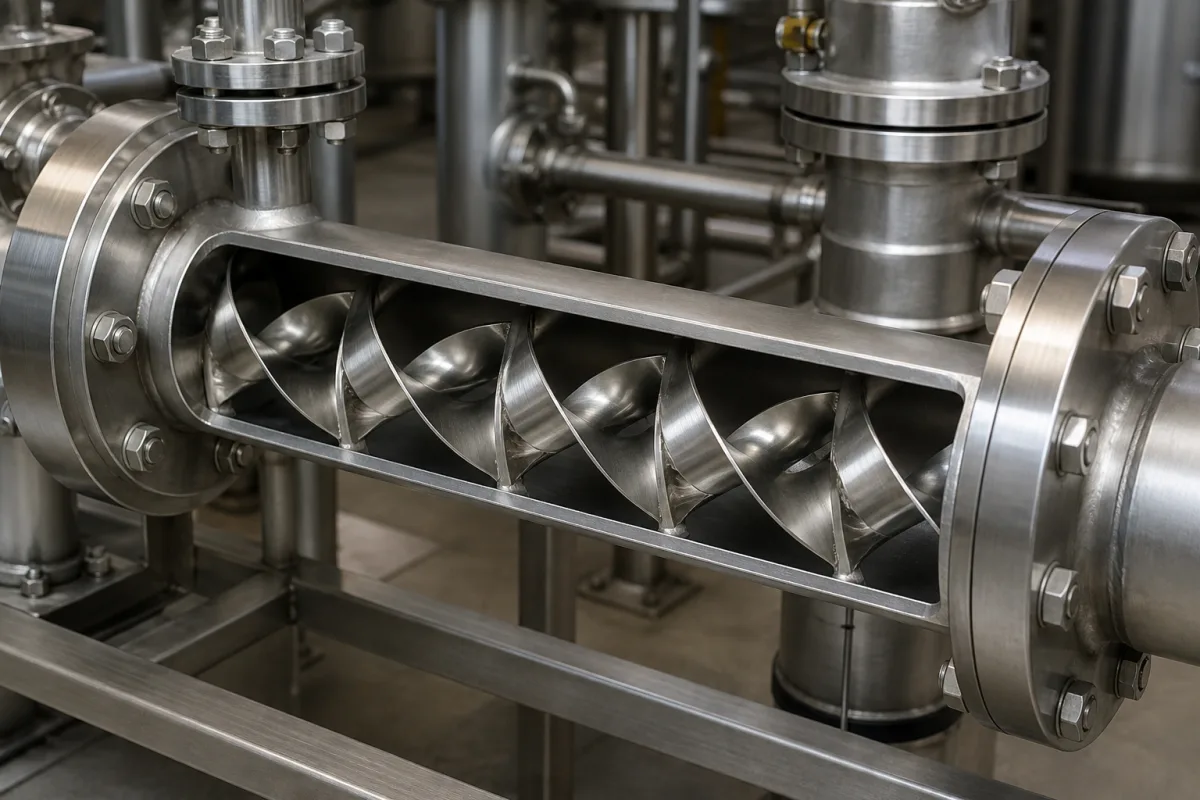
A canonical Static Mixing Elements is characterized by the integration of Helical Blade and End Connection/Flange. In industrial production environments, manufacturers listed on CNFX commonly emphasize Stainless Steel (e.g., 316L) construction to support stable, high-cycle operation across diverse manufacturing scenarios.

Stationary internal components of an in-line blender that promote fluid mixing through geometric design without moving parts.
Product Specifications

Technical details and manufacturing context for Static Mixing Elements

Definition
Static mixing elements are precision-engineered, stationary components installed within the housing of an in-line blender. Their primary role is to continuously divide, reorient, and recombine fluid streams as they flow through the blender, achieving homogeneous mixing, blending, or dispersion of liquids, gases, or multi-phase materials. They operate solely through the energy of the flowing process stream.
Working Principle
Fluid enters the static mixer housing containing a series of fixed elements. Each element's specific geometry (e.g., helical, corrugated, or lattice design) splits the flow, rotates it, and recombines it with adjacent streams. This process is repeated sequentially by each element, exponentially increasing the interfacial contact area between components, leading to efficient laminar or turbulent mixing via flow division and radial redistribution.
Common Materials
Stainless Steel (e.g., 316L), PTFE (Teflon), Hastelloy, Polypropylene
Technical Parameters
  • Diameter (ID/OD) and length of the individual mixing element, determining fit within the housing and residence time. (mm) Per Request
Components / BOM
  • Helical Blade
    Twists and splits the fluid stream to create radial mixing and interfacial surface generation.
    Material: Stainless Steel
  • End Connection/Flange
    Secures the element within the mixer housing and ensures proper alignment in the flow path.
    Material: Stainless Steel
Engineering Reasoning
0.1-6.0 MPa (1-60 bar) at 20-150°C fluid temperature
Material yield strength exceeded at 8.2 MPa (82 bar) for 316L stainless steel, or erosion rate exceeding 0.1 mm/year at fluid velocities above 3 m/s
Design Rationale: High-cycle fatigue from von Mises stress concentration at geometric discontinuities exceeding 207 MPa (30 ksi) for 316L stainless steel, or erosion-corrosion synergy when fluid velocity exceeds 3 m/s with particulate concentration >100 ppm
Risk Mitigation (FMEA)
Trigger Fluid cavitation at vapor pressure threshold (2.34 kPa at 20°C for water)
Mode: Surface pitting and material loss at 0.5-2.0 mm depth per 1000 operating hours
Strategy: Design with NPSHa > NPSHr + 1.5 m margin, maintain system pressure > fluid vapor pressure by 150%
Trigger Chloride-induced stress corrosion cracking at >50 ppm Cl- concentration
Mode: Intergranular cracking initiating at weld heat-affected zones with crack propagation rate >10^-9 m/s
Strategy: Material specification of duplex stainless steel (UNS S32205) with PREN >40, post-weld heat treatment at 1050°C for 1 hour per mm thickness

Industry Taxonomies & Aliases

Commonly used trade names and technical identifiers for Static Mixing Elements.

Applied To / Applications

This component is essential for the following industrial systems and equipment:

Industrial Ecosystem & Supply Chain DNA

Complementary Systems
Downstream Applications
Specialized Tooling

Application Fit & Sizing Matrix

Operational Limits
pressure: Up to 150 bar (dependent on material and design)
flow rate: 0.1 to 1000 m³/h (dependent on element size and configuration)
temperature: -40°C to 200°C (dependent on material)
slurry concentration: Up to 60% solids by weight (dependent on element geometry)
Media Compatibility
✓ Water-based fluids ✓ Polymer melts ✓ Chemical solutions
Unsuitable: Highly abrasive slurries with large particulate (>5mm)
Sizing Data Required
  • Fluid viscosity (cP)
  • Required mixing intensity (number of mixing elements)
  • Pipe diameter (mm)

Reliability & Engineering Risk Analysis

Failure Mode & Root Cause
Abrasive erosion
Cause: High-velocity flow of abrasive particles in the fluid stream causing gradual material loss on mixing element surfaces, leading to reduced mixing efficiency and potential structural weakening.
Fatigue cracking
Cause: Cyclic stress from turbulent flow, pressure fluctuations, or vibration leading to crack initiation and propagation, typically at stress concentration points like weld joints or sharp edges.
Maintenance Indicators
  • Increased pressure drop across the mixer indicating flow restriction or fouling
  • Visible material degradation, discoloration, or unusual noise/vibration during operation
Engineering Tips
  • Select materials with appropriate hardness and corrosion resistance for the specific process fluid, considering factors like pH, temperature, and abrasive content
  • Implement regular inspection protocols using non-destructive testing methods (e.g., ultrasonic thickness measurement) to monitor wear patterns and detect early-stage fatigue

Compliance & Manufacturing Standards

Reference Standards
ISO 9001:2015 - Quality Management Systems ASME BPE-2019 - Bioprocessing Equipment DIN 11850-1:2019 - Fittings for the food industry
Manufacturing Precision
  • Bore diameter: +/-0.05mm
  • Element alignment: +/-0.1° angular deviation
Quality Inspection
  • Dimensional Verification via CMM
  • Material Composition Verification via PMI

Factories Producing Static Mixing Elements

Verified manufacturers with capability to produce this product in China

✓ 92% Supplier Capability Match Found

T Technical Director from United States Jan 22, 2026
★★★★★
"Standard OEM quality for Machinery and Equipment Manufacturing applications. The Static Mixing Elements arrived with full certification."
Technical Specifications Verified
P Project Engineer from United Arab Emirates Jan 19, 2026
★★★★☆
"Great transparency on the Static Mixing Elements components. Essential for our Machinery and Equipment Manufacturing supply chain. (Delivery took slightly longer than expected, but technical support was excellent.)"
Technical Specifications Verified
S Sourcing Manager from Australia Jan 16, 2026
★★★★★
"The Static Mixing Elements we sourced perfectly fits our Machinery and Equipment Manufacturing production line requirements."
Technical Specifications Verified
Verification Protocol

“Feedback is collected from verified sourcing managers during RFQ (Request for Quote) and factory evaluation processes on CNFX. These reports represent historical performance data and technical audit summaries from our B2B manufacturing network.”

16 sourcing managers are analyzing this specification now. Last inquiry for Static Mixing Elements from Mexico (25m ago).

Supply Chain Compatible Machinery & Devices

Automated Assembly Line System

Integrated production system for sequential component assembly operations

Explore Specs →
Automated Powder Coating System

Integrated industrial system for applying dry powder coatings to metal substrates.

Explore Specs →
Centrifugal Pump Impeller

Rotating component that transfers energy to fluid in centrifugal pumps.

Explore Specs →
High-Precision CNC Laser Cutting Machine

Computer-controlled industrial machine using focused laser beams to cut sheet metal with micron-level accuracy.

Explore Specs →

Frequently Asked Questions

What materials are static mixing elements available in?

Static mixing elements are commonly manufactured in stainless steel (such as 316L), PTFE (Teflon), Hastelloy, and polypropylene to suit various fluid compatibility and corrosion resistance requirements.

How do static mixing elements work without moving parts?

Static mixing elements use fixed geometric designs, typically helical blades, to split, rotate, and recombine fluid streams as they flow through the element, creating thorough mixing through controlled turbulence and flow division.

What are the main components of a static mixing element assembly?

A typical static mixing element assembly consists of end connections or flanges for installation and helical blades that form the mixing structure, all designed as stationary internal components of an in-line blender.

Can I contact factories directly on CNFX?

CNFX is an open directory, not a transaction platform. Each factory profile provides direct contact information and production details to help you initiate direct inquiries with Chinese suppliers.

Get Quote for Static Mixing Elements

Request technical pricing, lead times, or customized specifications for Static Mixing Elements directly from verified manufacturing units.

Your business information is encrypted and only shared with verified Static Mixing Elements suppliers.

Thank you! Your message has been sent. We'll respond within 1–3 business days.

Need to Manufacture Static Mixing Elements?

Connect with verified factories specializing in this product category

Add Your Factory Contact Us
Previous Product
Static Mixer
Next Product
Station Controller (PLC/I/O)