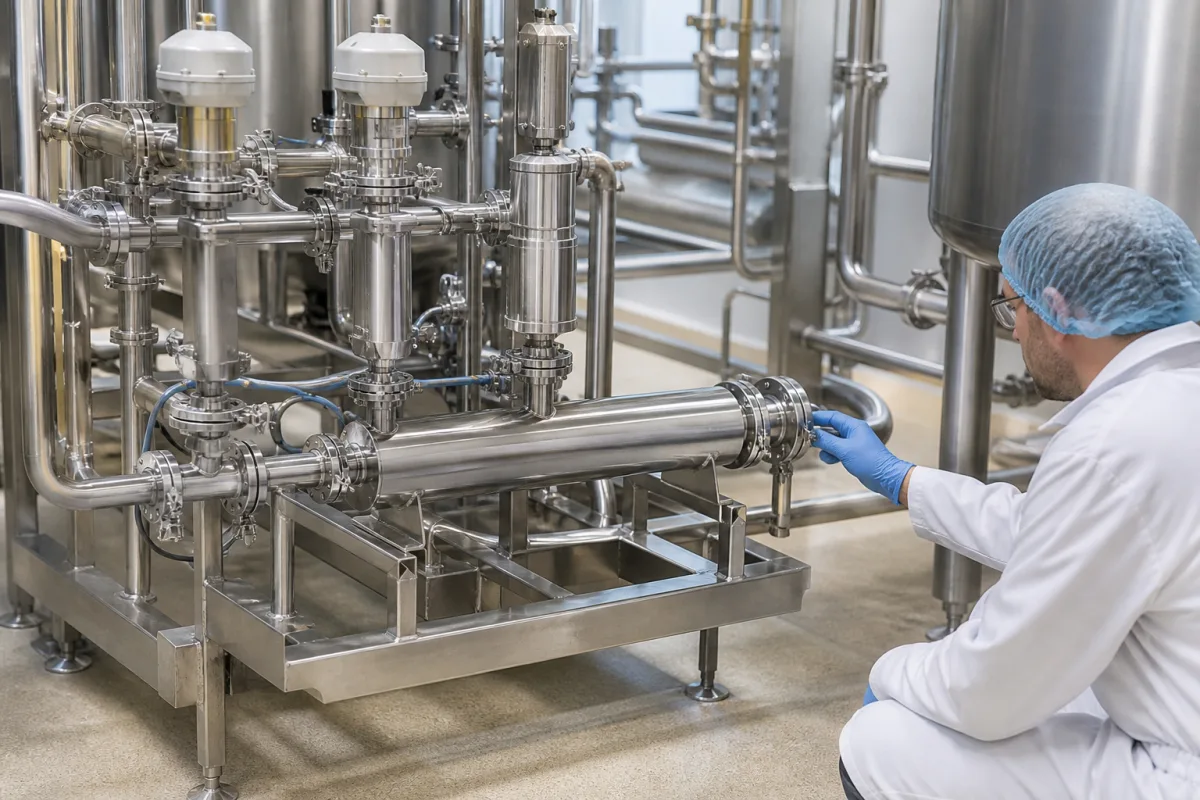
In-line blender for high-gravity beer: the skid that doses deaerated water into strong filtered beer to hit the sales original gravity and alcohol
Brewery blending skids · deaerated water dosed into filtered high-gravity beer, two flowmeters and an extract or alcohol analyser, 20 to 1,400 hl/h, ±0.05 °P
High-gravity brewing makes and ferments a stronger wort than the brand needs, then dilutes the finished beer with oxygen-free water just before packaging. The in-line blender is the skid that does that dilution continuously: it meters the strong beer and the deaerated water, measures the blend, and trims the water flow until the extract or alcohol matches the recipe. Settle three things when buying one: what the ratio is controlled on and how accurately the blend is measured, which flow range and pipe size the skid covers, and where the deaerated water comes from and how much oxygen it carries.
Continuous in-line blending units for breweries that dilute filtered high-gravity beer with deaerated water to a target original gravity, extract or alcohol content: the beer and water flowmeters, water control valves, in-line extract, alcohol or density measurement, ratio control and alarms, flow range and connections, and the link to the blending-water deaerator and the carbonation step that follows. Static mixer elements as pipe inserts are covered on the Static mixer element (gas and liquid in-line mixer) page and on the Static mixer (inline pipe mixer) page; soft-drink syrup rooms, where syrup and water are proportioned by recipe, on the Automated beverage batch blending system page; sugar dissolving and simple-syrup dosing on the Sugar syrup preparation and dosing station for soft drinks page; CO₂ dosing and dissolution skids on the Automated beverage carbonation control system page; water deaeration plants on the Deaerator page; rotor–stator mixers on the In-line homogenizer (high-shear rotor–stator mixer) page.
CNFX editorial research · Sources checked October 13, 2026 · 5 sources
Coarse and fine water valves, two magnetic flowmeters and an extract analyser: how the water dose is set
Bucher Denwel's Inline Carboblender shows the control layout in one skid. An in-line alcohol and extract analyser continuously checks the standardized beer, and two water control valves of different sizes sit in parallel; the software moves both at once so that the coarse valve makes the large corrections and the fine valve never sits at an end stop, which the maker says gives fast regulation in one process step. Two electromagnetic flowmeters measure the high-gravity beer and the deaerated water, and if their ratio leaves the expected range the unit warns or stops. [1]
The same sheet states that the beer pump does the mixing, so no separate mixer is fitted, which avoids its pressure drop. [1] Pentair's high-gravity line at Crown Beers India controlled its Carbo Blender on the beer-to-water ratio instead of on a measured strength, because the state's alcohol tax depends on the alcohol content of the finished beer; the static mixers described in that line come after blending and serve to distribute and dissolve the CO₂. [3]
Where the blend is checked by density, Endress+Hauser describes a Promass 63 Coriolis meter with a special density calibration measuring the finished beer leaving a high-gravity unit, with an analog output set directly in °Plato over a 12–18 °Plato range, at up to 6 bar and 0–10 °C, in line sizes from 12 to 100 mm. [4]
KHS describes its Innopro HGB as blending beer and deaerated water under ratio control to the required original gravity, then trimming the beer to its final CO₂ content in the same unit. [2]
Ask whether the water dose is corrected on measured extract, alcohol or density, or held on a fixed beer-to-water ratio, which instrument does the measuring and on which side of the blend, what ratio deviation trips a warning or a stop, and whether a separate mixer is fitted or the pump does the mixing.
02
From DN 40 at 20 hl/h to 1,400 hl/h: flow range, measuring accuracy and operating window
Bucher Denwel lists nine Inline Carboblender sizes, each named by its top flow, with the line size growing from DN 40 to DN 150. [1]
The table shows five of Bucher's nine sizes; the others are DBC075A (DN 40, 30–75 hl/h), DBC150A (DN 65, 60–150 hl/h), DBC300A (DN 80, 120–300 hl/h) and DBC750A (DN 125, 300–750 hl/h). Editorial calculation: in every listed Bucher size the top flow is 2.5 times the bottom flow, so a skid sized for the peak filler demand covers down to 40 % of it. [1]
The same data sheet gives the measuring ranges and accuracies of the analyser: original gravity 0–20 °P at ±0.05 °P, and alcohol 0–10 %vol at ±0.03 %vol. It lists a blending ratio of up to 100 %, carbonation up to 6 g/l, operating pressure 2–5 barg, operating temperature 0–5 °C, CIP at 2–5 barg and up to 90 °C, tri-clamp connections, AISI 304 stainless steel with EPDM, PSU and PP, and a frame from 1.9 m high, 2.0 m wide and 0.6 m deep weighing from 250 kg. [1]
How much water the blender adds depends on how strong the beer was brewed. In the example of a 1977 patent on high-gravity brewing, a beer of original gravity 1.120 was diluted with de-aerated water to an original gravity of 1.052. [5] Editorial calculation, treating gravity points ((SG − 1) × 1000) as proportional to extract, which is an approximation: 120 / 52 ≈ 2.3, so each litre of that strong beer became about 2.3 litres, and the water was about 57 % of the blend.
Give the supplier the maximum and minimum blended flow, the line size at the filter outlet, the original gravity or alcohol of the high-gravity beer and of each sales brand, the accuracy the brand specification and tax authority require, and the temperature and pressure at the blending point.
03
Blending water under 10 ppb oxygen, cooled to beer temperature, and the capacity it frees
Pentair's case study lists the process steps of a high-gravity line as water deaeration, mixing the strong 'mother beer' with deaerated water, and carbonating the finished beer; hops or colour can be added during mixing. Pentair supplied a membrane water deaeration system type MDS, a plant type it characterises by residual oxygen below 10 ppb; in that step the water is also sterilized automatically and cooled to the blending temperature, and an in-line OGM oxygen meter was added at the brewery's request to monitor residual oxygen. [3]
The 1977 patent on high-gravity brewing prefers to dilute only after the beer has been stored cold and at least coarsely filtered. [5]
Crown Beers India used the high-gravity concept to lift annual capacity from 200,000 hl to 500,000 hl without enlarging the brewhouse, tank or filter capacity; deaeration, blending, carbonation, controls and cabling were built on one shared frame as an 'HGB unit'. [3] Editorial calculation: 500,000 / 200,000 = 2.5 times the earlier annual output.
State where the blending water is deaerated and to what residual oxygen, whether it is sterilized and cooled before the blender, whether an in-line oxygen meter is wanted on the water or the blend, and whether carbonation follows on the same frame.
04
Brewery data for an in-line high-gravity blender
Paste it into your enquiry below or into an email to a maker, then replace every bracket.
Beer: [high-gravity original gravity or alcohol; brands and their sales strength]
Control: [measured extract, alcohol or density; or fixed ratio; required accuracy]
Flow: [maximum and minimum blended hl/h; line size]
Water: [deaerator type; residual O₂; temperature; pressure]
Operating window: [blend temperature; pressure; CIP temperature]
Additions: [colour or hop extract dosed during blending]
After blending: [carbonation on the same skid or separate]
Materials and connections: [stainless grade; seals; clamp or flange]
Explore company information and manufacturing capabilities, then discuss the scope of your project with a relevant supplier.
Share this page
Compiled and source-reviewed by the CNFX editorial team.
Each manufacturer above links to the page on that company's own website where the product is listed, with the date we checked it. How we source and review
· Page last updated 13 October 2026
Buyer questions
What does an in-line blender do in a high-gravity brewery?
It doses deaerated water into filtered high-gravity beer under ratio control so the blend reaches the required original gravity, then the beer goes on to final CO₂ adjustment, as KHS describes for its Innopro HGB. [2]
How accurately can an in-line blender hold original gravity?
Bucher Denwel's Inline Carboblender data sheet states ±0.05 °P over 0–20 °P original gravity and ±0.03 %vol over 0–10 %vol alcohol. [1]
Does a beer blender need a static mixer?
Bucher Denwel states its beer pump blends the two liquids, so no extra mixer is needed; in Pentair's Crown Beers line the static mixers are used for CO₂ dissolution after blending. [1][3]
How much oxygen can the blending water carry?
Pentair characterises the membrane deaeration plant type it supplied to Crown Beers India by residual oxygen below 10 ppb. [3]
Sources and what still needs a direct check
Sources checked 2026-10-13. Two brewery-equipment makers' own descriptions (Bucher Denwel's data sheet and KHS's product page), a Pentair case study of an installed high-gravity line, an Endress+Hauser application note on density measurement in a high-gravity unit, and a 1977 US patent on high-gravity brewing with a worked dilution.