Industry-Verified Manufacturing Data (2026)

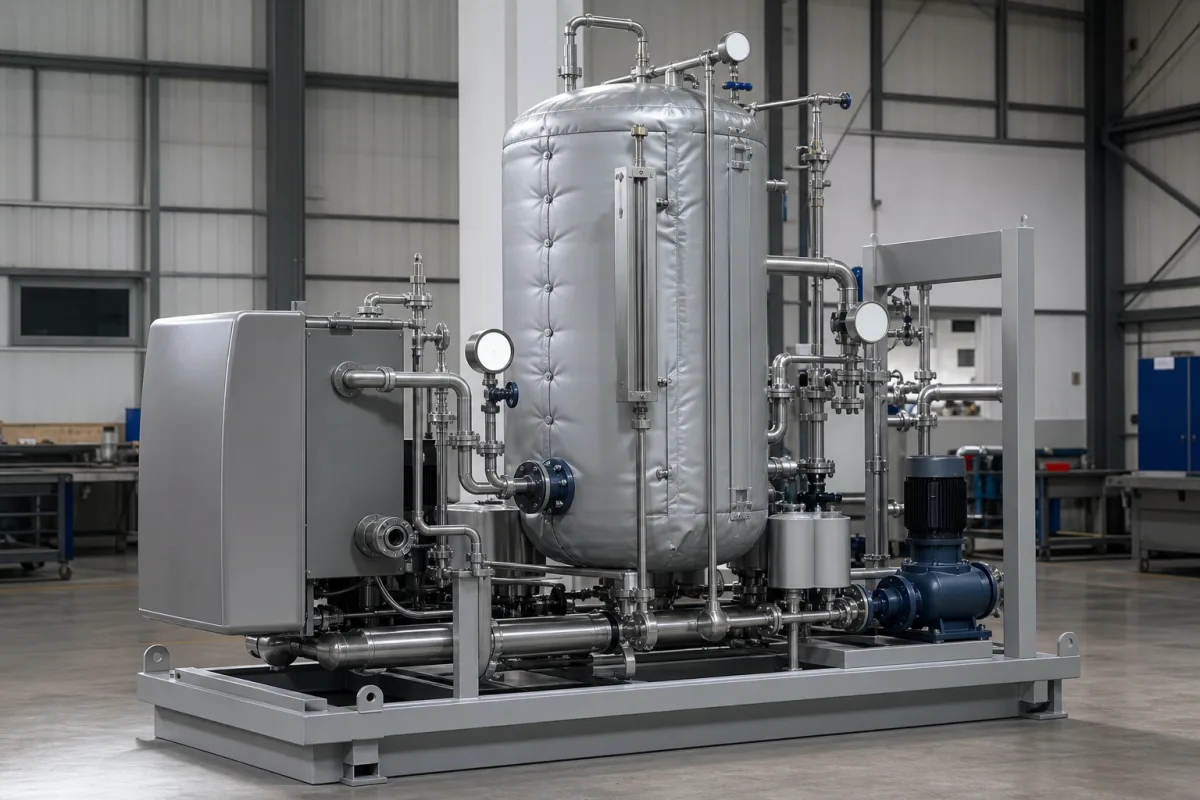
Steam Generation Vessel

Based on aggregated insights from multiple verified factory profiles within the CNFX directory, the standard Steam Generation Vessel used in the Machinery and Equipment Manufacturing sector typically supports operational capacities ranging from standard industrial configurations to heavy-duty production requirements.

Technical Definition & Core Assembly

A canonical Steam Generation Vessel is characterized by the integration of Shell and Heating Surface. In industrial production environments, manufacturers listed on CNFX commonly emphasize Carbon Steel construction to support stable, high-cycle operation across diverse manufacturing scenarios.

A pressure vessel designed to generate steam through heat transfer from combustion gases or other heat sources to water.
Product Specifications

Technical details and manufacturing context for Steam Generation Vessel

Definition
The core component of the Modular Industrial Steam Generation System for Process Applications, responsible for converting water into steam through controlled heat exchange. It serves as the primary steam production unit within the system, ensuring consistent steam output for various industrial processes.
Working Principle
Water is contained within the vessel and heated by an external heat source (such as combustion gases from a burner or thermal fluid). The heat transfer causes the water to reach boiling point and generate steam, which is then collected and distributed for industrial use. Pressure and temperature are carefully controlled to maintain efficient steam production.
Common Materials
Carbon Steel, Stainless Steel
Technical Parameters
  • Vessel diameter and length dimensions (mm) Per Request
Components / BOM
  • Shell
    Main pressure-containing body of the vessel
    Material: Carbon Steel
  • Heating Surface
    Area where heat transfer occurs from heat source to water
    Material: Stainless Steel
  • Steam Outlet
    Connection point for steam distribution from vessel
    Material: Carbon Steel
  • Water Inlet
    Connection for feeding water into the vessel
    Material: Carbon Steel
  • Pressure Relief Valve
    Safety device to prevent overpressure conditions
    Material: Stainless Steel
Engineering Reasoning
0.1-20 MPa (1-200 bar)
Yield strength of SA-516 Grade 70 carbon steel at 343°C: 172 MPa (25 ksi)
Design Rationale: Creep rupture due to sustained operation above 0.4Tm (melting point) of steel (Tm=1538°C) causing grain boundary sliding and void formation
Risk Mitigation (FMEA)
Trigger Water chemistry imbalance with chloride concentration >25 ppm
Mode: Stress corrosion cracking initiating at weld heat-affected zones
Strategy: Install continuous online conductivity monitoring with automatic blowdown at >5 μS/cm
Trigger Thermal shock from >55°C/min temperature differential during startup
Mode: Circumferential cracking at tube-to-tubesheet joints due to differential expansion
Strategy: Implement ASME B31.1-2022 compliant warm-up rate control: 28°C/h for first 111°C, then 56°C/h to operating temperature

Industry Taxonomies & Aliases

Commonly used trade names and technical identifiers for Steam Generation Vessel.

Industrial Ecosystem & Supply Chain DNA

Complementary Systems
Downstream Applications
Specialized Tooling

Application Fit & Sizing Matrix

Operational Limits
pressure: Up to 2.5 MPa (25 bar) typical, higher for specialized designs
flow rate: Varies by design: 0.5-50 tons/hour steam generation capacity
temperature: 150-350°C (saturated steam temperature range)
slurry concentration: Not applicable - designed for clean water feed only
Media Compatibility
✓ Industrial process steam ✓ Power generation feedwater ✓ Clean boiler water with treatment
Unsuitable: Corrosive or acidic media (pH <6.5)
Sizing Data Required
  • Required steam output (kg/hr)
  • Operating pressure (bar)
  • Heat source capacity (kW or BTU/hr)

Reliability & Engineering Risk Analysis

Failure Mode & Root Cause
Stress Corrosion Cracking (SCC)
Cause: Combination of tensile stress (from pressure, thermal expansion, or residual welding stress) and corrosive environment (chlorides, caustics, or dissolved oxygen in water), particularly in heat-affected zones or at stress concentrators like nozzles or seams.
Thermal Fatigue Cracking
Cause: Cyclic thermal stresses from frequent startups/shutdowns, rapid load changes, or uneven heating/cooling, leading to crack initiation and propagation, often at areas of constraint such as tube-to-tubesheet joints or shell discontinuities.
Maintenance Indicators
  • Unusual or increasing vibration or audible knocking from the vessel, indicating potential water hammer, loose internals, or flow-induced resonance.
  • Visible external leaks, especially at welded seams, nozzles, or manways, or signs of localized overheating (discoloration, blistering paint) on the shell.
Engineering Tips
  • Implement strict water chemistry control (e.g., maintaining proper pH, oxygen scavenging, and minimizing chlorides) to reduce corrosion risks, coupled with regular non-destructive testing (NDT) like ultrasonic testing (UT) at high-stress areas.
  • Optimize operational procedures to minimize thermal cycling—use gradual heating/cooling rates during startups/shutdowns and avoid rapid load swings—and ensure proper support alignment to prevent mechanical stress concentrations.

Compliance & Manufacturing Standards

Reference Standards
ISO 16528-1: Boilers and pressure vessels ASME BPVC Section I: Rules for Construction of Power Boilers EN 12952: Water-tube boilers and auxiliary installations
Manufacturing Precision
  • Wall thickness: +/-5% of nominal thickness
  • Nozzle alignment: +/-1.5mm from true position
Quality Inspection
  • Hydrostatic pressure test
  • Radiographic testing (RT) of welded joints

Factories Producing Steam Generation Vessel

Verified manufacturers with capability to produce this product in China

✓ 97% Supplier Capability Match Found

T Technical Director from Canada Jan 10, 2026
★★★★★
"Testing the Steam Generation Vessel now; the technical reliability results are within 1% of the laboratory datasheet."
Technical Specifications Verified
P Project Engineer from United States Jan 07, 2026
★★★★☆
"Impressive build quality. Especially the technical reliability is very stable during long-term operation. (Delivery took slightly longer than expected, but technical support was excellent.)"
Technical Specifications Verified
S Sourcing Manager from United Arab Emirates Jan 04, 2026
★★★★★
"As a professional in the Machinery and Equipment Manufacturing sector, I confirm this Steam Generation Vessel meets all ISO standards."
Technical Specifications Verified
Verification Protocol

“Feedback is collected from verified sourcing managers during RFQ (Request for Quote) and factory evaluation processes on CNFX. These reports represent historical performance data and technical audit summaries from our B2B manufacturing network.”

13 sourcing managers are analyzing this specification now. Last inquiry for Steam Generation Vessel from Poland (1h ago).

Supply Chain Compatible Machinery & Devices

Automated Assembly Line System

Integrated production system for sequential component assembly operations

Explore Specs →
Automated Powder Coating System

Integrated industrial system for applying dry powder coatings to metal substrates.

Explore Specs →
Centrifugal Pump Impeller

Rotating component that transfers energy to fluid in centrifugal pumps.

Explore Specs →
High-Precision CNC Laser Cutting Machine

Computer-controlled industrial machine using focused laser beams to cut sheet metal with micron-level accuracy.

Explore Specs →

Frequently Asked Questions

What materials are used in your steam generation vessels?

Our steam generation vessels are constructed from high-quality carbon steel or stainless steel, selected based on application requirements for durability and corrosion resistance.

What safety features are included in your steam vessels?

All our steam generation vessels include pressure relief valves as standard safety components, along with robust shell construction and proper pressure ratings for safe operation.

What are the key components of your steam generation vessels?

Key components include the heating surface for efficient heat transfer, pressure relief valve for safety, durable shell, steam outlet for distribution, and water inlet for continuous operation.

Can I contact factories directly on CNFX?

CNFX is an open directory, not a transaction platform. Each factory profile provides direct contact information and production details to help you initiate direct inquiries with Chinese suppliers.

Get Quote for Steam Generation Vessel

Request technical pricing, lead times, or customized specifications for Steam Generation Vessel directly from verified manufacturing units.

Your business information is encrypted and only shared with verified Steam Generation Vessel suppliers.

Thank you! Your message has been sent. We'll respond within 1–3 business days.

Need to Manufacture Steam Generation Vessel?

Connect with verified factories specializing in this product category

Add Your Factory Contact Us
Previous Product
Steam Drum
Next Product
Steam Generator or Water Atomizer