Industry-Verified Manufacturing Data (2026)

Swirl Chamber/Vanes

Based on aggregated insights from multiple verified factory profiles within the CNFX directory, the standard Swirl Chamber/Vanes used in the Machinery and Equipment Manufacturing sector typically supports operational capacities ranging from standard industrial configurations to heavy-duty production requirements.

Technical Definition & Core Assembly

A canonical Swirl Chamber/Vanes is characterized by the integration of Swirl Chamber Body and Stationary Vanes. In industrial production environments, manufacturers listed on CNFX commonly emphasize Stainless Steel (e.g., 316, 17-4PH) construction to support stable, high-cycle operation across diverse manufacturing scenarios.

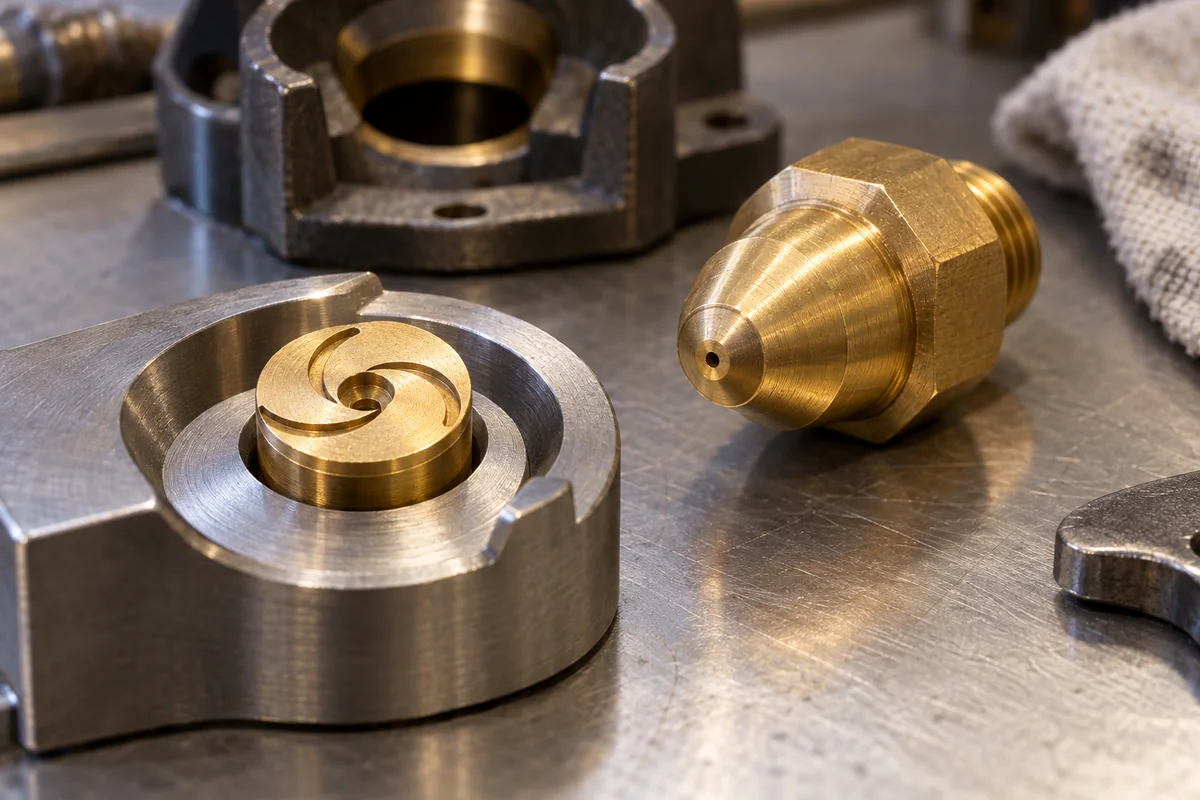
A component within a fuel nozzle that imparts a swirling motion to the fuel for improved atomization and combustion.
Product Specifications

Technical details and manufacturing context for Swirl Chamber/Vanes

Definition
The swirl chamber and vanes are critical internal components of a fuel nozzle, typically found in combustion systems such as gas turbines, industrial burners, and engines. Their primary function is to create a controlled, high-velocity rotational flow (swirl) in the liquid fuel as it passes through the nozzle. This swirling action destabilizes the fuel stream, significantly enhancing its breakup into fine droplets upon exit, which is essential for efficient mixing with air and complete combustion.
Working Principle
Fuel enters the swirl chamber under pressure. Stationary vanes or a helical passage within the chamber deflect the fuel flow, converting its linear momentum into angular momentum. This creates a vortex or swirling motion. The centrifugal force generated by this rotation forces the fuel against the chamber walls, forming a thin, unstable film. As the swirling fuel exits through the nozzle orifice, it expands rapidly into a hollow cone spray pattern, breaking into a fine mist of droplets ideal for vaporization and mixing.
Common Materials
Stainless Steel (e.g., 316, 17-4PH), Nickel-based Superalloys (e.g., Inconel), Tungsten Carbide (for wear-resistant coatings)
Technical Parameters
  • Swirl Angle - The angle of the vanes or the helical passage, determining the intensity of the swirl and the resulting spray cone angle. (degrees) Standard Spec
Components / BOM
  • Swirl Chamber Body
    Houses the vanes and contains the swirling fuel flow.
    Material: Stainless Steel or Superalloy
  • Stationary Vanes
    Fixed blades that impart the rotational motion to the fuel stream.
    Material: Stainless Steel or Superalloy
  • Inlet Port
    Entry point for pressurized fuel into the swirl chamber.
    Material: Same as Chamber Body
  • Exit Orifice/Throat
    The constricted outlet where the swirling fuel exits to form the spray.
    Material: Wear-resistant alloy or coated surface
Engineering Reasoning
0.5-15 bar differential pressure across vanes
Vane material yield strength exceeded at 250 MPa stress or vane tip velocity > 120 m/s causing centrifugal failure
Design Rationale: High-cycle fatigue from vortex-induced vibrations at Strouhal numbers > 0.2, combined with erosion-corrosion from cavitation at vapor pressure < 0.023 bar
Risk Mitigation (FMEA)
Trigger Fuel contamination with particulates > 10 μm diameter
Mode: Abrasive wear on vane leading edges exceeding 0.1 mm/year material loss
Strategy: Install dual-stage filtration (40 μm primary + 5 μm secondary) with differential pressure monitoring
Trigger Thermal cycling between 20°C and 650°C exceeding 3 cycles/hour
Mode: Thermal fatigue cracking initiating at vane root fillets with crack growth rate > 10⁻⁸ m/cycle
Strategy: Apply thermal barrier coating (8% yttria-stabilized zirconia, 300 μm thickness) and implement controlled cooldown rate < 50°C/min

Industry Taxonomies & Aliases

Commonly used trade names and technical identifiers for Swirl Chamber/Vanes.

Applied To / Applications

This component is essential for the following industrial systems and equipment:

Industrial Ecosystem & Supply Chain DNA

Complementary Systems
Downstream Applications
Specialized Tooling

Application Fit & Sizing Matrix

Operational Limits
pressure: Up to 100 bar
flow rate: 0.5 to 50 L/min
temperature: -40°C to 540°C
slurry concentration: Not applicable (liquid fuel only)
Media Compatibility
✓ Diesel fuel ✓ Kerosene (Jet-A) ✓ Biofuels (FAME)
Unsuitable: High-viscosity crude oils with particulate matter
Sizing Data Required
  • Fuel viscosity at operating temperature
  • Required fuel flow rate
  • Desired spray angle and droplet size distribution

Reliability & Engineering Risk Analysis

Failure Mode & Root Cause
Abrasive erosion
Cause: High-velocity particulate-laden fluid flow causing material degradation, often due to improper filtration or contaminated process media.
Cavitation damage
Cause: Pressure drops below vapor pressure causing bubble formation and violent collapse, typically from improper operating conditions or design mismatch.
Maintenance Indicators
  • Abnormal vibration or audible knocking from the swirl chamber assembly
  • Visible flow pattern distortion or performance deviation from design specifications
Engineering Tips
  • Implement real-time condition monitoring with vibration analysis and pressure differential tracking to detect early degradation
  • Optimize operating parameters to maintain stable flow conditions and install protective coatings on vanes for erosion resistance

Compliance & Manufacturing Standards

Reference Standards
ISO 1219-1:2012 (Fluid power systems and components) ANSI B93.5M-1981 (Hydraulic fluid power - Valves) DIN 24342:1994 (Hydraulic fluid power - Directional control valves)
Manufacturing Precision
  • Bore diameter: +/-0.02mm
  • Surface flatness: 0.1mm per 100mm
Quality Inspection
  • Dye Penetrant Test for surface defects
  • Coordinate Measuring Machine (CMM) verification of geometric tolerances

Factories Producing Swirl Chamber/Vanes

Verified manufacturers with capability to produce this product in China

✓ 98% Supplier Capability Match Found

T Technical Director from Singapore Jan 26, 2026
★★★★★
"The technical documentation for this Swirl Chamber/Vanes is very thorough, especially regarding technical reliability."
Technical Specifications Verified
P Project Engineer from Germany Jan 23, 2026
★★★★☆
"Reliable performance in harsh Machinery and Equipment Manufacturing environments. No issues with the Swirl Chamber/Vanes so far. (Delivery took slightly longer than expected, but technical support was excellent.)"
Technical Specifications Verified
S Sourcing Manager from Brazil Jan 20, 2026
★★★★★
"Testing the Swirl Chamber/Vanes now; the technical reliability results are within 1% of the laboratory datasheet."
Technical Specifications Verified
Verification Protocol

“Feedback is collected from verified sourcing managers during RFQ (Request for Quote) and factory evaluation processes on CNFX. These reports represent historical performance data and technical audit summaries from our B2B manufacturing network.”

12 sourcing managers are analyzing this specification now. Last inquiry for Swirl Chamber/Vanes from India (20m ago).

Supply Chain Compatible Machinery & Devices

Heavy-Duty CNC Plasma Cutting Machine

Industrial machine for precision metal cutting using plasma arc technology

Explore Specs →
Automated Assembly Line System

Integrated production system for sequential component assembly operations

Explore Specs →
Automated Powder Coating System

Integrated industrial system for applying dry powder coatings to metal substrates.

Explore Specs →
Centrifugal Pump Impeller

Rotating component that transfers energy to fluid in centrifugal pumps.

Explore Specs →

Frequently Asked Questions

What materials are best for swirl chamber vanes in high-temperature applications?

For high-temperature environments, nickel-based superalloys like Inconel are recommended due to their excellent heat resistance and strength, while tungsten carbide coatings provide superior wear resistance.

How do swirl chamber vanes improve fuel combustion efficiency?

Swirl chamber vanes impart a swirling motion to the fuel, breaking it into finer droplets for better atomization, which leads to more complete and efficient combustion in machinery.

What are the key components in a swirl chamber vane assembly?

The main components include the swirl chamber body, stationary vanes, inlet port, and exit orifice/throat, all designed to optimize fuel flow and atomization in fuel nozzles.

Can I contact factories directly on CNFX?

CNFX is an open directory, not a transaction platform. Each factory profile provides direct contact information and production details to help you initiate direct inquiries with Chinese suppliers.

Get Quote for Swirl Chamber/Vanes

Request technical pricing, lead times, or customized specifications for Swirl Chamber/Vanes directly from verified manufacturing units.

Your business information is encrypted and only shared with verified Swirl Chamber/Vanes suppliers.

Thank you! Your message has been sent. We'll respond within 1–3 business days.

Need to Manufacture Swirl Chamber/Vanes?

Connect with verified factories specializing in this product category

Add Your Factory Contact Us
Previous Product
Swirl Chamber/Insert
Next Product
Swirl Vane Assembly