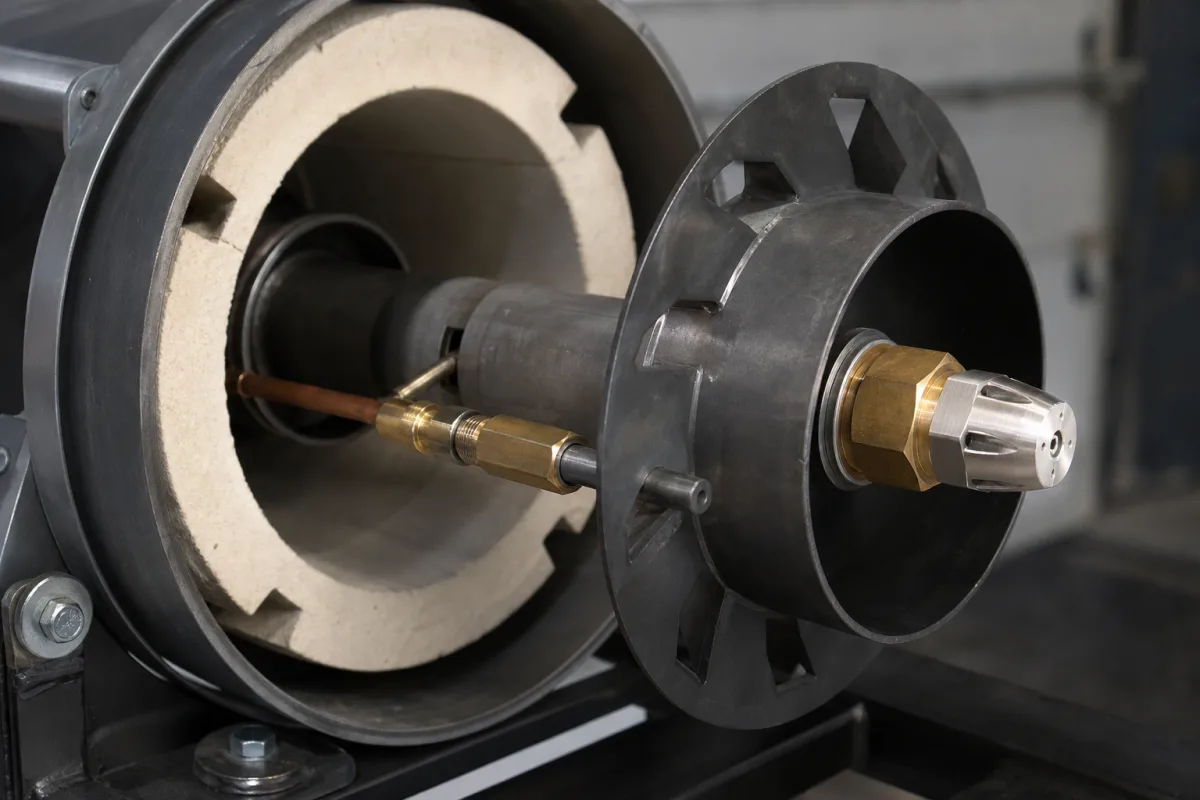
Pressure-atomising oil burner nozzles · USgal/h at 7 bar versus EN kg/h at 10 bar, spray angle and pattern, filter and fitting
A fuel nozzle for an oil burner is a small pressure-atomising nozzle screwed into the burner's oil line: pump pressure forces oil through a filter, past the nozzle cone and out of a precision orifice disc as a cone of fine droplets that mixes with the combustion air. Ask three things first: on what pressure, density and viscosity basis its capacity is stated, which spray angle and pattern the burner maker specifies, and what oil, filter and fitting it is designed for.
Pressure-atomising nozzles for domestic, commercial and light industrial oil burners running on heating oil, kerosene or heavier fuel. Fuel dispenser (filling) nozzles, gas turbine fuel nozzles, air-atomising process spray nozzles and complete burners are outside this page.
CNFX editorial research · Sources checked October 12, 2026 · 4 sources
Danfoss marks its HFD/HD and SFD/SD nozzles with two capacities: a reference capacity in USgal/h at 700 kPa (7 bar), 2.7 cSt and 820 kg/m³, and an EN specified capacity in kg/h at 1,000 kPa (10 bar), 3.4 cSt and 840 kg/m³, with spray angle and angle index according to EN 293/EN 299. Its EH and ES kerosene nozzles carry a third basis, an OFTEC specified capacity at 800 kPa (8 bar), 1.65 cSt and 790 kg/m³, with a capacity tolerance of ±5%. [1][4]
In the HFD/HD and SFD/SD programme, a 0.60 USgal/h nozzle has an EN specified capacity of 2.31 kg/h and a 1.00 USgal/h nozzle 3.87 kg/h. [1] Editorial calculation: 0.60 USgal/h × 3.785 L/USgal × 0.820 kg/L ≈ 1.86 kg/h at the 7-bar reference point, so the EN figure at 10 bar is about 24% higher for the same nozzle. Always compare nozzles, and the burner's firing rate, on the same pressure, density and viscosity basis.
Danfoss's AH/AS/AB and OD data sheet gives the US-style specification point as 100 psi (7 bar), 37 SSU (3.4 cSt) and 6.84 lb/gal (820 kg/m³), and states that the OD programme covers 0.30 to 35 USgal/h, with each nozzle 100% tested for capacity and performance. [3]
Give the supplier the burner make and model, the burner maker's nozzle specification, fuel (heating oil, kerosene, heavy oil) and its viscosity at the nozzle, pump pressure, firing rate, combustion chamber, required approvals (EN, OFTEC, CSA) and the thread or adapter.
02
Match the spray angle and pattern to the burner
Danfoss offers its Hago nozzles in 45°, 60° and 80° spray angles with three patterns: hollow cone (H), with more volume at the periphery, suited to low firing rates and burners with a hollow air pattern; semi-solid (S-S), the choice where the exact air or spray pattern cannot be established; and solid cone (B), evenly distributed, suited to burners with an even air pattern and high static pressure flame retention burners. It notes that optimal combustion needs a match between nozzle capacity, spray pattern, air supply and distribution, and combustion chamber design. [2]
Filters depend on size: 30–40 μm sintered bronze for 0.40–1.35 USgal/h and a 120-mesh stainless strainer from 1.50 USgal/h in the Hago range; 30–40 μm bronze up to 1.50 USgal/h and 105 μm Monel mesh for 1.65–2.50 USgal/h in the HFD/SFD range. Recommended tightening torque is 25–30 Nm in steel adapters and 15–20 Nm in brass adapters (maximum 35 and 25 Nm). [2][1] Tips and discs of Hago nozzles are AISI 416 stainless steel. [2]
03
Solid, hollow and semi-solid OD-series nozzles and waste-oil burner nozzles on the linked sites
Listings include OD-series pressure-atomising oil burner nozzles with solid, hollow and semi-solid patterns, siphon air-atomising oil nozzles and nozzles for waste oil burners, and brass oil fuel nozzles from spray-nozzle makers. Ask each for the rating basis, test method and capacity tolerance.
04
Nozzle body, filter, cone, orifice disc and bottom screw
The filter row changes with nozzle size: in the Hago range Danfoss fits 30–40 µm sintered bronze up to 1.35 USgal/h and a 120-mesh stainless steel strainer from 1.50 USgal/h. [2]
Capacity and rating point, spray angle, pump pressure, tip material, tolerance and thread for a nozzle order
State capacity together with its rating point: Danfoss marks its nozzles at 7 and 10 bar, or at 7 and 8 bar for its kerosene types. Droplet size and maximum temperature have no published value here. [1][4]
Field
What it means and published values
Ask the supplier for
Capacity (USgal/h or kg/h)
Danfoss states a reference capacity in USgal/h at 7 bar or kg/h at 10 bar. [1]
2 companies list this product among what they make. Company figures are quoted from each
company's own website; every card states where the relationship came from.
Dongguan ST Cooling Spray Technologies Co., Ltd.
Manufacturing site to be confirmed for the order
Lists oil fuel nozzles for oil burners, including brass fuel nozzles.
Explore company information and manufacturing capabilities, then discuss the scope of your project with a relevant supplier.
Share this page
Compiled and source-reviewed by the CNFX editorial team.
Each manufacturer above links to the page on that company's own website where the product is listed, with the date we checked it. How we source and review
· Page last updated 13 October 2026
Buyer questions
Why do nozzle capacities differ between USgal/h and kg/h?
They are stated at different points: Danfoss gives USgal/h at 7 bar and 820 kg/m³, and EN kg/h at 10 bar and 840 kg/m³; a 0.60 USgal/h nozzle is listed at 2.31 kg/h. [1]
Hollow, solid or semi-solid spray?
Danfoss suits hollow to low firing rates and hollow air patterns, solid to even air patterns and flame retention burners, and semi-solid where the pattern cannot be established. [2]
How tight should a nozzle be fitted?
Danfoss recommends 25–30 Nm in steel adapters and 15–20 Nm in brass adapters, with maxima of 35 and 25 Nm. [2]
Sources and what still needs a direct check
Sources checked 2026-10-12. All four sources are Danfoss data sheets for its own oil nozzles; they illustrate rating bases and selection, not general limits. EN 293/EN 299 and OFTEC OFS E100 are referenced as cited by Danfoss.