Industry-Verified Manufacturing Data (2026)

Tactile probe stylus

Based on aggregated insights from multiple verified factory profiles within the CNFX directory, the standard Tactile probe stylus used in the Machinery and Equipment Manufacturing sector typically supports operational capacities ranging from standard industrial configurations to heavy-duty production requirements.

Technical Definition & Core Assembly

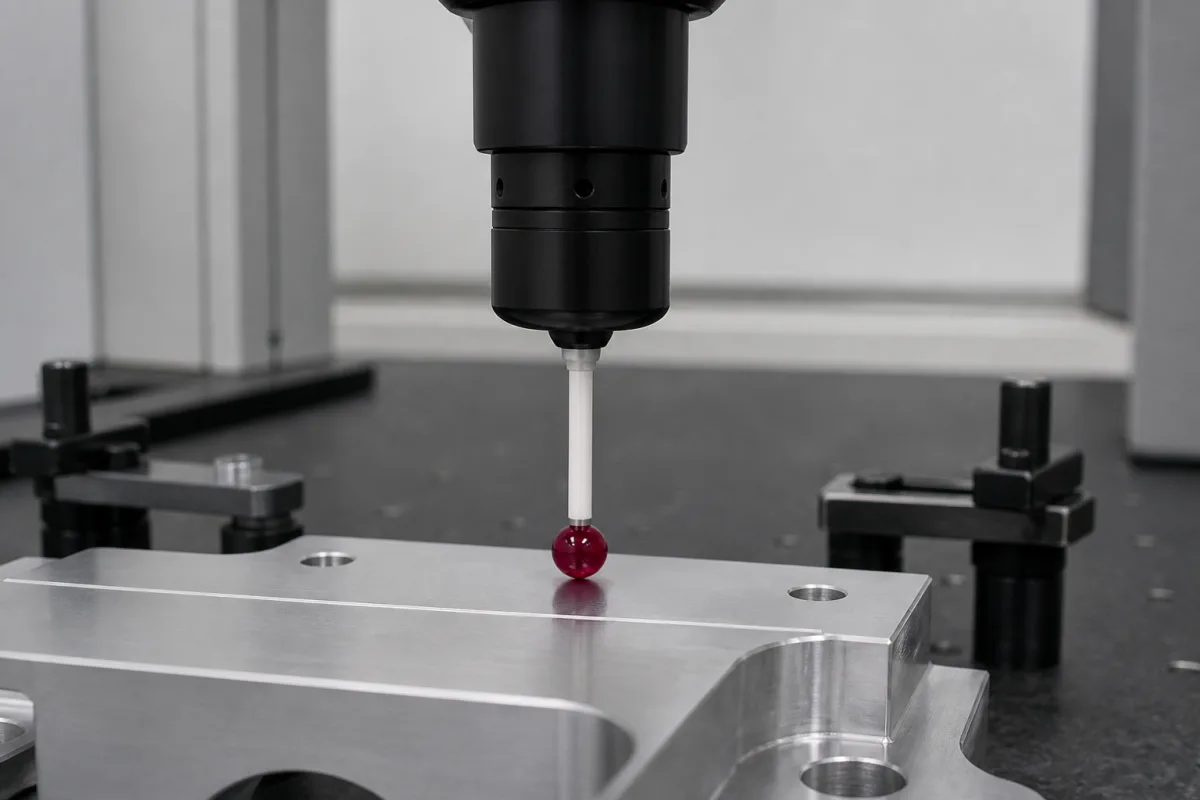
A canonical Tactile probe stylus is characterized by the integration of Stylus tip and Stylus shaft. In industrial production environments, manufacturers listed on CNFX commonly emphasize Ruby construction to support stable, high-cycle operation across diverse manufacturing scenarios.

A precision contact sensor component used for dimensional measurement and surface profiling.
Product Specifications

Technical details and manufacturing context for Tactile probe stylus

Definition
The tactile probe stylus is a critical component of the Multi-sensor Probe Head, serving as the physical interface that makes direct contact with the workpiece. It transmits surface coordinate data to the probe's sensing system for dimensional metrology, quality control, and reverse engineering applications.
Working Principle
When the stylus tip contacts a workpiece surface, it deflects slightly. This deflection is detected by strain gauges or other sensing mechanisms within the probe head, which convert the physical movement into electrical signals. These signals are processed to determine the precise XYZ coordinates of the contact point.
Common Materials
Ruby, Tungsten carbide, Silicon nitride
Technical Parameters
  • Stylus tip diameter, typically ranging from 0.3mm to 5mm depending on application requirements (mm) Per Request
Components / BOM
  • Stylus tip
    Precision spherical contact point that touches the workpiece surface
    Material: Ruby or ceramic
  • Stylus shaft
    Rigid structural element connecting tip to mounting interface
    Material: Stainless steel or carbon fiber
  • Mounting shank
    Standardized interface for attachment to probe head
    Material: Stainless steel
Engineering Reasoning
0.1-5.0 N contact force, 0.1-100 μm deflection
6.0 N contact force causing permanent plastic deformation of ruby sphere tip
Design Rationale: Exceeding yield strength of synthetic ruby (4000 MPa) at Hertzian contact stress concentration
Risk Mitigation (FMEA)
Trigger Abrasive particle contamination (≥5 μm silicon carbide)
Mode: Spherical tip geometry deviation exceeding 0.2 μm form error
Strategy: Integrated air purge system with 0.3 μm filtration at 2 bar pressure
Trigger Thermal expansion mismatch between tungsten carbide shaft (4.5×10⁻⁶/K) and aluminum mount (23×10⁻⁶/K)
Mode: Probe deflection calibration drift exceeding 0.5 μm/100K temperature delta
Strategy: Invar 36 alloy coupling with 1.2×10⁻⁶/K coefficient of thermal expansion

Industry Taxonomies & Aliases

Commonly used trade names and technical identifiers for Tactile probe stylus.

Applied To / Applications

This component is essential for the following industrial systems and equipment:

Industrial Ecosystem & Supply Chain DNA

Complementary Systems
Downstream Applications
Specialized Tooling

Application Fit & Sizing Matrix

Operational Limits
pressure: 0 to 50 kPa contact pressure
other spec: Maximum stylus deflection: 0.5 mm, Vibration tolerance: <5 g RMS
temperature: -20°C to +80°C
Media Compatibility
✓ Metallic surfaces (steel, aluminum) ✓ Plastic components (ABS, polycarbonate) ✓ Ceramic materials
Unsuitable: Abrasive slurry environments with particulate >50 μm
Sizing Data Required
  • Required measurement resolution (μm/mm)
  • Target surface hardness (Rockwell/Shore scale)
  • Maximum allowable contact force (mN)

Reliability & Engineering Risk Analysis

Failure Mode & Root Cause
Tip wear and deformation
Cause: Repeated contact with hard surfaces causes abrasive wear, while excessive force leads to plastic deformation, compromising measurement accuracy.
Shaft misalignment or bending
Cause: Improper handling, accidental impacts, or excessive lateral forces during use cause mechanical damage to the stylus shaft, affecting probe geometry and precision.
Maintenance Indicators
  • Visible wear, flattening, or deformation of the stylus tip during routine inspection
  • Audible clicking or grinding noises during probe contact, indicating mechanical interference or damage
Engineering Tips
  • Implement regular calibration checks using a master sphere or artifact to detect early wear and maintain measurement traceability
  • Use appropriate probe force settings and avoid unnecessary contact with surfaces; store in protective cases when not in use to prevent physical damage

Compliance & Manufacturing Standards

Reference Standards
ISO 10360-2:2009 - Geometrical product specifications (GPS) - Acceptance and reverification tests for coordinate measuring machines (CMM) ANSI/ASME B89.1.12 - Methods for Performance Evaluation of Coordinate Measuring Machines DIN EN ISO 10360-5:2020 - Geometrical product specifications (GPS) - Acceptance and reverification tests for coordinate measuring systems (CMS) - Part 5: CMMs using single and multiple stylus contacting probing systems
Manufacturing Precision
  • Stylus tip sphericity: +/-0.0005 mm
  • Stylus shaft straightness: 0.001 mm per 25 mm length
Quality Inspection
  • Stylus tip sphericity verification using optical comparator or CMM
  • Stylus shaft runout measurement using precision dial indicator or laser interferometer

Factories Producing Tactile probe stylus

Verified manufacturers with capability to produce this product in China

✓ 98% Supplier Capability Match Found

S Sourcing Manager from Singapore Feb 21, 2026
★★★★★
"Standard OEM quality for Machinery and Equipment Manufacturing applications. The Tactile probe stylus arrived with full certification."
Technical Specifications Verified
P Procurement Specialist from Germany Feb 18, 2026
★★★★☆
"Great transparency on the Tactile probe stylus components. Essential for our Machinery and Equipment Manufacturing supply chain. (Delivery took slightly longer than expected, but technical support was excellent.)"
Technical Specifications Verified
T Technical Director from Brazil Feb 15, 2026
★★★★★
"The Tactile probe stylus we sourced perfectly fits our Machinery and Equipment Manufacturing production line requirements."
Technical Specifications Verified
Verification Protocol

“Feedback is collected from verified sourcing managers during RFQ (Request for Quote) and factory evaluation processes on CNFX. These reports represent historical performance data and technical audit summaries from our B2B manufacturing network.”

16 sourcing managers are analyzing this specification now. Last inquiry for Tactile probe stylus from Mexico (11m ago).

Supply Chain Compatible Machinery & Devices

Automated Assembly Line System

Integrated production system for sequential component assembly operations

Explore Specs →
Automated Powder Coating System

Integrated industrial system for applying dry powder coatings to metal substrates.

Explore Specs →
Centrifugal Pump Impeller

Rotating component that transfers energy to fluid in centrifugal pumps.

Explore Specs →
High-Precision CNC Laser Cutting Machine

Computer-controlled industrial machine using focused laser beams to cut sheet metal with micron-level accuracy.

Explore Specs →

Frequently Asked Questions

What are the advantages of using a ruby tip on a tactile probe stylus?

Ruby tips offer excellent wear resistance, low friction, and high hardness, making them ideal for precision dimensional measurement with minimal surface damage and long service life in machinery manufacturing applications.

How does stylus shaft material affect measurement accuracy?

The stylus shaft's stiffness and vibration damping properties directly impact measurement precision. Proper material selection minimizes deflection and resonance, ensuring accurate surface profiling and dimensional data collection in industrial metrology.

When should I choose tungsten carbide versus silicon nitride for stylus tips?

Tungsten carbide provides superior durability for high-frequency contact measurements, while silicon nitride offers better thermal stability and corrosion resistance for harsh manufacturing environments. Selection depends on specific application requirements and measurement conditions.

Can I contact factories directly on CNFX?

CNFX is an open directory, not a transaction platform. Each factory profile provides direct contact information and production details to help you initiate direct inquiries with Chinese suppliers.

Get Quote for Tactile probe stylus

Request technical pricing, lead times, or customized specifications for Tactile probe stylus directly from verified manufacturing units.

Your business information is encrypted and only shared with verified Tactile probe stylus suppliers.

Thank you! Your message has been sent. We'll respond within 1–3 business days.

Need to Manufacture Tactile probe stylus?

Connect with verified factories specializing in this product category

Add Your Factory Contact Us
Previous Product
Table Base
Next Product
Tail Skin Seal