Industry-Verified Manufacturing Data (2026)

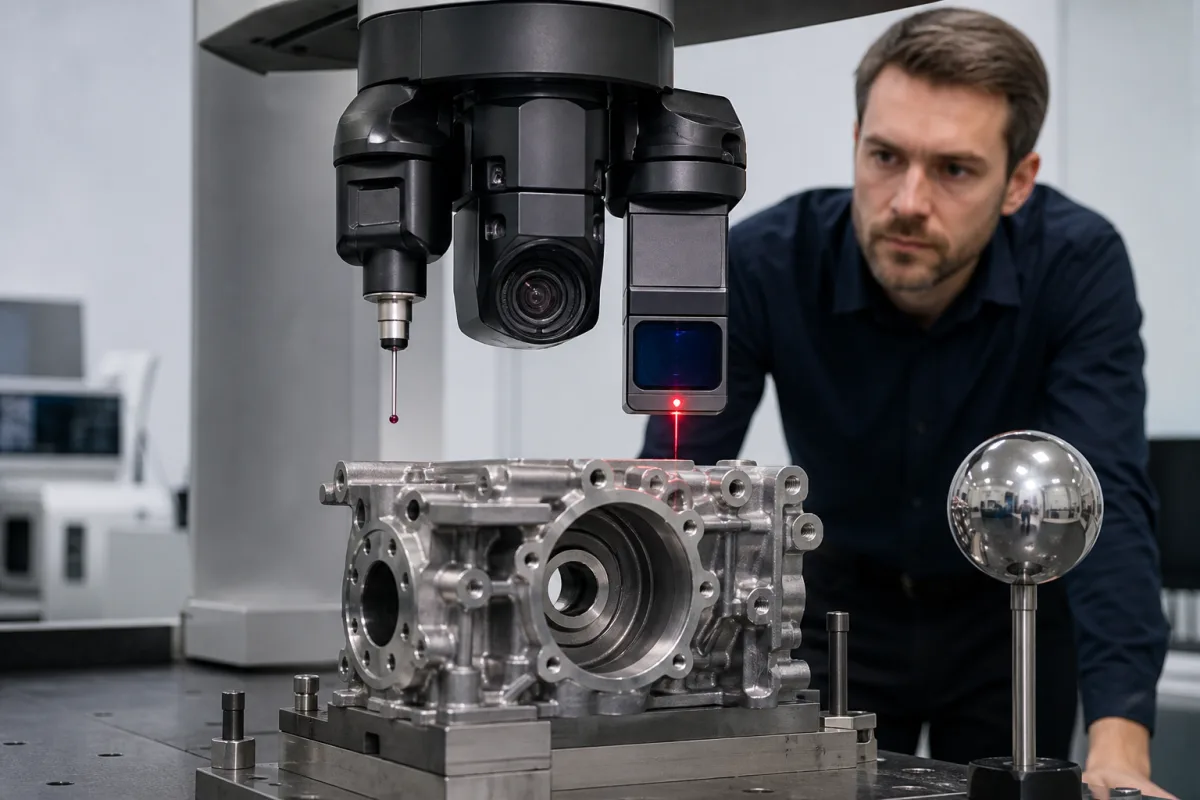
Multi-sensor Probe Head

Based on aggregated insights from multiple verified factory profiles within the CNFX directory, the standard Multi-sensor Probe Head used in the Machinery and Equipment Manufacturing sector typically supports operational capacities ranging from standard industrial configurations to heavy-duty production requirements.

Technical Definition & Core Assembly

A canonical Multi-sensor Probe Head is characterized by the integration of Tactile probe stylus and Laser scanner module. In industrial production environments, manufacturers listed on CNFX commonly emphasize Tungsten carbide construction to support stable, high-cycle operation across diverse manufacturing scenarios.

A precision measurement component that integrates multiple sensing technologies for comprehensive dimensional inspection.

Product Specifications

Technical details and manufacturing context for Multi-sensor Probe Head

Definition
The multi-sensor probe head is a critical component of automated coordinate measuring machine (CMM) systems, designed to perform high-precision dimensional measurements by combining various sensing technologies such as tactile probing, optical scanning, and laser triangulation. It enables comprehensive inspection of complex geometries, surface features, and internal structures in a single setup, significantly enhancing measurement efficiency and accuracy in industrial quality control applications.
Working Principle
The probe head operates by precisely positioning multiple sensors relative to the measured object. Tactile probes make physical contact to measure discrete points, while optical sensors capture surface data through non-contact methods like laser scanning or vision systems. The integrated system coordinates data from all sensors, compensating for environmental factors and probe deflection to generate accurate 3D measurements.
Common Materials
Tungsten carbide, Ceramic, Stainless steel, Optical glass
Technical Parameters
  • Measurement accuracy typically ranging from 0.5 to 5 micrometers depending on sensor configuration and environmental conditions (μm) Customizable
Components / BOM
  • Tactile probe stylus
    Makes physical contact with measured surfaces to capture discrete point data
    Material: Ruby or tungsten carbide
  • Laser scanner module
    Captures surface profiles and contours through non-contact laser triangulation
    Material: Optical glass, aluminum alloy
  • Vision camera system
    Provides optical imaging for edge detection and feature recognition
    Material: Glass, plastic, electronic components
  • Probe head interface
    Connects the probe head to the CMM arm and transmits sensor data
    Material: Stainless steel, electronic connectors
  • Temperature compensation sensor
    Monitors thermal variations to maintain measurement accuracy
    Material: Ceramic, semiconductor materials
Engineering Reasoning
0.1-100 μm displacement, 0-100°C temperature, 0-1000 lux illumination
150°C thermal limit, 120 μm displacement overshoot, 2000 lux sensor saturation
Design Rationale: Thermal expansion mismatch between silicon sensors and aluminum housing causing 15 μm misalignment at 150°C, piezoelectric crystal depolarization at 120 μm displacement, photodiode junction breakdown at 2000 lux
Risk Mitigation (FMEA)
Trigger Electrostatic discharge exceeding 8 kV
Mode: CMOS sensor latch-up causing permanent 5 V offset in capacitance measurements
Strategy: Integrated spark gap protection with 6 kV breakdown rating on all signal lines
Trigger Cyclic thermal loading at 2 Hz between -20°C and 80°C
Mode: Solder joint fatigue failure at 10,000 cycles causing intermittent 12 Ω resistance in strain gauge circuits
Strategy: Underfill epoxy encapsulation with 25 MPa shear strength and 15 ppm/°C CTE matching

Industry Taxonomies & Aliases

Commonly used trade names and technical identifiers for Multi-sensor Probe Head.

Industrial Ecosystem & Supply Chain DNA

Complementary Systems
Downstream Applications
Specialized Tooling

Application Fit & Sizing Matrix

Operational Limits
pressure: 0 to 10 bar
other spec: Max vibration: 5g, IP67 rating
temperature: -20°C to 85°C
Media Compatibility
✓ Metallic surfaces ✓ Plastic components ✓ Ceramic materials
Unsuitable: High-concentration abrasive slurries
Sizing Data Required
  • Measurement accuracy requirement
  • Target surface material type
  • Required inspection speed

Reliability & Engineering Risk Analysis

Failure Mode & Root Cause
Sensor Drift or Calibration Loss
Cause: Thermal cycling, vibration-induced misalignment, or contamination of sensing elements leading to inaccurate readings over time.
Seal Failure and Fluid Ingress
Cause: Degradation of O-rings or gaskets due to chemical attack, thermal stress, or mechanical wear, allowing process media to penetrate and damage internal electronics.
Maintenance Indicators
  • Erratic or inconsistent readings from the probe, such as sudden spikes, drops, or noise in the data stream.
  • Visible corrosion, leakage, or moisture accumulation around the probe housing or cable entry points.
Engineering Tips
  • Implement a regular calibration and verification schedule using traceable standards to detect and correct drift before it impacts process control.
  • Ensure proper installation with adequate strain relief on cables, use of compatible sealing materials for the process environment, and protection from excessive vibration or thermal shock.

Compliance & Manufacturing Standards

Reference Standards
ISO 10360-2:2009 - Acceptance and reverification tests for coordinate measuring machines (CMM) ANSI/ASME B89.1.12M - Methods for Performance Evaluation of Coordinate Measuring Machines DIN EN ISO 9001:2015 - Quality management systems - Requirements
Manufacturing Precision
  • Probe tip sphericity: +/-0.0005 mm
  • Repeatability of measurement: +/-0.001 mm
Quality Inspection
  • Laser interferometry for geometric accuracy verification
  • Environmental stability test under varying temperature/humidity conditions

Factories Producing Multi-sensor Probe Head

Verified manufacturers with capability to produce this product in China

✓ 92% Supplier Capability Match Found

S Sourcing Manager from United States Mar 01, 2026
★★★★★
"Reliable performance in harsh Machinery and Equipment Manufacturing environments. No issues with the Multi-sensor Probe Head so far."
Technical Specifications Verified
P Procurement Specialist from United Arab Emirates Feb 26, 2026
★★★★☆
"Testing the Multi-sensor Probe Head now; the technical reliability results are within 1% of the laboratory datasheet. (Delivery took slightly longer than expected, but technical support was excellent.)"
Technical Specifications Verified
T Technical Director from Australia Feb 23, 2026
★★★★★
"Impressive build quality. Especially the technical reliability is very stable during long-term operation."
Technical Specifications Verified
Verification Protocol

“Feedback is collected from verified sourcing managers during RFQ (Request for Quote) and factory evaluation processes on CNFX. These reports represent historical performance data and technical audit summaries from our B2B manufacturing network.”

9 sourcing managers are analyzing this specification now. Last inquiry for Multi-sensor Probe Head from Poland (35m ago).

Supply Chain Compatible Machinery & Devices

Hydraulic Press

Industrial machine using hydraulic pressure to compress, form, or assemble materials

Explore Specs →
Heavy-Duty CNC Plasma Cutting Machine

Industrial machine for precision metal cutting using plasma arc technology

Explore Specs →
Automated Assembly Line System

Integrated production system for sequential component assembly operations

Explore Specs →
Automated Powder Coating System

Integrated industrial system for applying dry powder coatings to metal substrates.

Explore Specs →

Frequently Asked Questions

What materials are used in the multi-sensor probe head construction?

The probe head is constructed from durable materials including tungsten carbide for wear resistance, ceramic for thermal stability, stainless steel for structural integrity, and optical glass for vision components.

How does the temperature compensation sensor improve measurement accuracy?

The integrated temperature compensation sensor monitors thermal variations and automatically adjusts measurement data to account for material expansion/contraction, ensuring consistent precision across different operating conditions.

What types of sensing technologies are integrated in this probe head?

This multi-sensor probe head integrates laser scanning for non-contact measurement, tactile probing for physical contact inspection, and vision camera systems for optical analysis, providing comprehensive dimensional inspection capabilities.

Can I contact factories directly on CNFX?

CNFX is an open directory, not a transaction platform. Each factory profile provides direct contact information and production details to help you initiate direct inquiries with Chinese suppliers.

Get Quote for Multi-sensor Probe Head

Request technical pricing, lead times, or customized specifications for Multi-sensor Probe Head directly from verified manufacturing units.

Your business information is encrypted and only shared with verified Multi-sensor Probe Head suppliers.

Thank you! Your message has been sent. We'll respond within 1–3 business days.

Need to Manufacture Multi-sensor Probe Head?

Connect with verified factories specializing in this product category

Add Your Factory Contact Us
Previous Product
Multi-Media Filter
Next Product
Mushroom Head Actuator