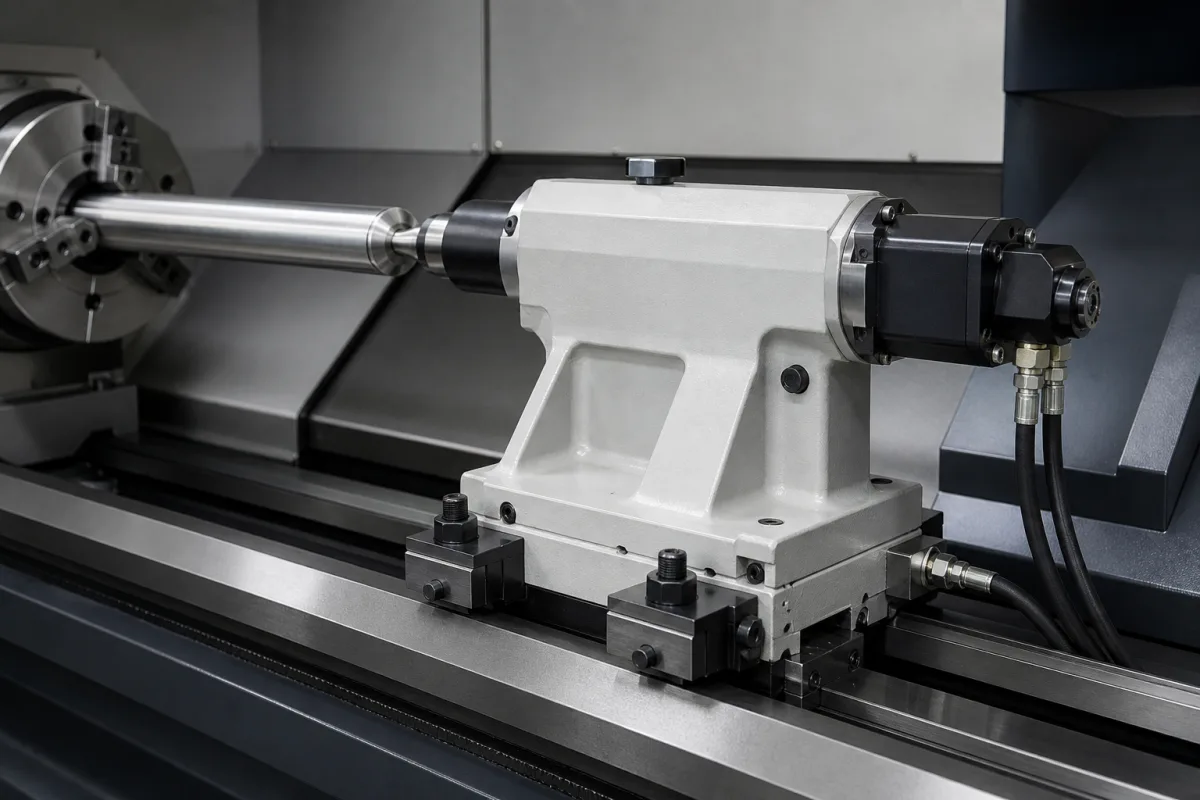
Hydraulic tailstock for CNC lathes: quill thrust from 2.5 to 11 kN, the live centre it pushes through, and programmable body and quill travel
Hydraulic-quill and programmable tailstocks on CNC turning machines · quill thrust and the pressure that sets it, the live centre's own thrust and speed limits, and how the body and quill are moved and clamped
On a CNC turning machine the tailstock does one job, holding the free end of a shaft on a centre, but three numbers decide whether it does that job on your part: the quill thrust the hydraulics can set, the thrust and speed the live centre in the quill is rated for, and how far the quill and the tailstock body can travel and be clamped without someone walking round the machine with a spanner. The machine data below come from three lathe listings with published tailstock specifications; the centre ratings from Royal Products.
Tailstocks of CNC turning machines with a hydraulically actuated quill, with manual, turret-towed or programmable body positioning, together with the live centre carried in the quill: quill thrust and hydraulic pressure, quill diameter, stroke and Morse taper, body stroke and clamping, and centre thrust, workpiece-weight and speed ratings. Complete horizontal CNC lathes and turning centres, sized from the part, are covered on the Universal CNC lathe page; flat-bed economy CNC lathes with manual chucks and tailstocks on the Economic CNC lathe page; bar-fed aluminium turning on the Bar-fed CNC turning centre page. Power chucks, adapter plates and draw tubes are covered on the Hollow power chuck assembly for CNC lathes page; the cross slide of a manual centre lathe on the Lathe cross slide page. Steady rests and manual-lathe tailstocks are outside this page.
CNFX editorial research · Sources checked October 13, 2026 · 4 sources
Quill thrust on three CNC lathe tailstocks: 250 kg, 5.5 kN and 11 kN at 40 bar
The force the quill can press into the part is set by the hydraulic pressure behind it, and the published maximums differ by a factor of more than four between the three machines below. Only the Doosan listing gives the tailstock pressure that produces its maximum thrust.
Editorial calculation: 250 kg force × 9.81 m/s² = about 2.45 kN, so the Clausing quill's maximum is under a quarter of the Doosan's 11 kN and under half of the Takamaz's 5.5 kN. Clausing's 560 psi is listed as the machine's hydraulic pressure, not as a tailstock setting, so it cannot be used to work back to the quill's piston area. [2][1][3]
Editorial calculation: on the Doosan, 11 kN at 40 bar (4 N/mm²) means 11,000 ÷ 4 = 2,750 mm² of effective piston area, equal to a plain piston of about 59 mm diameter. If thrust is proportional to pressure, every bar of tailstock pressure adds about 275 N, so a setting of 20 bar (an example value, not from the listing) would give about 5.5 kN. Ask the builder for the actual thrust-versus-pressure chart; seal friction and any annulus area are not given in the listing. [3]
Takamaz describes its XTT-500 tailstock as a rigid unit developing its thrust with hydraulic drive, offered with an MT-5 taper as one of the options for heavy cutting; Clausing says the L45's rigid tailstock with hydraulic quill reduces cutting vibration. [1][2]
Tell the supplier the part's length, diameter and mass, the heaviest cut planned between centres, and the lowest thrust a thin-walled or slender part will tolerate, and ask for the thrust range, the pressure-to-thrust relation and how the setting is read (gauge or control).
02
Live centre in the quill: Royal Products' 4 MT and 5 MT ratings against the quill force
The centre carries the same thrust as the quill plus the part's weight, so its rating has to sit above the tailstock's maximum. Royal Products publishes, for each taper of its heavy-duty CNC spindle-type live centres, a thrust load, a workpiece weight and a maximum suggested speed. [4]
Royal states that the speed figure is a maximum recommended operating limit and that running above it could cause heat build-up and accelerated bearing wear. [4]
Editorial calculation: each Royal centre's thrust rating (1 lb = 4.448 N) is above the maximum quill thrust of all three machines on this page: the 5 MT centre's 25.4 kN against the Doosan's 11 kN at 40 bar, and the 4 MT centre's 18.0 kN against the Takamaz's 5.5 kN. The workpiece-weight column converts to about 508 kg for 4 MT and 875 kg for 5 MT. The speed limit, 3,500 rpm for 5 MT and 4,500 rpm for 4 MT, is a separate check against the spindle speed planned for the part. [4][3][1]
Royal's 2 MT size, 2,360 lb at 6,000 rpm, is in the same table but below the tapers fitted to these three tailstocks. [4]
Specify the Morse taper of the quill, the centre type (standard point, extended point or interchangeable points), and the spindle speed and part weight it must carry; check the centre's thrust rating against the maximum quill thrust, not against the setting you expect to use.
03
Moving the tailstock body: by hand, towed by the turret, or programmable with an encoder
Quill stroke covers small changes in part length; changing to a much longer or shorter part means moving the whole tailstock body along its ways and clamping it. The three listings show three ways of doing that.
Clausing Colchester L45: tailstock body movement is manual over a 17.7 in (450 mm) body stroke, and Clausing says the tailstock can be positioned by a manual connection with the turret; the quill is then extended hydraulically over 3.15 in. [2]
Doosan GT2600L: the listing describes a programmable hydraulic tailstock with body clamp, drive pin and quill, on a 235 mm (9.25 in) guide way span, with 1,263 mm (49.7 in) between spindle nose and tailstock centre and 1,078 mm (42.4 in) maximum turning length. [3] Editorial calculation: centre distance exceeds maximum turning length by 185 mm.
Takamaz XTT-500: the tailstock's travel position is detected by a linear encoder that works with the cutting programs, which Takamaz says reduces setup man-hours; its 350 mm hydraulic stroke is listed in the tailstock specification table. [1]
State how often the part length changes, whether the body must be positioned and clamped by program, whether position feedback (encoder) is wanted, and whether the quill must be retracted automatically for a loader or bar feeder.
04
Tailstock data to put in the enquiry
Paste it into your enquiry below or into an email to a maker, then replace every bracket.
Part: [length; diameter; mass; slenderness; centre hole size]
Cutting: [heaviest cut between centres; spindle speed range]
Quill: [Morse taper; diameter; stroke; maximum thrust; pressure-to-thrust chart]
Centre: [type; thrust rating; workpiece-weight rating; max rpm]
Body: [manual, turret-towed or programmable; stroke; clamping; encoder]
Automation: [loader or bar feeder interlocks; quill retract signal]
Explore company information and manufacturing capabilities, then discuss the scope of your project with a relevant supplier.
Share this page
Compiled and source-reviewed by the CNFX editorial team.
Each manufacturer above links to the page on that company's own website where the product is listed, with the date we checked it. How we source and review
· Page last updated 13 October 2026
Buyer questions
How much thrust does a CNC lathe tailstock quill apply?
Three published maximums: 250 kg (about 2.45 kN) on a Clausing Colchester L45, 5.5 kN on a Takamaz XTT-500 and 11 kN at 40 bar on a Doosan GT2600L. [2][1][3]
What thrust can a 5 MT live centre take?
Royal Products rates its heavy-duty CNC spindle-type live centre at 5,700 lb (about 25.4 kN) thrust, 1,930 lb workpiece weight and 3,500 rpm maximum suggested speed in 5 MT. [4]
What does a programmable tailstock add?
The Doosan GT2600L listing describes programmable body clamp, drive pin and quill; Takamaz detects tailstock position with a linear encoder linked to the cutting program. [3][1]
Sources and what still needs a direct check
Sources checked 2026-10-13. Four sources from four publishers: Takamaz's XTT-500 brochure hosted by its distributor Yuasa, Clausing's Colchester L45 product page, a machine dealer's listing reproducing the Doosan GT2600L specification, and Royal Products' heavy-duty CNC live centre page. The Royal table was captured as text because the page refuses scripted downloads.